By the tiswa editorial team, from the official sources listed at the end of this guide. How we write our guides
Picture a supply chain student who titles the project “Improving the supply chain in Saudi retail”. By week four they need data from ten companies, nobody has replied, and the term ends in eleven weeks. The student is made up, but the pattern is common: the idea keeps growing while the calendar stays the same.
How do you scope a supply chain management capstone project?
Scope answers three questions: what will you study, where, and with which data? If you cannot answer each in one sentence, the project is still too wide. The UNC Writing Center advises separating the broad purpose of a study from the specific hypothesis you will test, because the purpose is the wider of the two.2 Apply that here: the purpose may be to reduce supply delays, while the hypothesis is that moving reorder points cuts delays for one product line.
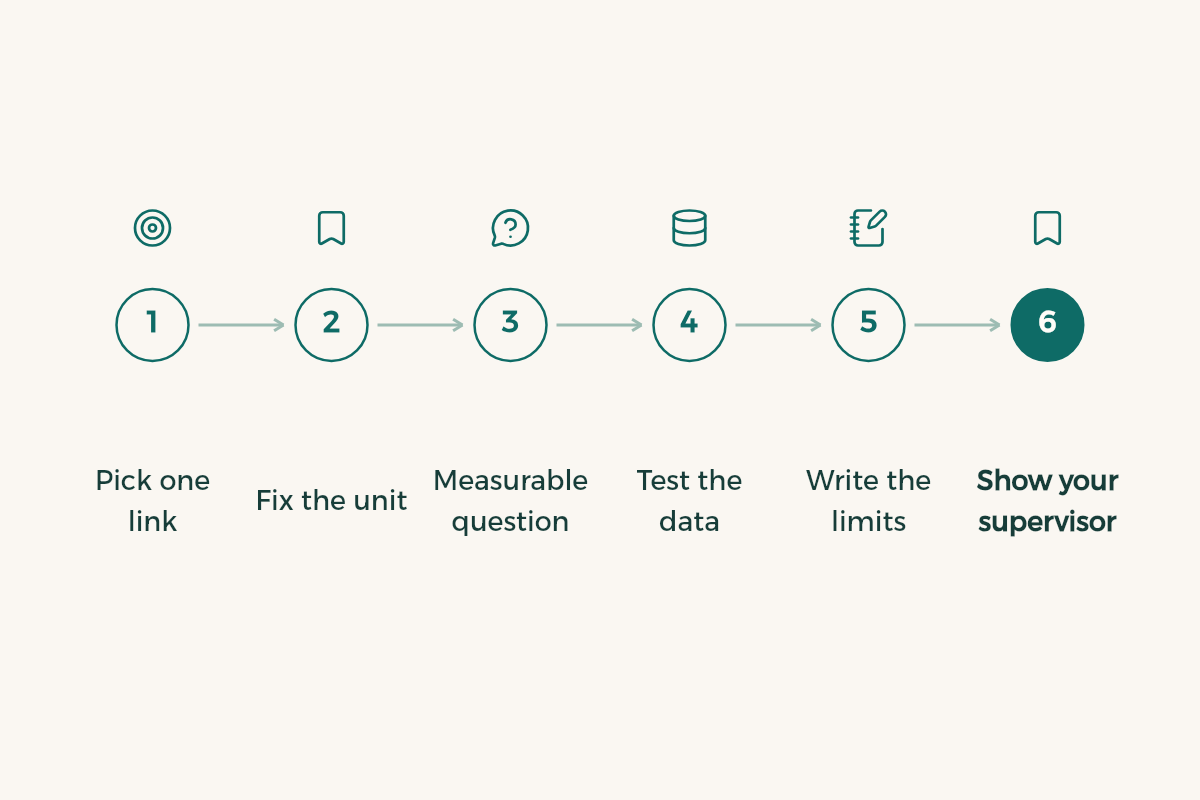
- Pick one link
Planning, sourcing, storage, delivery or returns. Do not combine two links in a one-semester project.
- Fix the unit of study
One company, one warehouse, one product category or one delivery route.
- Write a measurable question
For example: how far does picking time fall if we change the shelf layout? For help wording it, read how to write a research question.
- Test the data
Ask for the numbers before you lock the title. If they have not arrived in three weeks, switch ideas.
- Write the limits
One line on what you will not cover: time window, products, branches.
- Show your supervisor
Get the limits agreed early. A written scope protects you when someone asks to widen it mid-term.
Larger programmes work the same way. The MIT supply chain programme says a thesis or capstone proposal must convince the review committee that the topic matters and that you can finish it in a timely manner.3 The second condition is where many students fall.
Which graduation project ideas fit one semester? Examples of different sizes
The table below gives teaching examples of scopes that suit a single term. They are not published projects or any university’s rules. Adjust the details to your department.
| Project type | Example scope | Data you need | Biggest risk |
|---|---|---|---|
| Inventory analysis | Rank the items in one warehouse by value (ABC analysis) | Item list and movements over several months | The company will not share numbers |
| Route improvement | Compare two delivery routes inside one city | Trip times and distances | Too few logged trips |
| Supplier study | Score three suppliers for one product on set criteria | Quotes, lead times, quality records | Prices are confidential |
| Survey | Ask warehouse staff what causes delays | A questionnaire with a small, sensible sample | Low response |
| Open-data project | Analyse published trade or transport data | Files from official bodies | Weak link to your question |

Every row carries a risk. No scope is risk-free, but a good one is a scope whose risk you know on day one and whose fallback you have already chosen. If the company refuses the numbers, you have the last row. And if you start from open data, learn how to cite open data from the first week.
How do you use the SCOR model to set project boundaries?
The ASCM SCOR Digital Standard organises a supply chain into seven processes: orchestrate, plan, order, source, transform, fulfil and return.1 You do not need the whole model. Use it as a map to say precisely: my project sits in “source” and does not touch “return”.
The benefit is practical. When the panel asks why you ignored delivery, you answer that the scope was fixed on one process by a written decision, not that you forgot. And when your supervisor suggests adding a second process, you can ask what comes out in exchange. For the courses that sit under each process, see the supply chain major.
Where do you get data for a supply chain capstone?
This is the hardest step. Start with your supervisor: many departments have company contacts, or faculty hold datasets ready to use. Then send the company a short written request that states exactly what you need, why, for how long and how you will protect confidentiality. A specific request gets answered faster than “I want data about your warehouse”.
If you will handle company figures or people (a survey or interviews), ask your department about research ethics requirements, because some departments need approval before any data is collected from people. Never publish the names of staff, customers or supplier prices without permission. If you plan interviews, read how to document research interviews, and see the student survey report for one way to present survey findings.
If private data falls through, begin with what is open: the Saudi Digital Library for earlier studies and official bodies’ reports for public figures.4 A project on published data is less novel but safer on the calendar, and that is often the smarter choice.
How do you make a senior project planner for one semester?
This is a suggested split for a fifteen-week term. Adjust it to your university’s calendar, and if your term is shorter, compress the writing phase, not the review phase.
| Weeks | Phase | Output |
|---|---|---|
| 1 to 2 | Fix the question and scope | A two-page plan your supervisor approves |
| 3 to 4 | Request data and review earlier studies | A data file, or a decision to switch |
| 5 to 8 | Collect, clean and analyse | First tables and charts |
| 9 to 11 | Write method, results and discussion | A full draft |
| 12 to 13 | Supervisor review | A second draft |
| 14 to 15 | Format, slides and hand-in | Final file and defence deck |
Our rule: do not let the data phase run past week eight, or the writing gets squeezed. For the method section see how to write a methodology section, and for the defence see graduation project defence slides. Keep every file in order with version control on Drive.
Which mistakes quietly widen a capstone?
First, a title that says “in Saudi Arabia” or “in the sector”. A title that covers a country or an industry needs a sample you do not have. Second, adding a second objective after week five because a supervisor or classmate suggested it. Third, relying on one company that said yes verbally. Fourth, collecting more data than you need and drowning in cleaning it.
Fifth, hiding the weak spots. The UNC Writing Center says to be precise about the weakness in your design, explain how it may have affected the data and say what you would change.2 A panel respects someone who knows the limits of the work more than someone who claims to cover everything. If you are still hunting for an idea, browse graduation project ideas, and for working with your adviser read working with your thesis supervisor.