By the tiswa editorial team, from the official sources listed at the end of this guide. How we write our guides
You wrote in the proposal: “The effect of social media on students.” Your supervisor read the line and raised an eyebrow. Which platforms? Which students? An effect on what: grades, sleep, confidence? Nobody on earth can answer that in one semester. The trouble is not the topic. It is that the topic never became a question.
How do you write a research question from a broad topic?
Narrow the topic by adding limits; each limit cuts off a slice of the width. Purdue OWL suggests narrowing by sub-topic, group of people or time period, and it shows the move from cancer treatments in general to how radiation therapy for women over fifty changed over twenty years.1 Apply the same moves to your topic. Once it is narrow, phrase it as a question. Writing it as a question keeps it focused and open to argument.1
Here is an example only, not a real study. A mechanical engineering student in Jeddah wants to write about renewable energy. That is a library, not a question. Narrowing to solar panels on student housing in hot coastal cities gives a place and a setting. Adding one measure, such as how dust affects output between cleanings, gives something to count. The finished question might read: how does dust build-up change the output of rooftop panels on university housing in Jeddah between cleanings? A classmate in Riyadh could run the same moves on a business topic, say how small cafés near a campus choose suppliers. The moves matter more than the subject.
- Write the topic as it is
“Social media and students.” Write it and do not judge it. It is your starting point.
- Choose a group
Which students? First-years at one university? Engineering students? Medical students?
- Choose a place or setting
On campus? In the dorm? During final exams? In one city?
- Choose a time
One semester? A year? Exam weeks only?
- Choose one thing to measure
Grades? Hours of sleep? Focus? Pick one or two.
- Phrase the question
Start with how, why or what is the relationship between. Then read it aloud.
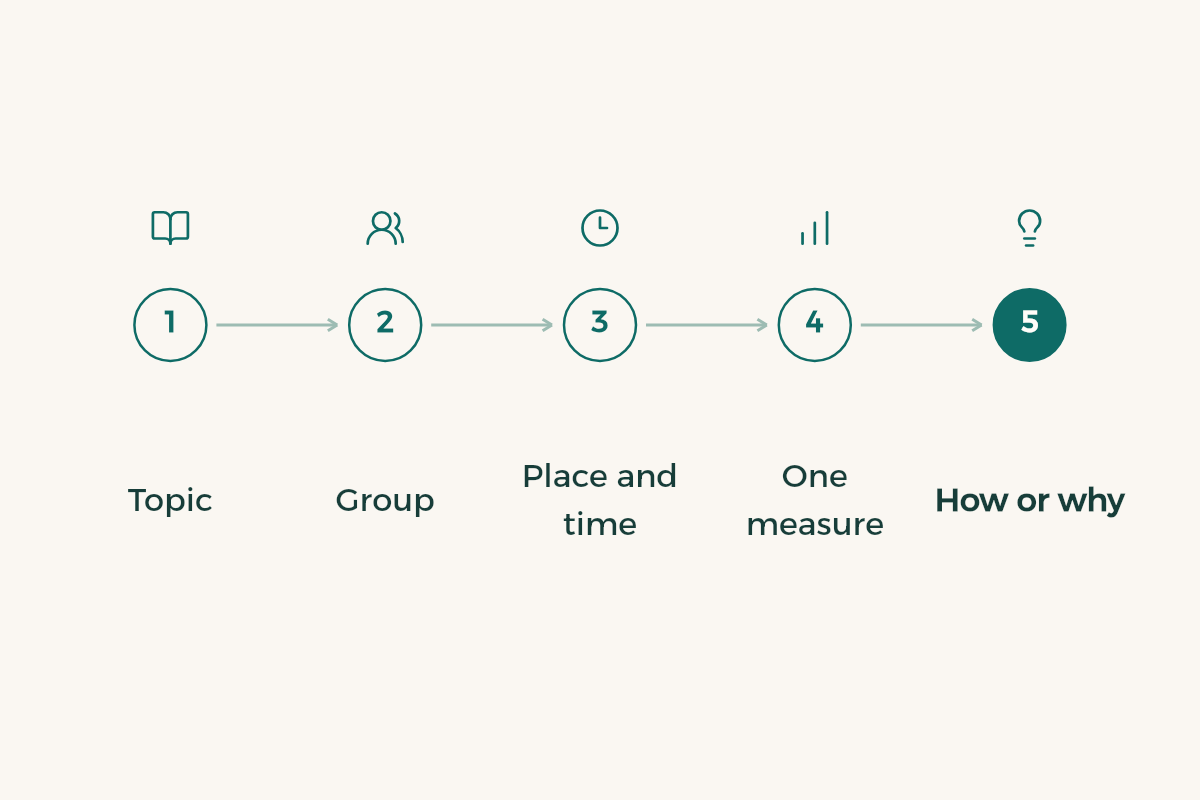
After the six steps you might end up here, as an example only: “How are hours spent on social apps at night related to sleep among first-year engineering students during final exams?” It is longer than the topic, but it is shorter than the pain it saves you. Every word removes a week of reading you do not need.
What is the difference between a topic, a problem and a research question?
A topic is something you want to understand. A problem is something you want to investigate: a worry, a gap, a difficulty that needs solving. A question is the form that leads you to an answer. The USC Libraries guide says a research problem is not a description of how to do something and not a vague broad claim, and it favours how and why questions because they need more analysis than who, what, where and when.2
| Form | Example | What is wrong with it |
|---|---|---|
| Topic | Social media and students | Does not say what you want to know |
| Yes-or-no question | Does social media affect grades? | The answer is one word and leads to no analysis |
| Too wide | What is the effect of technology on education in Saudi Arabia? | No group, no time, no measure |
| Studyable question | How are hours spent on social apps at night related to sleep among first-year engineering students? | Bounded, and it can be measured |
The examples in the table show the shape of each form. They are not suggested topics. If you have not reached the proposal stage yet, read the research proposal guide to see where the question sits in the plan.
How do you test a research question before committing to it?
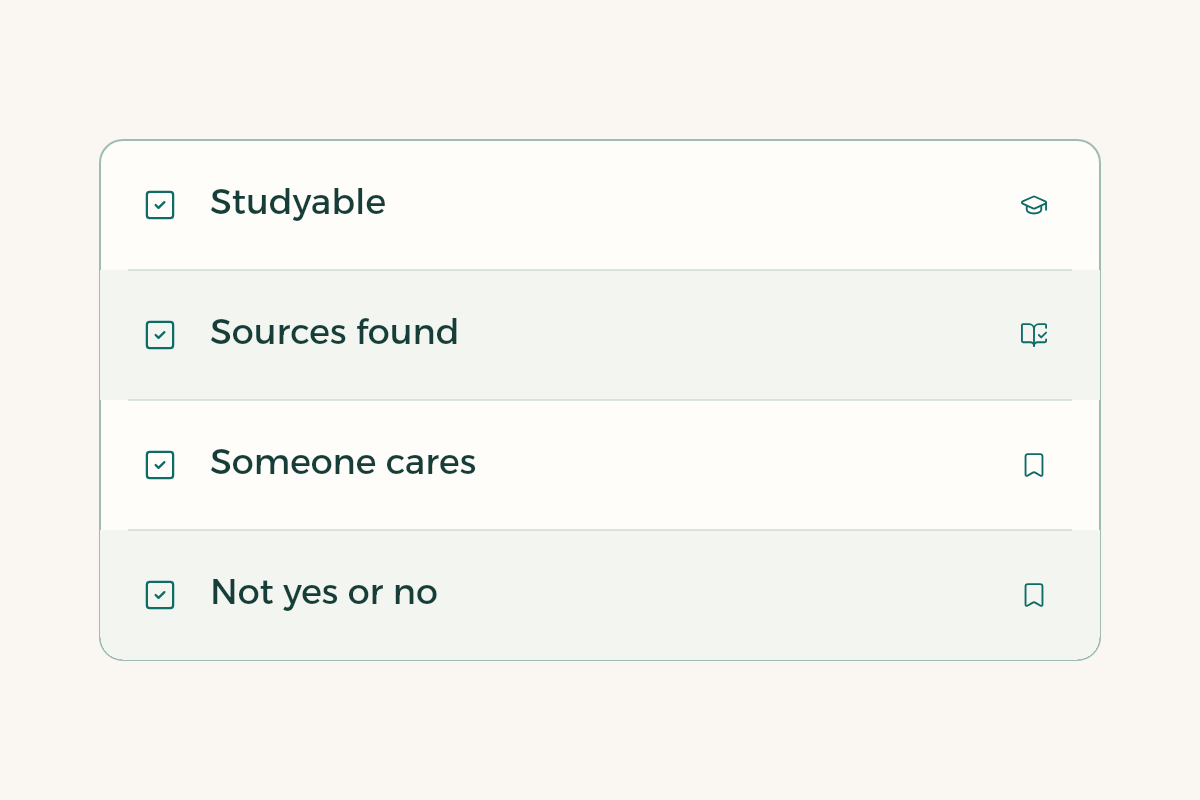
Run four checks before you hand in the proposal. First, can it be studied? Can you reach the people, documents or data it needs? Second, are there sources? Search its key words in the Saudi Digital Library or Google Scholar. If you cannot find enough for a literature section in a week, the question is too narrow. If you find hundreds of studies, it is too wide.
Third, “so what?” The USC guide describes the test as showing why the question matters: it adds knowledge, clarifies existing knowledge or informs practice.2 If you cannot write two sentences on its use, rephrase it. Fourth, is it realistic? The University of Sheffield asks a researcher to show the project fits the time, the access to sources and participants, and the practical limits.3
How many research questions do you need, and where do they go?
One main question is enough for most undergraduate work, with two or three sub-questions when needed. The USC guide advises no more than four questions per problem, related to each other, either listed at the end of the introduction or woven into the text.2 Let the question appear in three places in nearly the same words: the introduction, the start of the methodology and the conclusion that answers it. The research introduction guide covers where it goes.
When you review earlier studies, your supervisor may tell you that your question was answered ten years ago. That is not failure. Change the variable, the group or the setting, and the gap becomes your question. See writing the literature review for how to show the gap.
Which mistakes ruin a research question?
The first is a question that carries its own answer: “Why does using a phone harm studying?” assumes the harm before you look. The second is an opinion question: “Should phones be banned in lectures?” is a question of values and data will not settle it. The third has several variables that are hard to separate. The fourth cannot be measured, such as “Are students happy?” with no definition of happy. The fifth is clinging to the old question after your findings have changed. A question can be adjusted until the middle of the project, so do not hold on to the first draft.
One more comes from enthusiasm: picking a topic you love that has no data behind it. A project with no sources turns into a different project after three weeks. Make your first test the week of reading, and decide after it.
Once the question settles, move to the method: how will you answer it? We cover that section in writing the research methodology, and the guide to writing a research paper shows where the question sits in the whole paper.