By the tiswa editorial team, from the official sources listed at the end of this guide. How we write our guides
You have just finished the fifth interview, with a primary school teacher in Riyadh, and what you have is a voice memo called “New Recording 7”. Two weeks later your supervisor asks who said this quote and whether she agreed to be named. You cannot remember whether you asked her aloud or in writing. That moment is why this guide exists. An interview is documented before it starts, not after it ends.
How do you document a research interview before it starts?
Ask your supervisor first: does this project need approval from the university research ethics committee? Some departments require it for any project with participants, and some accept the supervisor’s sign-off. Do not assume, and do not copy another university’s rule. If approval applies to you, a good methodology says so in one clear line.2
Then prepare your papers in one afternoon: a consent form, a short information sheet for the participant, the question list, and an empty log for your interviews. Four pages, one page each. Whoever prepares them before the first interview does not repeat the first interview.
What goes in a participant consent form?
| Item | What you write | Why |
|---|---|---|
| Purpose | The topic in two sentences, the course and the supervisor | The participant knows what they agree to |
| What happens | Length of the interview, and whether it is audio-recorded or noted by hand | No surprise when you press record |
| Privacy | Whether their name, a code or only their job title will appear | Some people fear consequences for speaking |
| Withdrawal | They may stop, or withdraw their words, and until when | This keeps the consent valid |
| File storage | Where files are kept and when they are deleted | They know the recording will not stay forever |
| Signature and date | Their name and signature, or a written yes in a message | Your evidence for the supervisor |
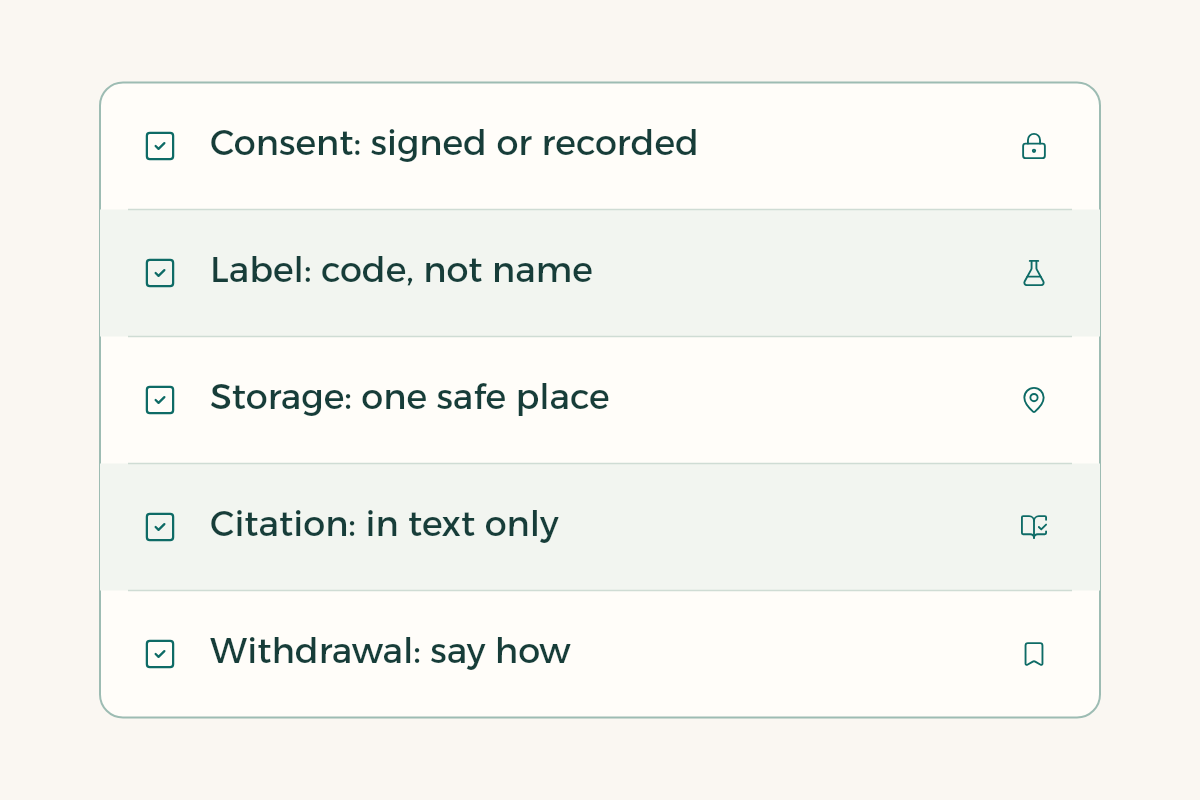
This table lists what a form should contain. It is not legal wording. Ask your department whether it has a template and use it instead of writing from scratch. If the participant is a minor or belongs to a group that needs extra protection, the supervisor decides the procedure.
How do you record an interview and store the files?
- Explain before you record
Read two lines from the information sheet, then ask for consent to record, aloud, at the start of the file. That keeps the consent on tape even if the paper is lost.
- Keep a backup
Use two devices if you can, or at least test a minute of audio first. A 40-minute interview can vanish with one wrong tap.
- Name the file with a code
P01_Mar14 beats the participant’s name. Keep the code-to-name list in a different folder, with a password.
- Transcribe within a week
Type it while you still remember the tone. Mark unclear words with a flag and do not guess.
- Check the transcript against the audio
Listen once while reading. The errors hide in numbers and names more than anywhere else.
- Delete as promised
If the form says recordings are deleted after submission, delete them and write down the date.
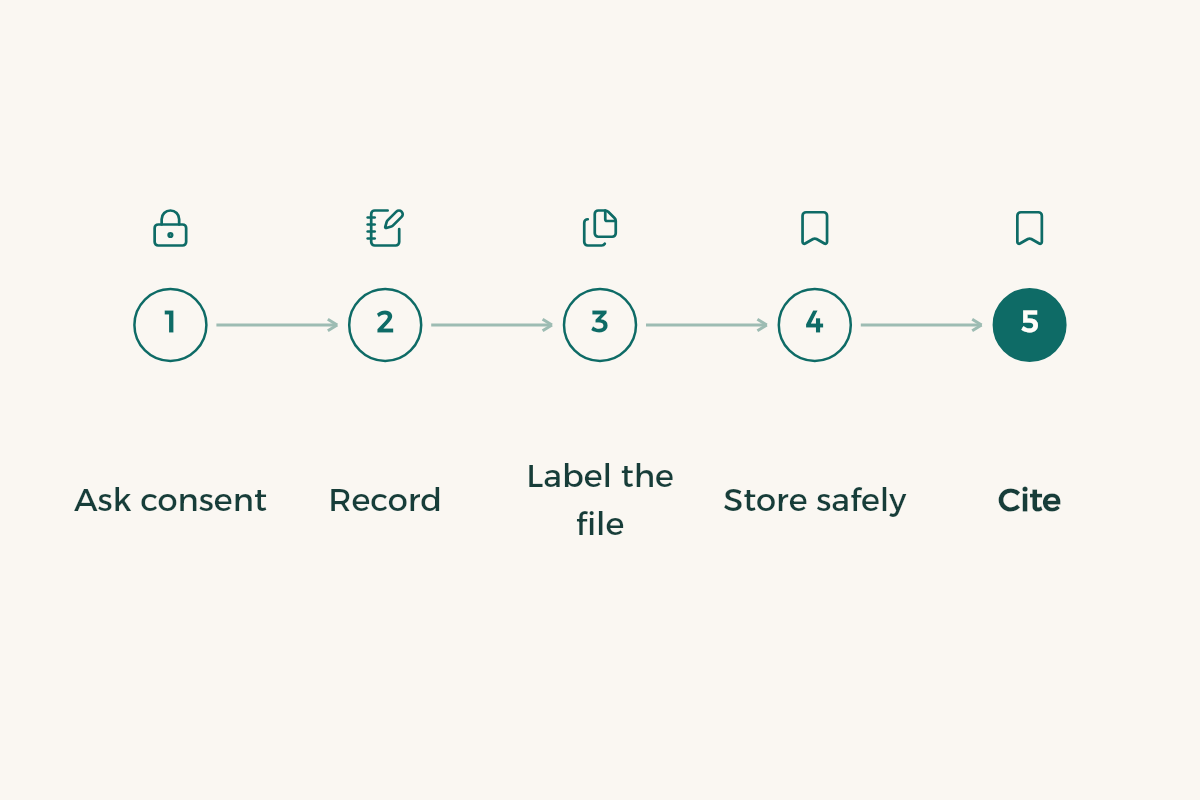
Meanwhile keep one log: interview code, date, length, place, whether consent arrived, and where the file sits. A simple Excel sheet is enough. If you work with a teammate, agree who holds the files, and read the guide to shared laptop project security before participant recordings sit on a shared machine.
How do you write a research paper methodology that covers interviews?
Keep two jobs apart. The first is describing the method, which belongs in the methodology section: how many interviews, with whom, how you chose them, when, how you recorded and transcribed, and whether you had ethics approval if it was needed. This is what your reader uses to judge whether the study is trustworthy.2 The full section is covered in writing the research methodology.
What do the APA citation and reference list say about an interview?
Crediting the quote is the second job. In APA, an interview you conducted yourself counts as a personal communication, so it is cited in the text only: initial and surname, the words “personal communication”, then the date. It does not go in the reference list, because readers cannot retrieve it.1 If naming people would expose them, use the code plus a general description such as “teacher, primary school, Riyadh”, and agree the wording with your supervisor before you submit. General APA rules are in the APA guide.
| Case | What you write in the text | In the reference list |
|---|---|---|
| Interview you ran, named participant | (M. Al-Otaibi, personal communication, date of interview) | Nothing |
| Interview with an anonymous participant | “One teacher (P03) said…” | Nothing, described in the methodology |
| Published interview in a journal or podcast | Author and year | Listed as a published source |
The names and dates in the table are examples to show the shape. One more trap: many students put the interview in the reference list as if it were a book. Under APA that is not required, and if your department wants something different, follow its instructions.
What if a participant withdraws or asks you to delete their words?
Respect the request at once and do not argue. Delete the recording, the transcript and any quotes from that person, write the date in your log, and tell your supervisor. Then state in the methodology that one participant withdrew and the final number of interviews is one lower. A reader trusts a researcher who reports what happened more than one who hides it.
Better never to reach that point. Put the right to withdraw in the consent form, with a cut-off date after which the data is already in the analysis and cannot be removed. That protects the participant and you. Ask your supervisor what date suits your project.
Which mistakes ruin interview documentation?
The first is recording before consent, which only a repeat interview can repair. The second is mixing names and files in one desktop folder. The third is transcribing two months late, when tone and meaning have blurred. The fourth is “cleaning up” a quote until the idea changes. A quote stays in the participant’s own words, and whatever you cut gets an ellipsis.
Group projects add one more: each member holds a different copy of the consent forms. Keep one folder, name one person to look after it, and never drop photos of signed forms into an open WhatsApp group. If the interview is with a government body or a company, ask whether you need an introduction letter from your college before the appointment.
Run the first interview on a classmate. You will find that question four is vague, that the room echoes, and that your phone stops recording when a call comes in. Then open the research proposal guide and check that each interview question serves your research question, not your curiosity.