By the tiswa editorial team, from the official sources listed at the end of this guide. How we write our guides
How to write a conclusion for a research paper is a question many students leave until the last night. Yet the conclusion is the last thing a marker reads. A good conclusion does not repeat the paper line by line. It restates the question in the light of what you found, explains what that means, and ends with a clear next step.
What the conclusion does
According to Purdue OWL, a conclusion restates the topic and why it matters, restates the thesis, addresses opposing views where relevant, and may call for action or suggest future research. The same guidance advises simplicity: a clear, direct conclusion is more convincing than a dramatic closing flourish.
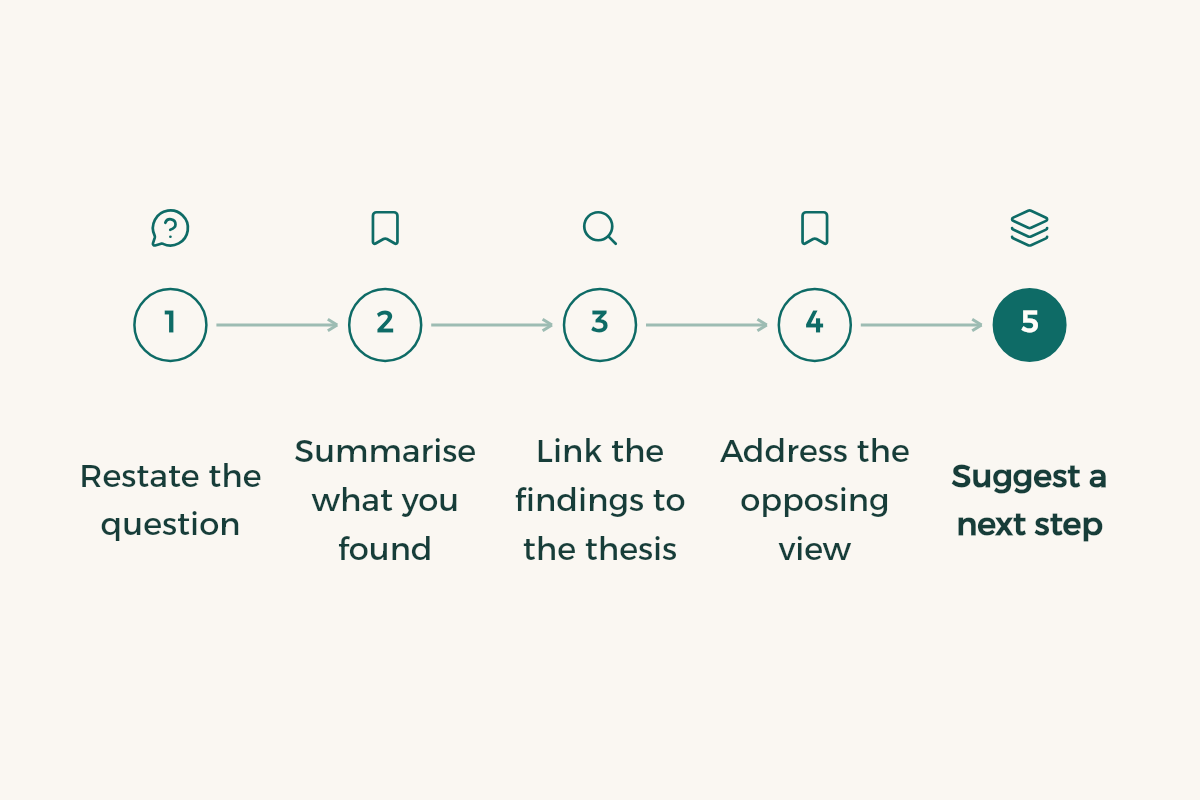
Five steps to write the conclusion
- Restate the question
Start from the research question as you wrote it in the introduction, then reword it now that you know the answer. Do not copy your opening sentence.
- Summarise what you found
Write one sentence for each main finding. Use what is already in your chapters, not new information.
- Link the findings to the thesis
Explain why these findings support your thesis, and what they mean for the people who care about the topic.
- Address the opposing view
If your paper raised a view you do not fully share, explain why your position still stands, or where the limits of your study lie.
- Suggest a next step
End with a sentence on what should be studied next, or what practical decision the findings can inform.
A template you can fill in
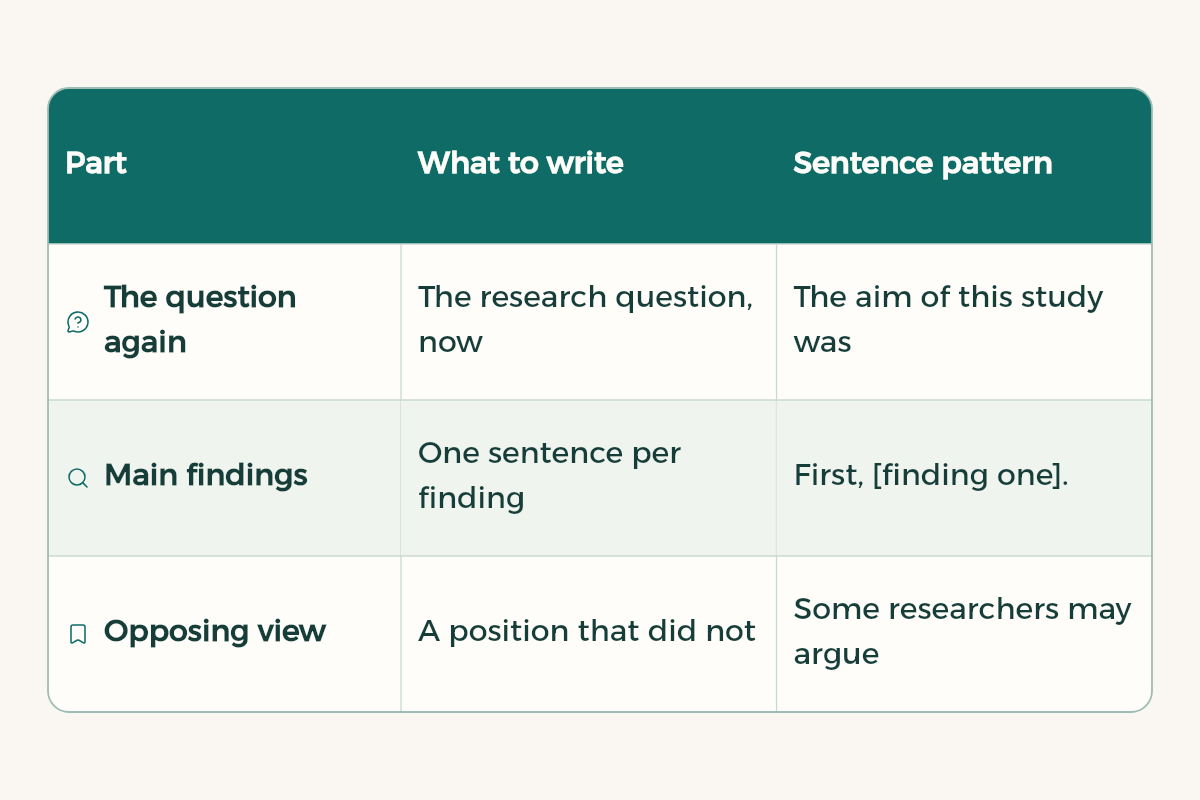
The table gives a sentence pattern for each part of the conclusion. Replace the bracketed parts with the content of your own paper:
| Part | What to write | Sentence pattern |
|---|---|---|
| The question again | The research question, now answered | The aim of this study was to understand [topic], and the evidence shows that [main idea]. |
| Main findings | One sentence per finding | First, [finding one]. Second, [finding two]. Finally, [finding three]. |
| Opposing view | A position that did not support your thesis | Some researchers may argue that [opposing view], but [why your thesis still holds]. |
| Next step | A further study or practical action | Further work is needed to examine [open question] before we can understand [the full effect]. |
Common conclusion mistakes
- Copying the introduction word for word. The reader has just read it, so the conclusion should feel like the final step.
- A dramatic ending or a big claim the study does not support. Purdue advises simplicity over a flourish.
- Trying to solve a huge problem in the last sentence. The conclusion should show what your study adds, not solve the world.
- Introducing new sources that never appeared in the chapters. If you need a new source, it belongs in the discussion.
- Repeated apology, such as “this paper may not be complete”. State the limits clearly in one or two sentences instead.
The introduction and the conclusion
The introduction makes a promise to the reader, and the conclusion keeps it. If your introduction asks whether phone use before bed affects sleep, the conclusion must answer that question clearly. To compare the two, read how to write a research introduction.
Read the conclusion below and answer only these questions: does it restate the question? does it summarise the findings without new information? does it address the opposing view, if there is one? does it suggest a next step? Do not write a replacement conclusion. Point to the sentences that need work:






A conclusion example to adapt, not copy
The paragraph below shows the order: restate the question, give the findings, address the opposing view, then suggest a next step. Fill the brackets with your own results:
The aim of this study was to understand how phone use before bed affects the sleep of first-year students. The findings showed [main finding], and [second finding]. Some researchers may argue that [opposing view], but [why your thesis still holds]. The study is limited by [limits of the study], so the topic needs a wider study that follows students across a full semester.
A checklist before you submit
- Have you reworded the question now that you know the answer?
- Does every finding in the conclusion appear in your chapters?
- Have you addressed the opposing view, if your paper raised one?
- Have you suggested one clear next step?
- Is the conclusion free of new sources or new information?
Related guides: writing an abstract, writing a report and plagiarism checks.
What to read next
To review the start and the end together, read how to write a research introduction. For correct citations of the sources you mention in your conclusion, read APA citation format. For the full structure of the paper, read how to write a research paper.
The conclusion by type of work
| Type of work | Focus of the conclusion | Avoid |
|---|---|---|
| Argumentative essay | Restate the thesis in new words and show why it holds against the counterargument | Opening a new argument you did not discuss |
| Empirical study | Answer the research question, note limitations, suggest further research | Repeating result figures as they are |
| Report or project | Practical recommendations and next steps | Generic recommendations unlinked to the findings |
Stating limitations shows maturity, not weakness. Keep it brief, calm and paired with a suggestion: "The sample came from one college, so future studies could include others." Then return to what the study did show.