By the tiswa editorial team, from the official sources listed at the end of this guide. How we write our guides
A third-year student has a cumulative GPA of 3.00 out of 5 and decides to finish next semester with an excellent result to reach 3.50. The plan goes in the notebook. When results arrive the cumulative GPA is only 3.10, even though the semester itself scored 4.50. The effort was fine. The misunderstanding was about the word “cumulative”.
What is a university cumulative GPA and how is it calculated?
It is the total points you earned across all courses, divided by the total credit hours of those courses. A course’s points equal its credit hours multiplied by the grade points. The table of grades and points differs from university to university and between the 5-point and 4-point scale.12 Read your own university’s scale in its study regulation before applying any example here.
It differs from the semester GPA, which concerns a single term. The semester GPA moves as you wish; the cumulative moves by the weight of your semester among all your hours. A fully worked calculation is in GPA calculation, and converting a percentage mark is in percentage to GPA conversion.
How much does one semester change your cumulative GPA?
It depends on completed hours. Take this illustration on a 5-point scale: your GPA is 4.00 and you complete a fifteen-hour semester at 3.00:
| Completed hours before the semester | New cumulative GPA | Drop |
|---|---|---|
| 30 | 3.67 | 0.33 |
| 60 | 3.80 | 0.20 |
| 90 | 3.86 | 0.14 |
| 120 | 3.89 | 0.11 |
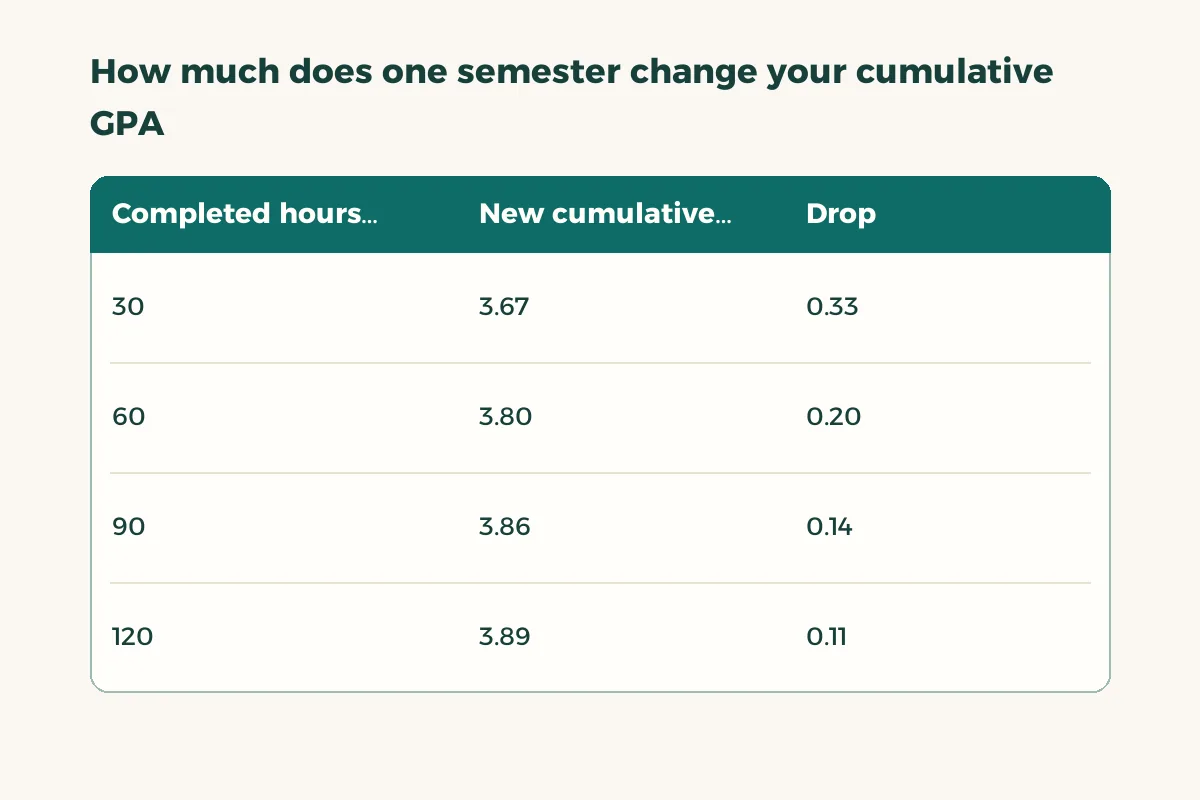
Same semester, same performance, but the effect shrinks to a third between the first year and the last. That is why advisors say raising a GPA is easier early and protecting it matters more later. To see what raising it really takes, read how to raise your GPA.
What semester GPA do you need to reach your target?
Apply this example (illustrative numbers on a 5-point scale): your GPA is 3.00, your target is 3.50, and you plan fifteen hours this semester:
| Completed hours before the semester | Semester GPA required | Verdict |
|---|---|---|
| 30 | 4.50 | possible but hard |
| 60 | 5.50 | impossible on a 5-point scale |
| 90 | 6.50 | impossible on a 5-point scale |
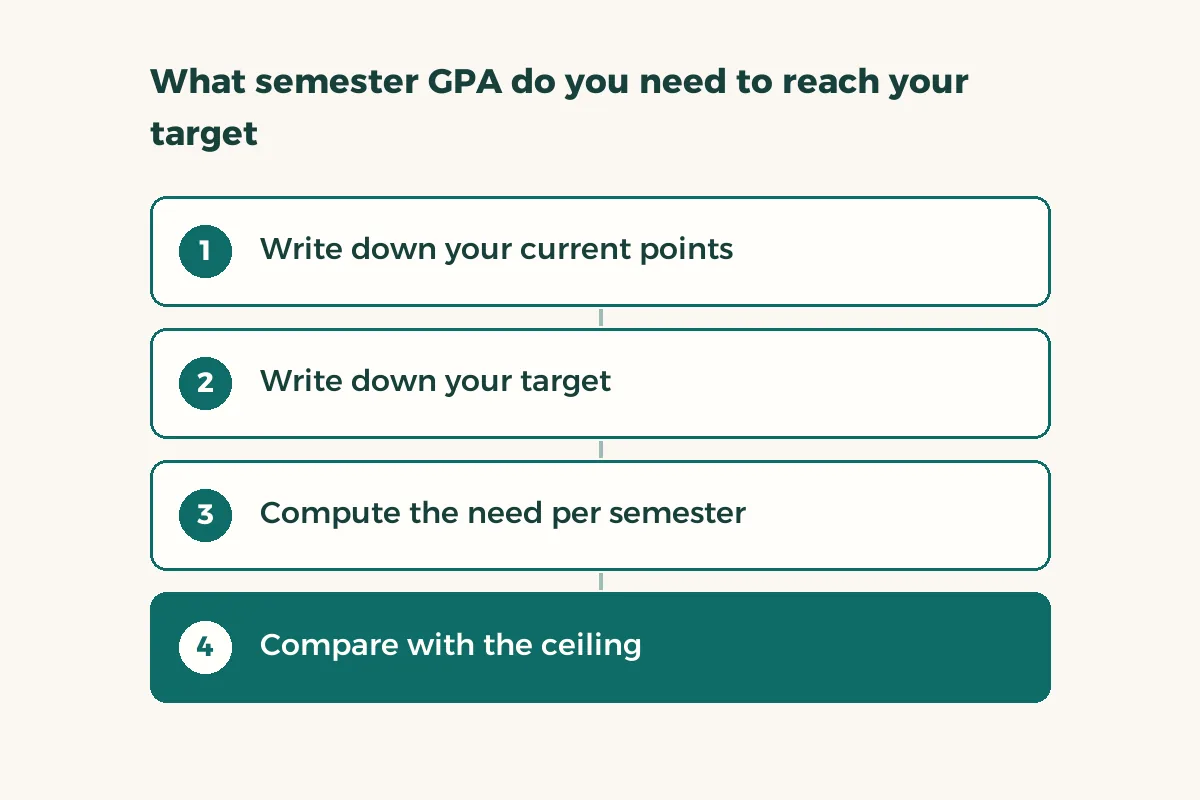
The rule: required semester GPA = (target × (completed hours + semester hours) − current points) ÷ semester hours. If the result exceeds the top of the scale, the target cannot be reached in one semester and you must split it across two or three. That is not pessimism. It gives you a realistic plan instead of one that collapses in the first term.
- Write down your current points
Cumulative GPA × completed hours.
- Write down your target
A GPA you want after several semesters, not after one.
- Compute the need per semester
Divide the gap by the number of semesters and by the semester hours.
- Compare with the ceiling
If the number passes your scale, stretch the plan or change the target.
Does a retake change your cumulative GPA?
It does, but how depends on your university’s regulation: some systems keep the newer grade and drop the old one, others count both or average them. Do not assume which applies to you. Find the repeat clause in the study and examination regulation on your admission and registration deanship’s site. A worked comparison of the cases is in King Khalid University GPA and retakes.
What does this mean for choosing your course load?
It means a lighter load in the first two years protects you less than you think, because early semesters move the GPA the most. To raise it, put your strong semesters early; to protect it, do not gamble on a heavy load in one term before graduation. And do not return to the numbers after the results; go to them before you register.
A two-hour course moves the same GPA less than a four-hour course, whatever your effort in each. Spread your effort in proportion to course hours, as in splitting study time between subjects.
How do you track your GPA each semester with a simple sheet?
Open a spreadsheet with four columns: semester, semester hours, semester points, running total of points. At the end of each semester add a row, sum the points and the hours from the first row to the last, then divide. After three semesters you can see the trend: is the GPA climbing, or levelling off because your hours have grown?
Add a last column titled “GPA needed for target” and fill it with the rule in this guide before each semester. When the number exceeds the top of the scale, do not despair; split the target across two semesters and recompute. For a ready-made tool see the Excel grade tracker.
Compare the sheet with the official transcript on your university portal every semester and confirm the system counted each course with the same hours and grade you recorded. One mis-entered course changes the final figure, and fixing it is easier in the first weeks of a term than after graduation.
What mistakes are common when reading a cumulative GPA?
Averaging semester GPAs instead of weighting by hours, which gives a wrong number when semesters differ in credits. Believing one superb semester will fix everything. Withdrawing from a course to protect the GPA and then delaying graduation. Ignoring a low-GPA warning until it is late; what follows is covered in academic probation.
For honours or scholarship thresholds, check the cut-off published by your own institution rather than a number passed around. The honours guide is honours degree.