By the tiswa editorial team, from the official sources listed at the end of this guide. How we write our guides
You open Blackboard and your statistics mark reads 84.6. Is that a B or a B+? The gap between the two letters is half a grade point, and it shows up in the whole semester GPA. The answer does not come from the sum. It comes from your university’s table: does it round 84.6 up to 85, or not?
How do you calculate GPA from a percentage?
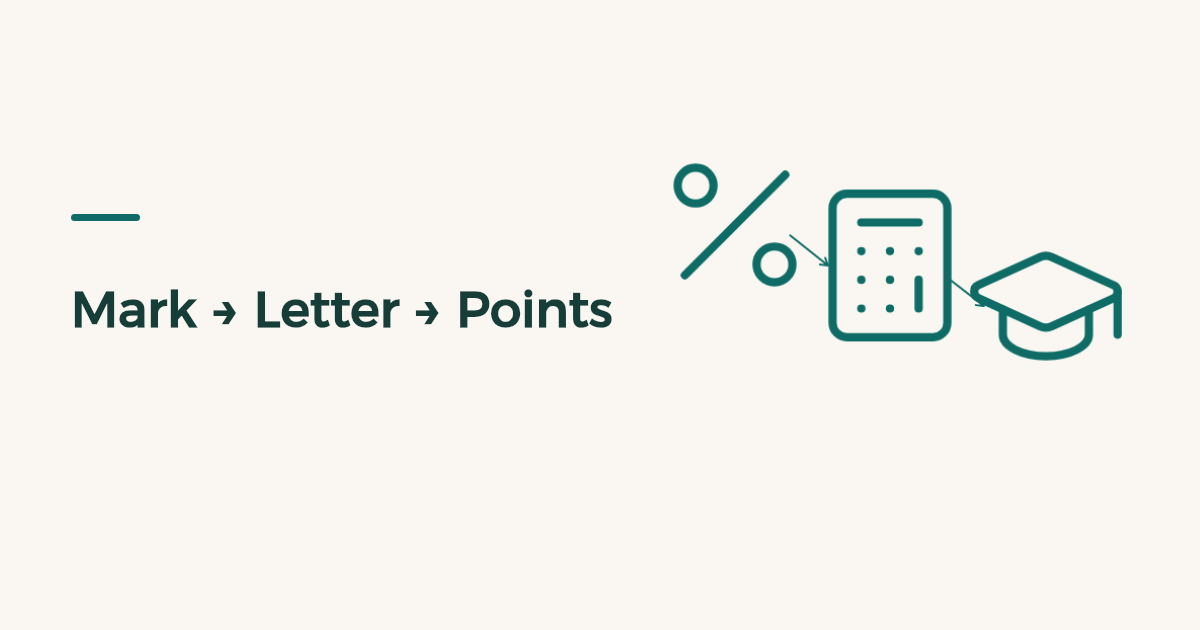
You never calculate GPA from the percentage directly; you convert it to points through a table first. In Article 28 of its undergraduate regulations, King Fahd University of Petroleum and Minerals publishes one such table, mapping each percentage band to a letter and to points on a 5.00 and a 4.00 scale. The band 95 to 100 is A+ with 5.00 or 4.00, and 90 to under 95 is A with 4.75 or 3.75.1 That is an example of the shape; your university may differ.
- Add up the course marks
Assignments, quizzes, project, and the final once you have it. The result is a number out of 100.
- Open your university’s table
Look in the study and examination regulations on the deanship of admission and registration site. Copy the bands, letters and points for your scale.
- Read off the letter and points
Find the band your mark falls in, and check whether decimals are rounded or cut.
- Multiply points by credit hours
A three-hour course worth 4.00 gives twelve quality points.
- Add up and divide
Sum the quality points across courses and divide by total credit hours for the semester GPA.
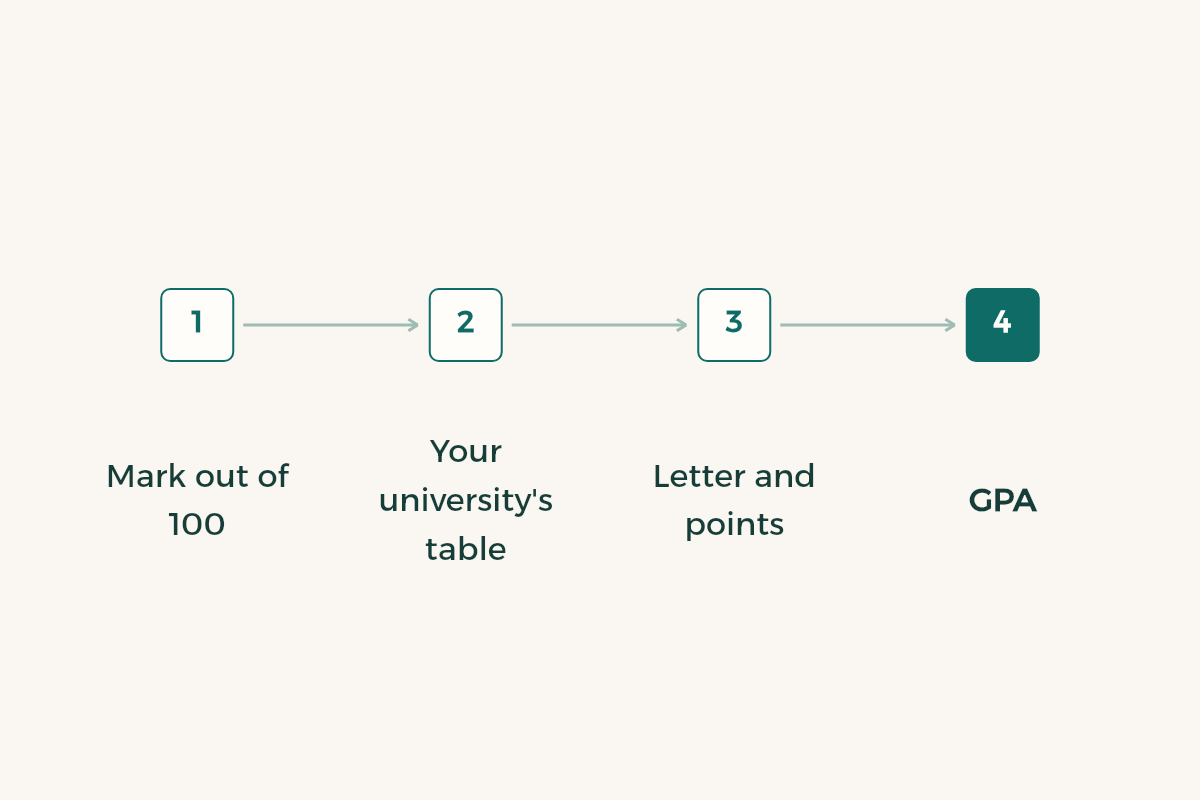
The last steps are the same as in how to calculate GPA on the 5 and 4 scales, which has a solved semester and cumulative table. The step students get wrong most often is the one covered here: turning a mark out of 100 into points.
What final-exam mark do you need to reach the letter you want?
Subtract what you have collected from the letter’s lower limit; what remains is what the final must give. An example with invented marks: before the final you hold 41 out of 50 (assignments 13 of 15, midterm 19 of 25, project 9 of 10), and the final is worth 50. Suppose your table starts B at 80, B+ at 85 and A at 90.
| Target letter | Lower limit out of 100 | Needed on the final (of 50) | As a share |
|---|---|---|---|
| B | 80 | 39 | 78% |
| B+ | 85 | 44 | 88% |
| A | 90 | 49 | 98% |
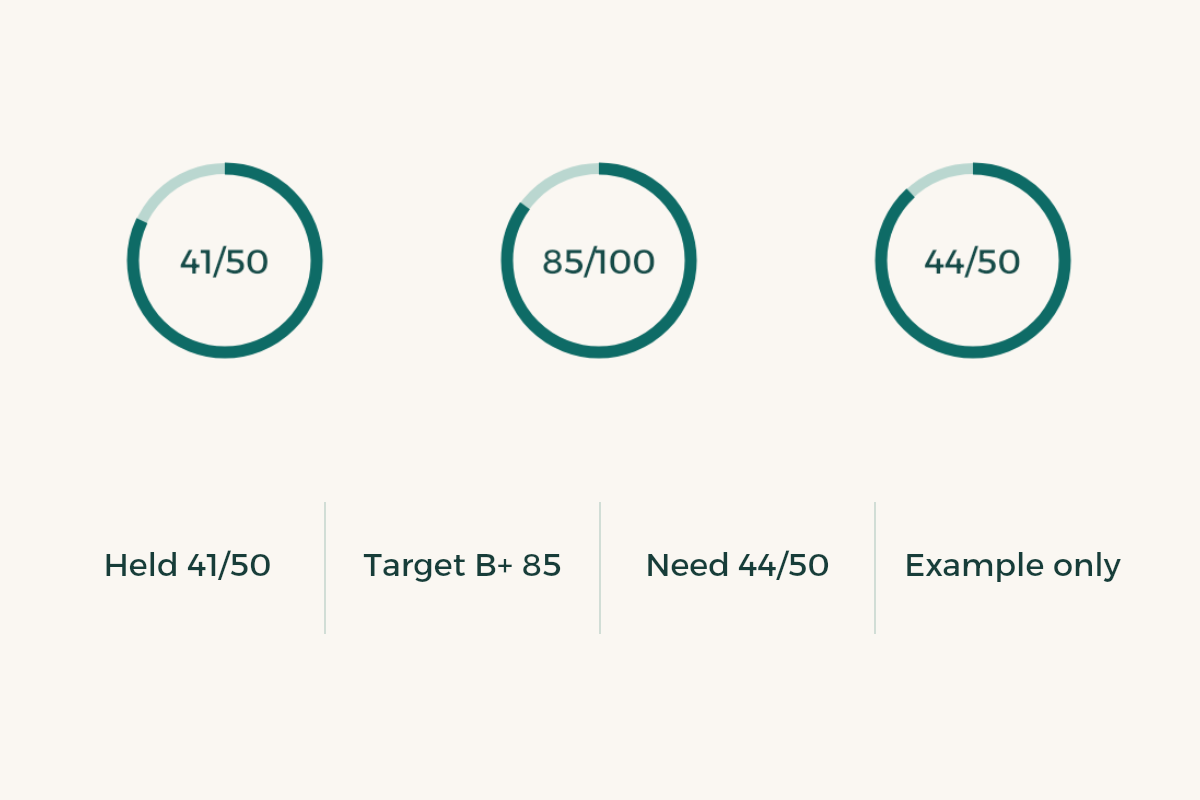
Read it like this: to reach B+ you need 44 of 50 on the final, which is 88 percent of it. A needs 49 of 50, which is rare, so decide realistically. If your final is worth 40, redo the numbers: the method stays and the figures move with your course’s weights.
Once you know the target, tie it to your plan. An 88 percent final means asking which midterm topics you lost marks on. Cornell’s Learning Strategies Center explains how to read a marked paper to find where marks went.2 For a whole exam week built around such targets, see revision for back-to-back exams.
Does a mark of 84.6 round up to 85?
That depends on your university’s regulations, not the arithmetic. Some round the final mark to a whole number before converting, some drop the decimal, and some leave band edges to the instructor. The KFUPM article itself says a final course grade falls in one of nine levels and that the instructor may weigh other known methods, such as the class average and standard deviation, in deciding the end-of-course grade.1 So the mark you see in Blackboard is not always the final one.
If you sit on a boundary, ask instead of assuming. Write a specific question to the instructor or the registrar: how are decimals treated in the course mark? For reading what shows up in your portal, see the Blackboard grade centre.
How do you work out a cumulative GPA afterwards?
Add the quality points for every course since you enrolled and divide by the total credit hours. KFUPM defines it exactly that way: total quality points over total credit hours.1 Article 29 sets graduation ranks from the cumulative GPA, with 4.50 to 5.00 on the five-point scale counting as Excellent.1 Those are one university’s figures, so read your own ranks in your own regulations.
If you need to lift the GPA after a weak first term, start with how to raise your GPA and take the plan to your academic advisor. Your GPA also depends on the hours you have left, so check your degree plan before choosing which course to push.
What are the most common conversion mistakes?
The first is using another university’s table. A general GPA site may put A at 90 while your university sets it elsewhere. The second is mixing scales: calculating on the 5-point scale and reading the result as if it were out of 4. The third is ignoring credit hours, since a one-hour course moves your GPA far less than a four-hour one.
Last, do not work out the needed final before confirming the weights in the course description. If the midterm is 30 and the final is 40, a calculation that assumes 50 gives the wrong answer. Read the description once; it is the cheapest time you will spend this term. Cornell also points to a weekly planner and a semester calendar for tracking such dates and weights.3