By the tiswa editorial team, from the official sources listed at the end of this guide. How we write our guides
Physics on Sunday, statistics on Monday, English on Wednesday. That is the shape of a first-year timetable at a Riyadh university that we use here as an example, not a real student. Eleven days remain, but the last stretch is eaten by the exams themselves, so the real revision window is nine days. What matters is not working harder. It is making the decisions earlier.
How do you prioritise revision when time is short?
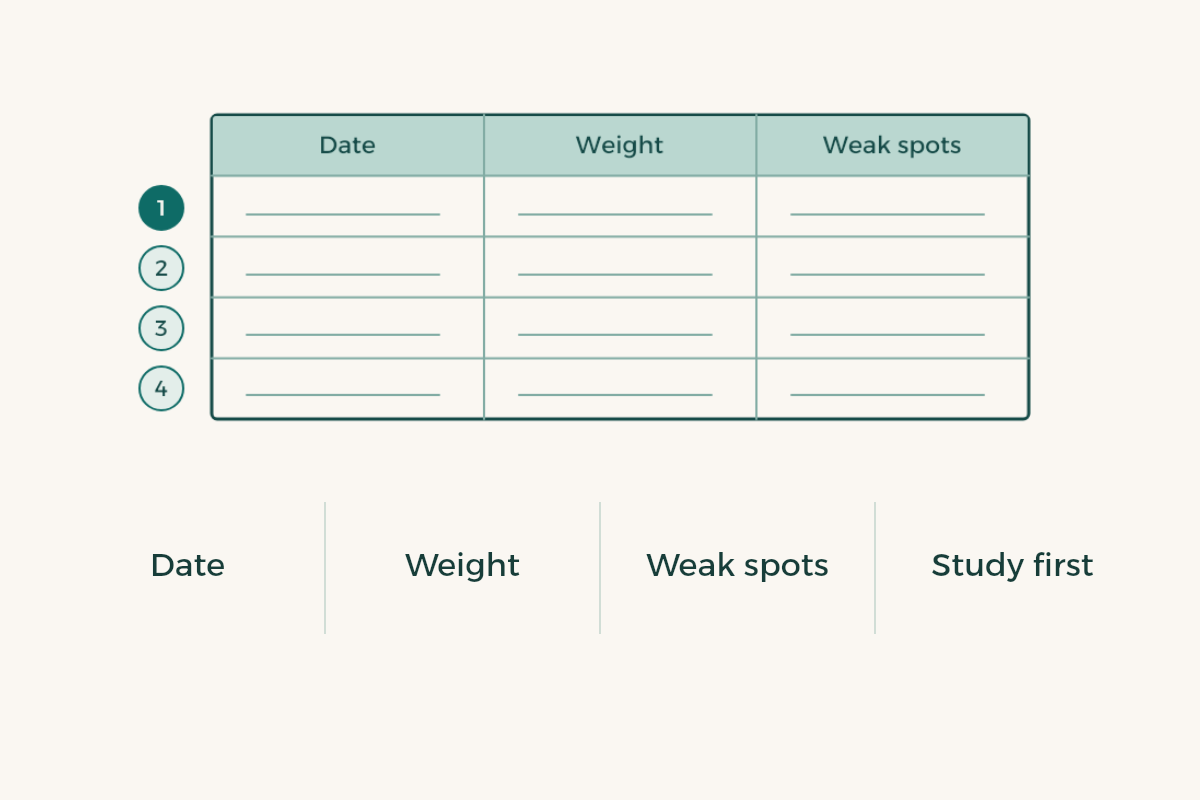
Ask three questions about each subject and answer them on paper before opening a book. When is the exam? How much of the course grade does it carry? Where do you know you are weak? The subject that is closest, heaviest and weakest gets the first hours; the easy, distant one gets short sessions spread across the week. Cornell’s Learning Strategies Center advises a schedule spread over time rather than a night-before push, with meals, rest and sleep built into it.1
- List the exam dates and weights
One page: day, time, hall, and the share of the course grade the exam carries, as shown in the course description or on Blackboard.
- Split each subject into topics
Use the headings in the course outline or the weekly units. A fifteen-week course becomes six to eight big topics.
- Rate each topic three ways
I know it, I know half of it, I do not know it. Answer two questions without notes before you tick a box, because feeling familiar is not the same as knowing.
- Share the hours by need
With thirty hours available, give each subject its weight and your weakness, not equal slices. Leave four hours empty for surprises.
- Build days from blocks
Forty to forty-five minutes, then a ten-minute break. Each block ends with questions you answer without looking.
- Reserve the final two hours
Before each exam, open only that subject. After the paper, rest for at least an hour before the next one.
What should you revise first in a subject you have not started?
Start with the topics that keep showing up in homework and earlier quizzes, since they are the closest signal of what the lecturer asks. UNC’s Learning Center suggests gathering everything for one topic together, slides, textbook notes and homework, and using the subtopics an instructor lists as a guide.2 Put it all in one place, then work the questions at the end before reading the explanation.
There is a rule nobody likes that saves marks: cover what could fail you before what could lift you. If one topic out of four appears in every paper and you cannot do it, covering it beats polishing a topic you already know at eighty percent.
What does a week with three exams in four days look like?
The table is an example, not a ready plan, and the numbers shift with your subjects. We assumed physics is heavy and the student is weak in it, and English is lighter.
| Day | Morning | Evening | Note |
|---|---|---|---|
| Two days before Sunday | Physics: two weak topics | Statistics: one new topic and questions | English gets one short block |
| Day before Sunday | Physics: timed practice paper | Physics: fix mistakes, then early sleep | No new material after 10 pm |
| Sunday (physics exam) | Two hours of physics only | After the paper: rest, then full statistics | Log physics mistakes on one sheet |
| Monday (statistics exam) | Statistics: solve questions, no reading | After the paper: two English blocks | Close physics for good |
| Tuesday (no exam) | English: grammar and vocabulary | English: practice test, then rest | Longest sleep of the week |
| Wednesday (English exam) | One hour on mistakes only | After the paper: stop | The week is over |
Tuesday is not empty. It is the lightest day, not a free one. A day without a paper between two papers is a chance to close a gap, and also the day your head recovers, so it should not fill with new topics.
What do you do the night between two exams?
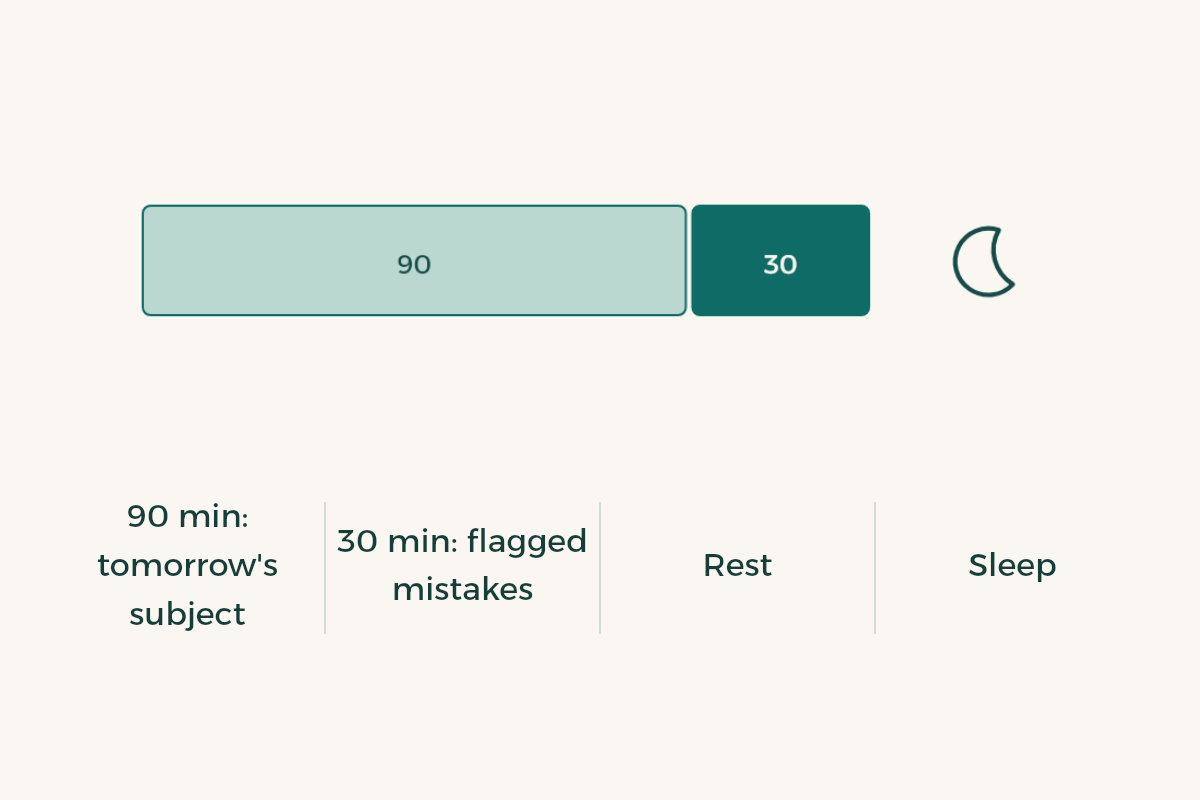
Count the hours before sleep and split them unevenly: an hour and a half on tomorrow’s subject, thirty minutes on the mistakes you flagged, and the rest for rest. Do not start the subject after tomorrow tonight. Cornell’s guidance treats sleep and food as part of learning, not extras on the timetable.1 If the night is already crowded, read the night before an exam and use the morning list in the exam day checklist.
When time is so tight the topics will not fit, choose coverage over mastery: one pass over every topic beats perfecting half of them. Papers tend to sample the whole course, and a complete blank in one topic costs more than a rough answer in all. For the longer version, see the three-week final exams plan.
How do you know your revision is working?
Test yourself on paper in conditions close to the hall: a timer, no notes, no phone. Seven of ten right means you are on track; three of ten means go back to the same topic before moving on. Watch the gap between recognising and recalling. A summary feels familiar when you reread it, but only retrieval shows what stuck. The steps are in self-testing before the final exam.
After each paper, take ten minutes to write down where you slipped, because the next subject may use similar question types. An exam error log shows how to turn a mistake into a lesson before it fades. UNC’s Learning Center also points to active review with questions as more useful than rereading.3
What is the most common mistake in a run of exams?
Postponing the last subject because its paper is further away. By Tuesday you have drained yourself on the first two, and Wednesday’s book is still shut. The fix is a small daily slot for it, even forty minutes, since returning every day beats one long night. Cornell also recommends managing time with a weekly planner and a semester calendar.4
The second mistake is staying up because time is short. Two extra hours feel like profit, then you spend them on a flat performance in tomorrow’s paper. Make sleep a line in the timetable, not whatever is left.