By the tiswa editorial team, from the official sources listed at the end of this guide. How we write our guides
A second-year engineering student opened the degree plan and found semester five held four courses that sounded hard: circuits, numerical analysis, a lab and a small project. The timetable allowed all four, so he registered. In week six the lab reports and the project deadline landed beside a midterm. The example is illustrative, but the story is familiar to anyone who has survived a heavy term. The whole degree plan had been in front of him from day one, and he had read only the course names.
What is a degree plan and what does it contain?
A degree plan is a document your college or department issues. It lists the courses of your major in order across semesters, normally with each course’s code, credit hours and prerequisites, and it separates compulsory from elective courses. Its format and wording differ from one university to another, so take your copy from your department’s page or your university’s registration portal, not from a friend in another college.
If you are unsure what credit hours mean and how they are counted, read the guide to the credit hour system first, then come back to your plan.
What are credit hours and how do they show up in a degree plan?
A credit hour appears as a number beside each course. It is a unit that measures the course’s weight in the semester. The number does not tell you how hard the course is; it tells you its share of your official time. That is why a three-hour lecture course can take less effort than a two-hour course with a weekly lab and reports. Ask your adviser or a student in an earlier cohort what each course demands, and do not judge by the number.
The University of North Carolina’s Learning Center publishes a time-management inventory that asks two plain questions: do you estimate the study hours you need each week, and do you leave contingency time for the unexpected?1 Do this before registration, not after. If your estimated hours add up to more than the day actually holds, you are looking at a heavier term than you can carry.
How do you spread courses across semesters without overloading one?
- Put the plan beside your transcript
Open your degree plan next to the record of what you passed, failed or withdrew from. Mark only what remains.
- Mark the prerequisites
Draw an arrow from each course to the courses it unlocks. A course that opens three later ones deserves an early slot; do not postpone it.
- Label each course by its kind of effort
Memorising, problem sets, project or lab. Ask someone who took it, or read the course description attached to your plan.
- Spread the kinds across the term
Try not to have more than two heavy courses of one kind in a semester. Pair a light course with a demanding one.
- Estimate weekly hours
Give every course an estimate of study hours outside lecture. Add them up. If the total is more than you can manage, defer or drop one course.
- Keep one flexible course
A course you can drop or postpone if the term tightens. Ask your adviser for the add and drop dates and read the guide to drop and add.
- Show the draft to your adviser
Before you register, let your adviser see the timetable you propose. They know better than you which sections open and close in your semester.
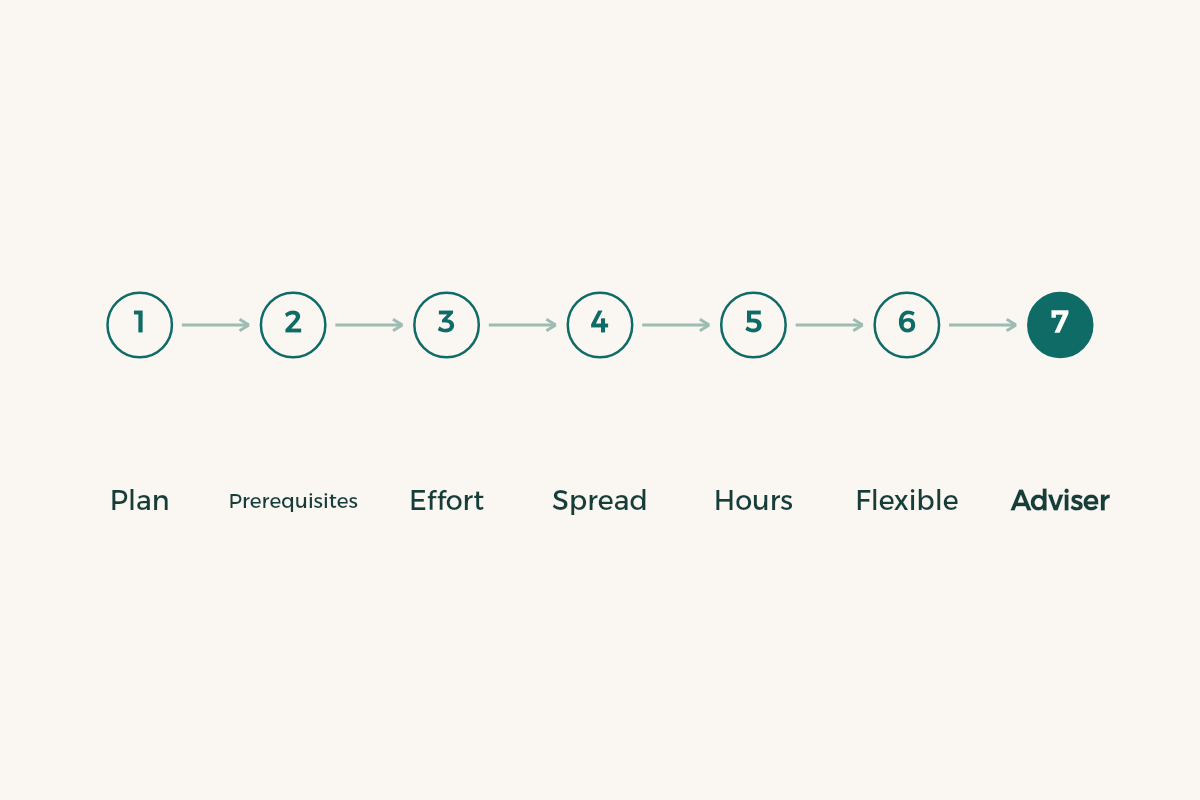
These steps are an example of a method. Your college’s rules may block some arrangements, such as a maximum number of hours or a prerequisite taught only in one semester. The plan tells you what you need; the regulations tell you what is allowed.
How do you make a realistic study schedule once you have chosen your courses?
After choosing courses you need a schedule. Cornell’s Learning Strategies Center reports that its students found a semester calendar and a weekly calendar useful for setting study goals and cutting wasted time.2 Put the deadlines and midterms you know from each course outline into the semester calendar, and you will sometimes find one week with three deadlines.
For that week do not wait until it arrives. Start the first deliverable two weeks ahead so it does not collide with the rest. For a ready weekly layout see the study plan template.
| Course type | How it eats your time | What lightens it |
|---|---|---|
| Memorising, lots of content | A few scattered hours all semester | Short weekly recall instead of cramming before the exam |
| Problems and calculations | Steady practice every week | Solving problems without ready-made answers on fixed days |
| Project or reports | Deadlines that bunch in certain weeks | Splitting it into stages and fixing an early start date |
| Lab course | Attendance plus a report after each session | Writing the report the same day |

What should you do if your semester looks too heavy?
Do not just worry; look at options. Defer a flexible course to a lighter semester, swap a section so two heavy courses fall on different days, or replace an elective with another. What matters is deciding before week one, not after the midterm, because dropping later can leave a mark on your record. Ask your adviser about the official calendar, since every university has its own.
And do not fear a lighter semester. A student who completes twelve hours with good grades often gains more than one who registers fifteen and stumbles in three, then stays longer to retake them. If a scholarship or your graduation date depends on a minimum number of hours, ask the administration before you lighten the load.
Here is an illustrative estimate. A three-hour course might need six hours of study a week outside lecture, and a course with a lab nine once reports are counted. Register five courses of that pattern and the total passes thirty hours, a figure the credit hours in the timetable never show. A common mistake follows: signing up for a friend’s section so you stay together, then finding it puts two heavy courses on one day. Put your timetable before company; Blackboard and your university’s registration portal show section times before you commit. If you have no clear adviser, ask the deanship of admission and registration or your college’s advising unit.
Reading the plan also reveals gaps. You may find that one elective can be skipped without delaying graduation, or that another is offered only in one semester a year. Write these notes on a sheet and revisit it each term. A student who knows their plan well is not surprised by a course that delays graduation by a full semester.
Should you register the hard courses first or the light ones?
There is no single rule. Put the courses that unlock others first, then balance. The same inventory asks whether you begin a study session with your hardest assignment,1 and the same idea applies to a term: keep the hard work where you are strongest. If this is your first semester, read the guide to your first week at university to see what is ahead.