By the tiswa editorial team, from the official sources listed at the end of this guide. How we write our guides
Fifty minutes a week. That is the least one credit hour is worth for a theory lecture under the undergraduate study and examinations regulation that Saudi universities work by.1 Everything else is built from that small number: your timetable, your course count, your GPA and the semester you graduate in.
What is the credit hours system?
Your degree is a list of courses, each worth a number of study units. You register a set of them each semester and graduate when the list is done. Nobody moves up a whole year as in school. You move up levels by the hours you have passed,1 so two students who started together can sit at different levels after three semesters.
What is a credit hour at a Saudi university?
The regulation calls it a "study unit", and its length depends on the activity:1
| Activity | Weekly time | Counts as |
|---|---|---|
| Theory lecture | At least 50 minutes | One unit |
| Clinical or tutorial session | At least 50 minutes | One unit |
| Practical (lab) session | At least 100 minutes | One unit |
| Field session | As the study plan sets | As the plan sets |
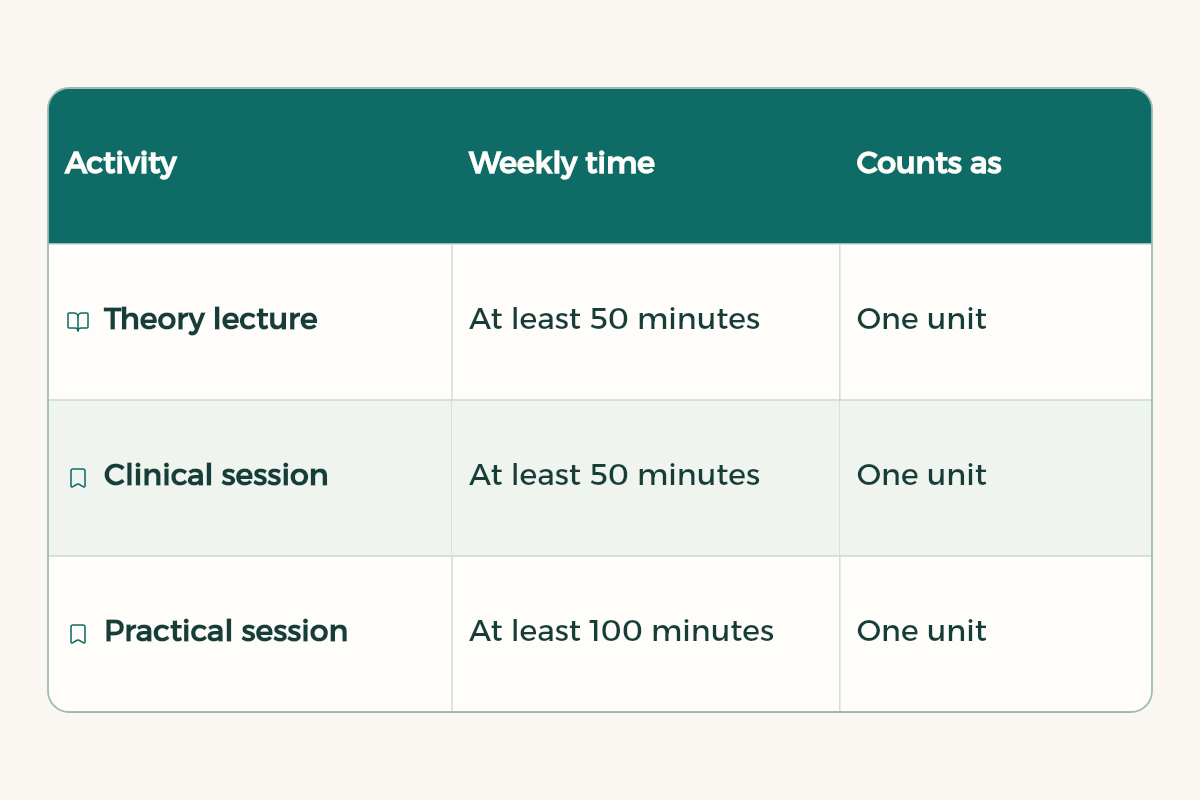
A 3-hour theory course is three lectures a week, or two longer ones. A course listed as 2 theory plus 1 lab takes more of your week than "3 hours" suggests, because the lab hour alone is 100 minutes. Do that sum before you put three lab courses in one semester.
How many credit hours per semester at Saudi universities?
Each university council sets the minimum and the maximum; the unified regulation does not fix one number for everyone.1 Two universities, two sets of numbers:
| Case | Jouf University | Umm Al-Qura University |
|---|---|---|
| Minimum, regular semester | 12 hours | 10 hours |
| Maximum with GPA under 2 of 5 | 14 hours | Set by university rules |
| Maximum with GPA 3.75 or above | 20 hours | Set by university rules |
| Expected to graduate | Up to 24 hours | Exempt from the minimum if under 10 remain |
| Summer term | Up to 12 if graduating | Up to 10 hours |
The Jouf figures come from its executive rules1 and the Umm Al-Qura figures from the rules on its website.2 Your university may use a third set, so read it on your admission and registration deanship's site before registration opens. University pages such as King Abdulaziz University on tiswa collect the links.
How are credit hours used to calculate GPA?
Multiply each course's grade weight by its hours, add the points, and divide by total hours.3 A short example on the 5-point scale: Maths, 4 hours at A (4.75), gives 19 points; Islamic culture, 2 hours at A+ (5.00), gives 10. That is 29 points over 6 hours, or 4.83. Swap the two grades and the result drops, because the 4-hour course carries more weight. The full grade table and a 4-point example are in how to calculate GPA.
The regulation sets your overall rating at graduation by cumulative GPA: Excellent from 4.50 out of 5, Very good from 3.75, Good from 2.75 and Pass from 2.00.1 Honours has extra conditions, covered in the honours degree guide.
Credit hours vs the annual system: what is the difference?
Under an annual system you pass a year or repeat it. Under credit hours you fail one course, repeat that course, and carry on with the rest. The catch: a prerequisite for three other courses holds up the whole chain if you fail it. The regulation defines the academic year as two or more semesters, with an optional summer term,1 covered in the summer semester guide.
What do the terms on my transcript mean?
- Prerequisite: a course you must pass before you can register another. Fail it and a chain slips.1
- Study plan: every course you need to graduate, spread over levels, compulsory and elective.
- Level: set by the total hours you have passed.
- W: withdrawn. It stays out of your GPA.
- DN (barred): barred from the final for absence, and counted as a fail.
The gap between the last two is large. Withdrawing on time protects your GPA; being barred adds a failed course, with all its hours, to the divisor. If absences are piling up in one course, withdrawing before the deadline is the kinder option.
How should I plan a semester in credit hours?
Start from your study plan, not from the list of offered sections. Mark every prerequisite you have not passed and register those first. Then spread the heavy courses: two 4-hour courses plus two labs in one semester is a lot if you also work or train. Count real weekly time, not the listed hours, because 15 hours with three labs is heavier than 18 hours of theory. For study habits during term, see how to study effectively.
Mistakes students make with credit hours
- Registering the maximum in the first semester because the system allows it.
- Dividing points by the number of courses instead of the number of hours.
- Putting off a prerequisite, then finding three courses locked next semester.
- Applying Jouf's numbers at another university without reading its rules.
- Forgetting that a lab hour is twice a lecture.
If you picked the wrong courses, the drop and add week at the start of term is there to fix the timetable.