By the tiswa editorial team, from the official sources listed at the end of this guide. How we write our guides
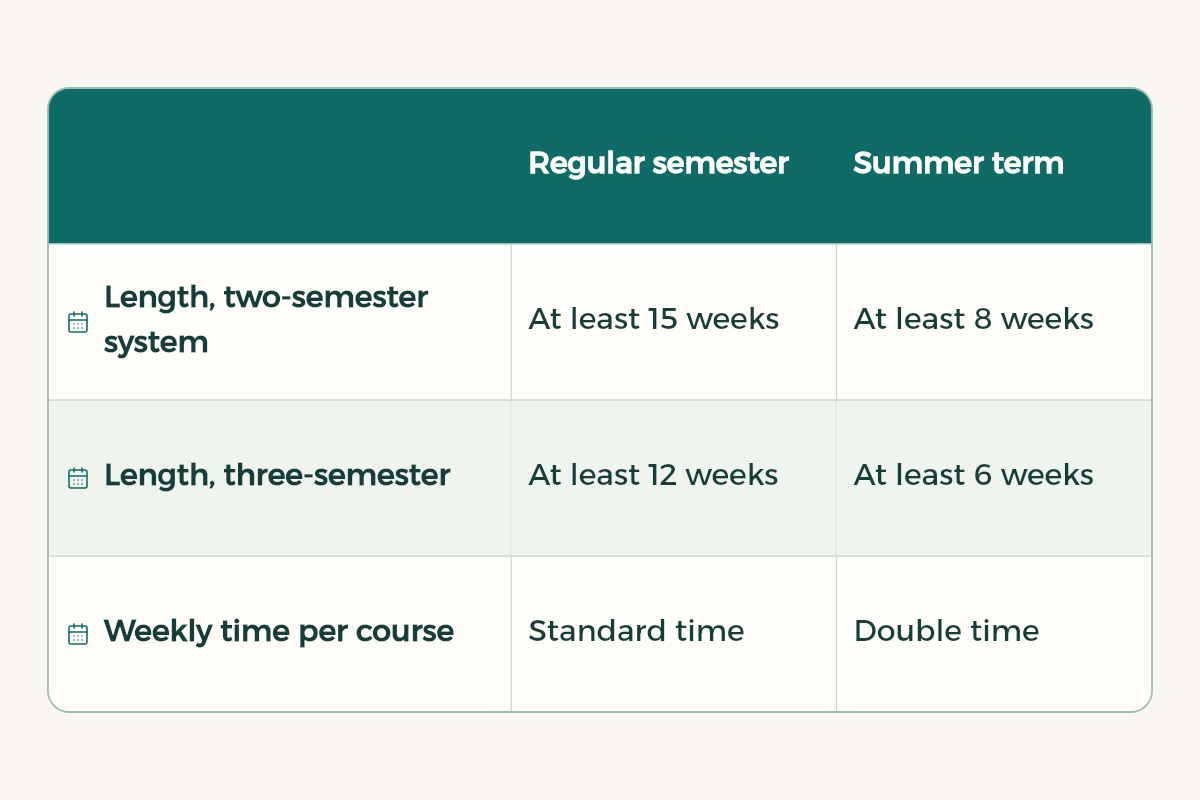
Eight weeks instead of fifteen. That is the gap between a summer term and a regular semester in a two-semester system under the undergraduate study and examinations regulation.1 Same content, same exams, double the weekly time per course. Summer students are not getting a lighter version; they are getting a compressed one.
What does the regulation say about the summer semester?
It defines a summer term as at least eight weeks in a two-semester system and at least six in a three-semester system, with the time allotted to each course doubled. The academic year is two or more semesters and may include a summer term.1 "May" is the key word: universities are not obliged to run one. Under Jouf University's executive rules, opening a summer term needs the university council's approval on the college's recommendation.1
| Regular semester | Summer term | |
|---|---|---|
| Length, two-semester system | At least 15 weeks | At least 8 weeks |
| Length, three-semester system | At least 12 weeks | At least 6 weeks |
| Weekly time per course | Standard | Double |
| Runs every year? | Yes | University decides |
How many hours can I take in the summer semester?
Ten hours is the ceiling at both universities whose rules we read. Umm Al-Qura caps summer at 10 study hours, not counting equivalence courses.2 Jouf sets a minimum of one hour and a maximum of 10, provided the load suits your cumulative GPA, and a student expected to graduate may take 12.1 Your university may differ, so check the admission and registration deanship and the academic calendar, such as King Saud University's calendar.3
How do I register for summer courses?
- Open the academic calendar
Find summer registration, drop and add, and final exam dates before you book any travel.
- Check the course is offered
Some summer sections only open if enough students register.
- Register in your academic system
Within the announced window and under the hour cap.
- Have a backup
Pick a second course in case the section is cancelled.
- Read the exam timetable
Summer finals fall in the last days of term, so plan work around them.
What is a visiting student in summer?
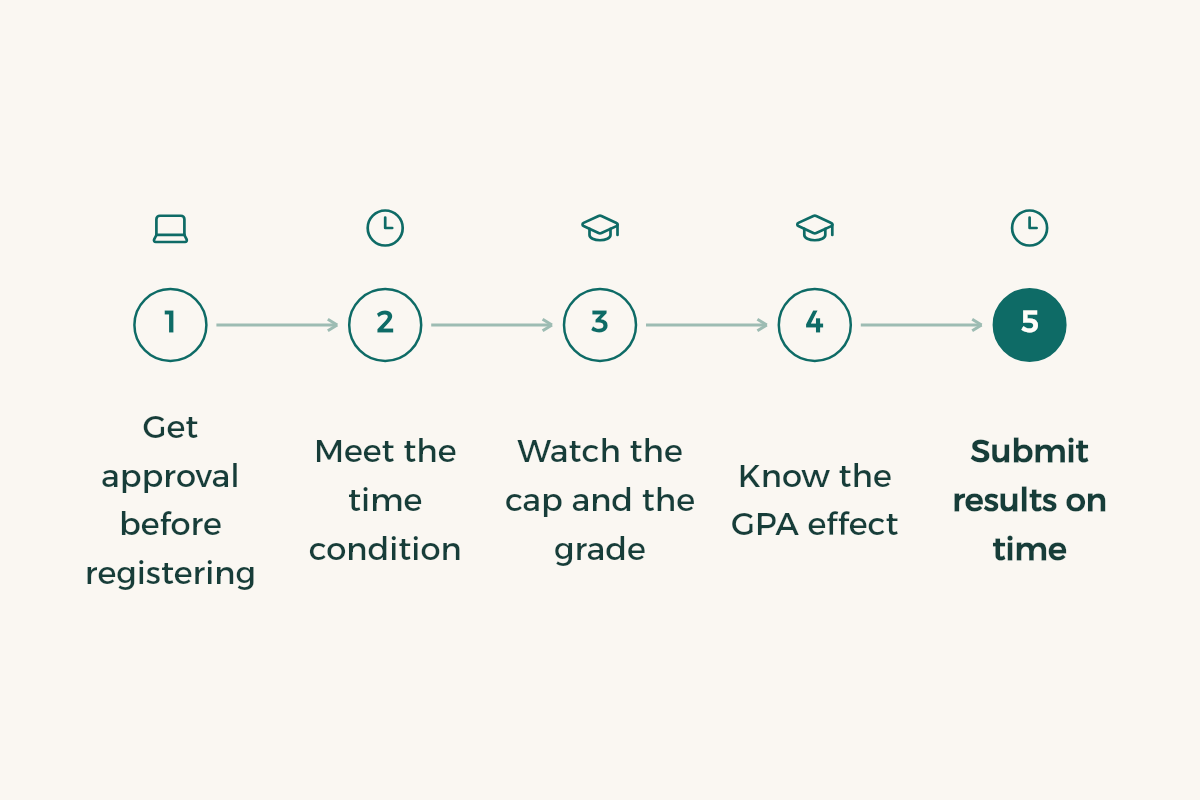
A student who takes one or more courses at another university, inside or outside the Kingdom, or at another branch of their own, without transferring. The regulation allows it with the college's approval; the courses are matched and recorded on the transcript, and each university council sets the rules, including whether they count in the GPA.1 Two universities' rules:
- Jouf: you must have studied two semesters as a regular student, the course must match in content with at least as many hours, and you need a Good grade or better.1
- Jouf: the matched grade does not count in your cumulative GPA, and results go to the deanship within two weeks of the next semester starting.1
- Umm Al-Qura: no more than 20% of graduation units outside the university, and no more than three semesters as a visitor.2
- Umm Al-Qura: approval from the department offering the course, your own department and the admission deanship, and never two universities in one semester.2
Jouf also caps credit from outside at 20% of graduation hours.1 Failing a course taken as a visitor rules out honours; see the honours degree guide.
Does the summer semester count in my GPA?
Yes, if you take it at your own university. A summer course counts with its hours and grade like any other semester, weighted as in the credit hours system. Visiting courses depend on your university; at Jouf they stay out of the GPA.1 So if the goal is to raise your GPA over the summer, study at home, not as a visitor, and pick a course you are confident in. The full method is in how to calculate GPA.
When is summer worth it, and when should you skip it?
| Take summer if | Skip summer if |
|---|---|
| You failed a prerequisite for next semester's courses | The course is one of the hardest in your plan |
| Only a few hours remain, so summer saves a semester | You have a summer internship or a full-time job |
| You want a general course off a crowded semester | You are close to academic probation and unsure of a good grade |
Doing summer study and an internship together usually hurts both; options for the break are in the summer training guide. If your GPA is near the line, read academic probation explained before you register. And count the summer in lectures, not hours: two 3-hour courses mean about twelve lectures a week, more than two every teaching day.
How do I pass a summer course in eight weeks?
Be consistent from day one. A lost week in summer is worth two in a regular semester, and the midterm arrives before the term feels like it has started. Set a fixed daily routine, review each lecture the same day, and do its exercises before the next one. Split the textbook across the weeks on day one: twelve chapters over eight weeks is a chapter and a half a week, plus a final week for revision. For the last stretch, use the final exams revision plan.
What if I am about to graduate?
The rules carve out room for you. Jouf lets a student expected to graduate take 12 summer hours instead of 10,1 and Umm Al-Qura exempts a graduating student with fewer than 10 hours left from the minimum load.2 If two or three courses remain after the second semester, summer can be your last term. Check with your advisor that those courses run in summer and that your field training or capstone does not require a regular semester.
Mistakes students make with summer courses
- Booking travel before the summer exam timetable is out.
- Registering as a visitor first and asking for approval after the grade.
- Taking 10 hours in a first summer.
- Assuming a visiting course will lift the GPA, when some universities leave it out.
- Losing the first week, which in summer is worth two in a regular semester.