By the tiswa editorial team, from the official sources listed at the end of this guide. How we write our guides
If you want to know how to raise your GPA in college, start with arithmetic, not effort. A cumulative GPA is an hours-weighted average, so each new semester moves it only as much as its hours compare with everything before it. Once you know the exact number you need, "I will work harder" turns into a target for every course.
Step 1: work out the average you need
If you are unsure how the GPA is calculated, read how to calculate GPA in Saudi Arabia first. Then use this formula:
Example: your GPA is 3.40 out of 5 after 60 hours and you want 3.75 after 30 more hours (about two semesters). Needed = (3.75 × 90 − 3.40 × 60) ÷ 30 = (337.5 − 204) ÷ 30 = 4.45. That is an average between B+ and A for two semesters. Hard, but possible, and now it is concrete.
Why raising it early is easier
The more hours behind you, the less weight a new semester carries. Here is a student at 3.40 out of 5 who averages 4.75 over one 15-hour semester:
| Hours already done | GPA after the semester | Rise |
|---|---|---|
| 30 hours | 3.85 | 0.45 |
| 60 hours | 3.67 | 0.27 |
| 90 hours | 3.59 | 0.19 |
| 120 hours | 3.55 | 0.15 |

Same semester, same grades, but its effect after first year is three times its effect going into final year. If you are early in your degree, this is the best time to act.
Step 2: rank your courses by impact
- High-hour courses move the GPA most. A 4-hour course going from C+ to B adds more points than a 2-hour course making the same jump.
- Watch the boundaries. B to B+ is half a point, A to A+ only a quarter. A student sitting near 85 gains more from extra effort than one near 95.
- Do not overload a semester you want to count. 15 hours of strong grades beats 19 hours of average ones.
- Spread heavy courses across semesters instead of stacking them, and plan it with your academic advisor.
Step 3: use repeats wisely
Many universities let you repeat low-grade courses. Under KFUPM's regulations, for example, you may repeat a course with a D or D+, the latest grade reflects your performance, and all attempts appear on the transcript. Rules on how often you can repeat and which grade counts vary between universities, so read your own regulations before deciding.
- Start with the course that has the most hours and the lowest grade.
- Do not repeat a course until you know why it went wrong: study method, attendance or a missing prerequisite.
- Check that the repeat will not delay other courses in your plan or affect your stipend.
Step 4: change how you study, not how long
A student who spends hours rereading and highlighting can score lower than one who studies less time by testing themselves. In the Dunlosky review, practice testing and distributed practice came out on top. The practical version is in how to study effectively.
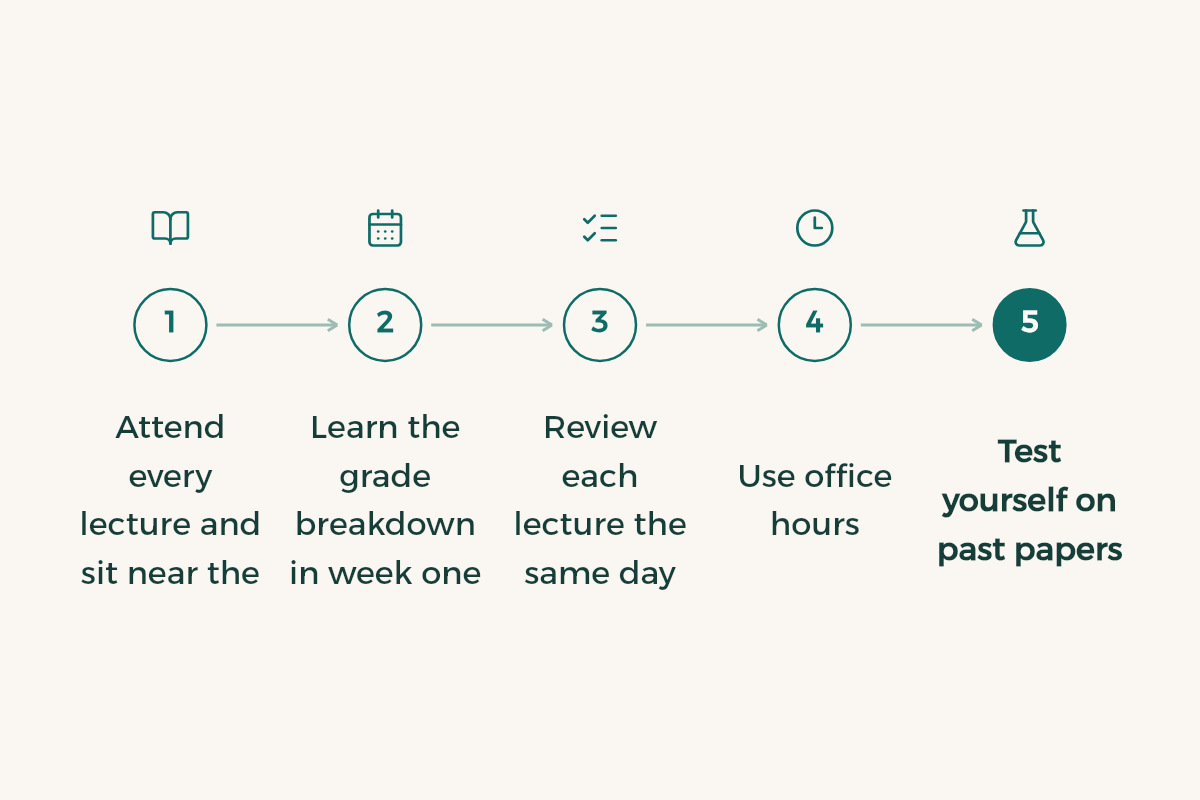
- Attend every lecture and sit near the front
Many exam questions come from the lecturer's own examples, and attendance counts toward the grade in many courses.
- Learn the grade breakdown in week one
How much for assignments, quizzes, the midterm and the final. Small marks add up and decide a lot of letter grades.
- Review each lecture the same day
Ten minutes writing what you understood from memory, then turn the key points into questions.
- Use office hours
One question to the professor before an exam saves hours and shows you what they emphasise.
- Test yourself on past papers
At least a week before the exam, not the night before. Then follow the final exams study plan.
An AI prompt for your semester plan
My cumulative GPA is [GPA] out of [5 or 4] after [number] hours, and my target is [target] after [number] hours.
My courses this semester (course, hours, grade breakdown, how I am doing):
[list them]
1) Calculate the average I need in the upcoming hours and show the working.
2) Suggest a target grade per course that reaches that average, prioritising the high-hour courses.
3) Give me a weekly study plan built on self-testing and spaced review.
Check the numbers yourself and treat the plan as a starting point to refine with your academic advisor.
Early warning signs worth acting on
- Your first quiz in a big course is below half marks: go to office hours this week, not after the midterm.
- Your absences are close to your university's limit: stop missing classes now, because being barred costs you the whole course.
- You do not understand a prerequisite for a current course: review its basics in the first two weeks before the gap grows.
- Your semester GPA has dropped two semesters in a row: sit down with your academic advisor and review your load and plan together.
Things outside class that move your GPA
- Sleep: regular all-nighters before exams hurt both focus and memory.
- Part-time work: if you work, cap the hours so you keep fixed study time. Ideas in part-time jobs for students.
- Money: end-of-month stress steals focus. A simple plan in student budget helps.
A worked example: how much can one term move your GPA?
Say your cumulative GPA is 3.00 out of 5 after 60 credit hours, and you take 15 hours this term. If you earn a 4.00 term GPA, your new GPA is (3.00 × 60 + 4.00 × 15) divided by 75, about 3.20. If you earn 4.50, it becomes 3.30. Each strong term moves the GPA a limited amount, so you need a plan over several terms, not one. Run your own numbers the same way with GPA calculation, and check your university's scale, because some universities use 4 rather than 5.
Meeting your academic advisor
Your advisor knows your university's rules better than any website. Before the meeting, prepare:
- Your current transcript and the courses where you scored low.
- The GPA you are aiming for and why, such as a programme, scholarship or job.
- Specific questions: can I retake this course? How does a retake count in my GPA? How many hours should I take this term?
Write down what they say the same day, because details matter in these decisions.
Mistakes that lower your GPA without you noticing
- Taking a heavy load in a term you know is busy with other commitments.
- Neglecting coursework and assignment marks, which are a large share of the grade in many courses.
- Late withdrawal, or missing the add and drop dates in the academic calendar.
- Studying every course the same way. Each needs its own approach, as in how to study effectively.
- Notion: Notion offers Notion Education plan for students to university students in Saudi Arabia for free.
- Google AI: Google AI offers Google AI Plus free for a year to university students in Saudi Arabia.
- WPS Office: WPS Office offers WPS Office for free to university students in Saudi Arabia.