By the tiswa editorial team, from the official sources listed at the end of this guide. How we write our guides
Five courses this term and eighteen study hours a week. You split them five ways and get three and a half hours each, then finish the midterms with a good mark in the easy course and a disappointing one in the course with three credit hours and four times the content. That is the usual mistake in dividing study time: arithmetic fairness is not real fairness.
How do I divide my study hours between subjects?
Ask two questions of each course. First, weight: how many credit hours does it carry, and how much of the mark is still open? Second, difficulty for you: do you follow the lecture as it happens, or need a second pass? Score difficulty from one to three: one easy, two medium, three hard. Multiply weight by difficulty and divide your hours in proportion.
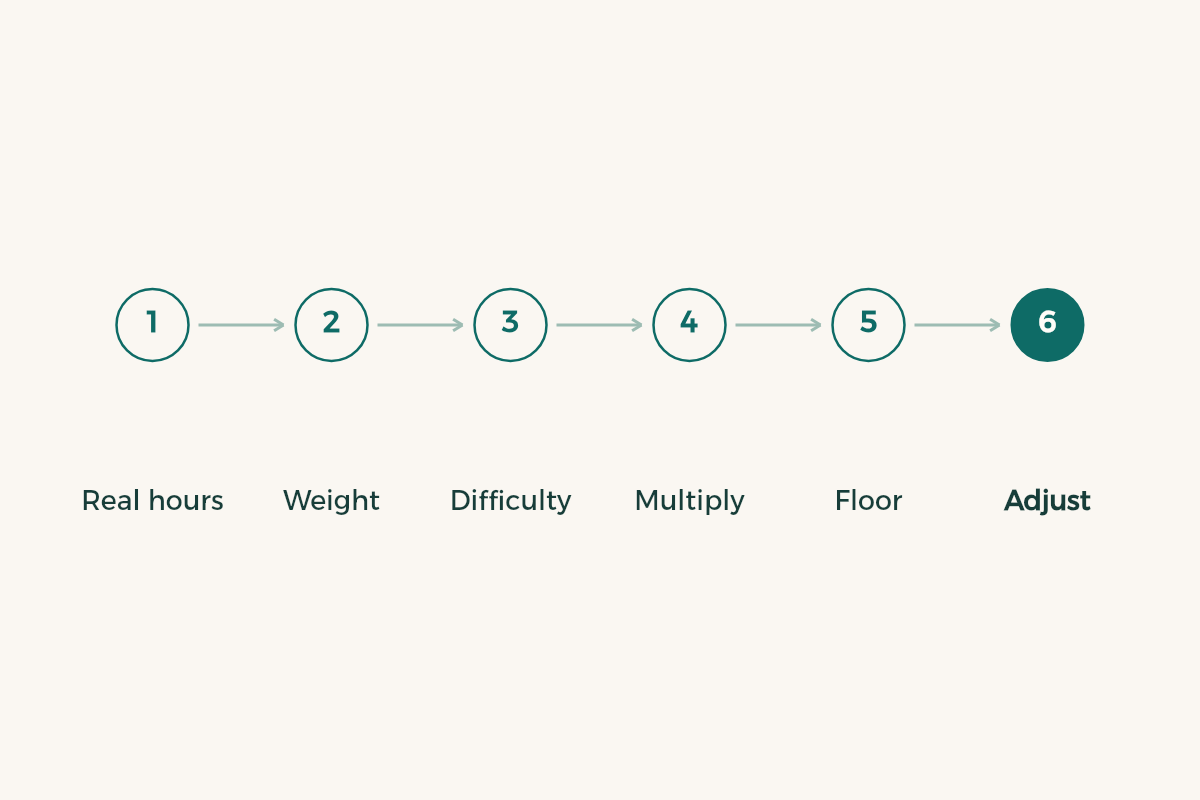
- Count your real hours
From the week’s hours, take away lectures, sleep, travel, meals and commitments. What remains is what you divide; do not divide imagined hours.
- Write each course’s weight
Its credit hours, which sit in your study plan and your registration system. If two courses carry different assessment, multiply by the share of marks still open.
- Score difficulty honestly
One and three for your easiest and hardest, two for the rest. Judge by what happened to you in the first weeks, not by what other students say.
- Multiply and divide
Multiply weight by difficulty, add the results, then give each course its share of the total.
- Set a floor
No course gets less than thirty minutes a day. An easy course that is neglected becomes hard the day before the exam.
- Adjust after two weeks
Look at short quizzes and assignments. A course that came in under your expectation takes an hour from one that came in over.
How do I know which subject is hardest for me?
Difficulty is personal. What your friend finds hard may be easier for you because your background is stronger, and the other way round. So estimate it from the first two weeks: how much of the lecture did you follow without going back to the book? How much of the assignment did you solve alone? How many questions did you miss in the first quiz? Those three answers give a better number than an impression.
If you have no data yet, use a temporary rule: calculation and programming courses need more separate sessions, and memorising courses need repeated review. For how credit hours are counted, see the guide to the credit hours system.
What does a split across five subjects look like?
| Course (example) | Weight | Difficulty | Product | Hours out of 18 |
|---|---|---|---|---|
| Mathematics | 3 | 3 | 9 | 5 hours |
| Programming | 3 | 2 | 6 | 3.5 hours |
| English | 2 | 1 | 2 | 1 hour |
| Physics | 3 | 3 | 9 | 5 hours |
| Islamic culture | 2 | 1 | 2 | 1 hour |
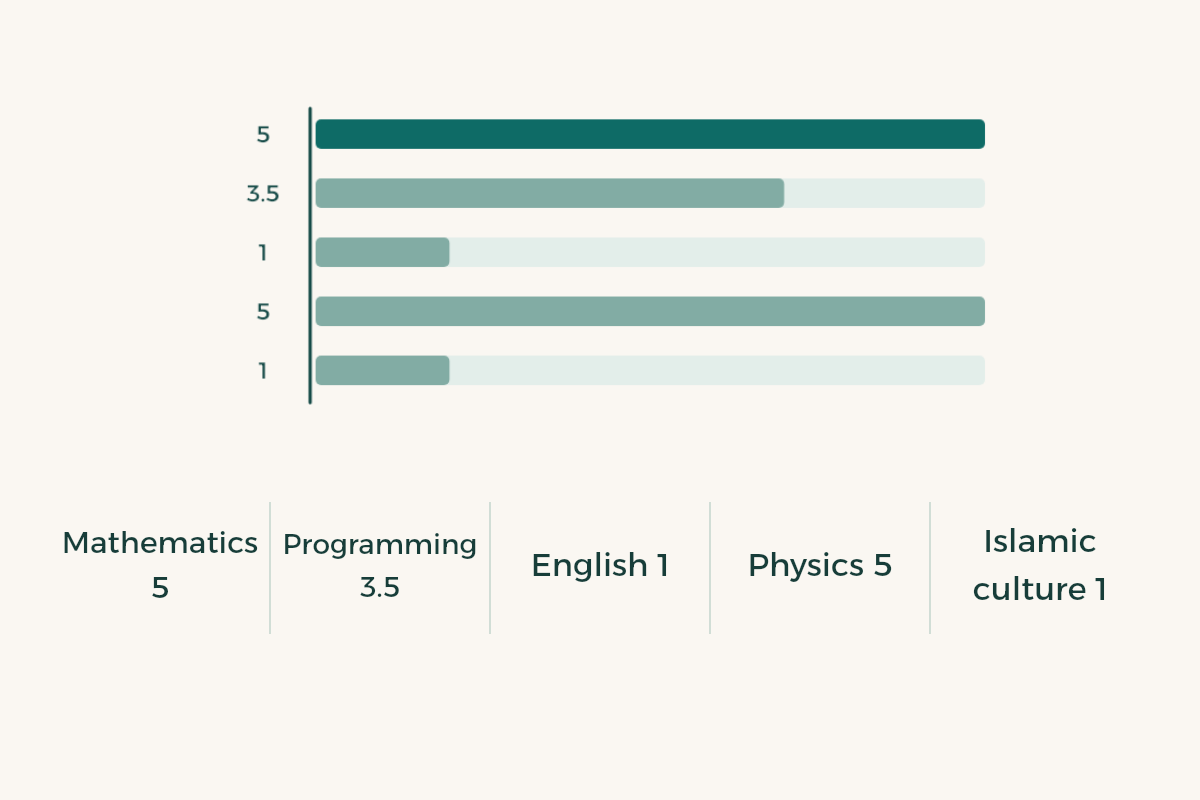
The names and numbers are illustrative only. The total here is thirty-two, so we divide eighteen hours in proportion to each product and round. Notice that English and Islamic culture got one hour each, so make them short daily sessions and not a single unbroken hour on Friday.
Should I study the hard subject first or last?
First in the day, when your energy is higher, with the easier one after it. But do not spend the whole day on one course. The UNC Learning Center recommends a short block per course each day; thirty minutes per class across six days beats one three-hour session with the same total.1 Cornell’s Learning Strategies Center calls spaced practice the opposite of cramming and says it improves retention.2
The Learning Scientists add that spacing and retrieval practice are among the strategies with the most evidence.3 So open the hard course’s session with questions from the previous one. If you want a ready weekly timetable, see a realistic study plan.
When should I change the split?
In three cases. When a near exam appears in one course, raise its share for one week at the expense of the others in a sensible proportion. When a short quiz comes in below expectation, add an hour a week until it improves. And when a course becomes easy, ease off and move that hour. Fix the appointment: every Sunday, ten minutes, look and adjust.
Remember that marks are not the only measure: a three-credit course affects your GPA more than a two-credit one. To see that effect, use the GPA calculator guide and check what each course’s mark is worth, then split your time.
Which mistakes ruin a study-time split?
The first is judging difficulty by impression, not results, so you shortchange one course and spoil another. The second is forgetting the easy courses completely and being surprised by them a day before the exam. The third is building the split on hours you do not have, so it breaks in week one. The fourth is deciding and never reviewing: a split you do not look at every two weeks becomes decoration.