By the tiswa editorial team, from the official sources listed at the end of this guide. How we write our guides
A student in the College of Science has two low-graded courses: one of three credit hours, one of two. The three-hour course gets retaken because it is “bigger”, and only afterwards does the student see the two-hour one would have lifted the GPA more per hour of work. The smarter decision needed a small table before registering, not after.
How do you calculate the King Khalid University GPA and find the repeat clause?
The Deanship of Admission and Registration publishes the undergraduate study and examination regulation on its site.1 It is the reference for the scale your GPA uses, for how a repeated course is treated, and for the academic warning limits. Open the file and search for: repeat, cumulative GPA, failure, warning, grade.
We do not quote clause numbers or figures here, because they change between years and the published version is the one that governs you. Note the clause name and number and the date of the version, and take it to your advisor. The deadlines that govern registering a retake are in the King Khalid University academic calendar.
How do you compare retake cases with a worked example?
The example below is an illustration with assumed numbers on a 5-point scale, not necessarily the university’s scale. Your cumulative GPA is 3.00 after sixty completed hours, which is 180 points. You retake a three-hour course in which you earned 2.00 grade points and hope for 4.00:
| Case | Points | Hours | New GPA |
|---|---|---|---|
| New grade replaces the old | 186 | 60 | 3.10 |
| Both grades count | 192 | 63 | 3.05 |
| A new course at 4.00 (for comparison) | 192 | 63 | 3.05 |
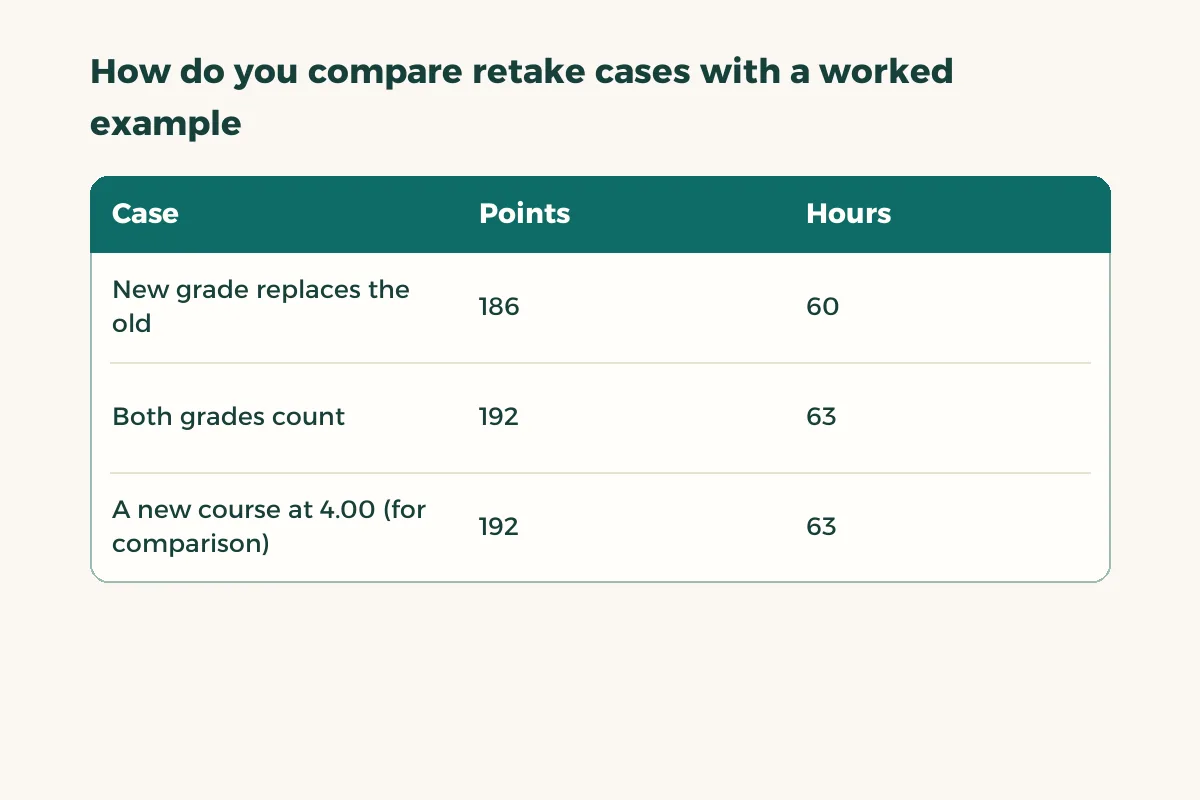
The first case lifts you by 0.10 and the second by 0.05. Notice that when both grades count, a retake gives the same result as a new course with the same grade. Then the question becomes: does the repeated course serve my graduation better, or is a new course from my plan more useful?
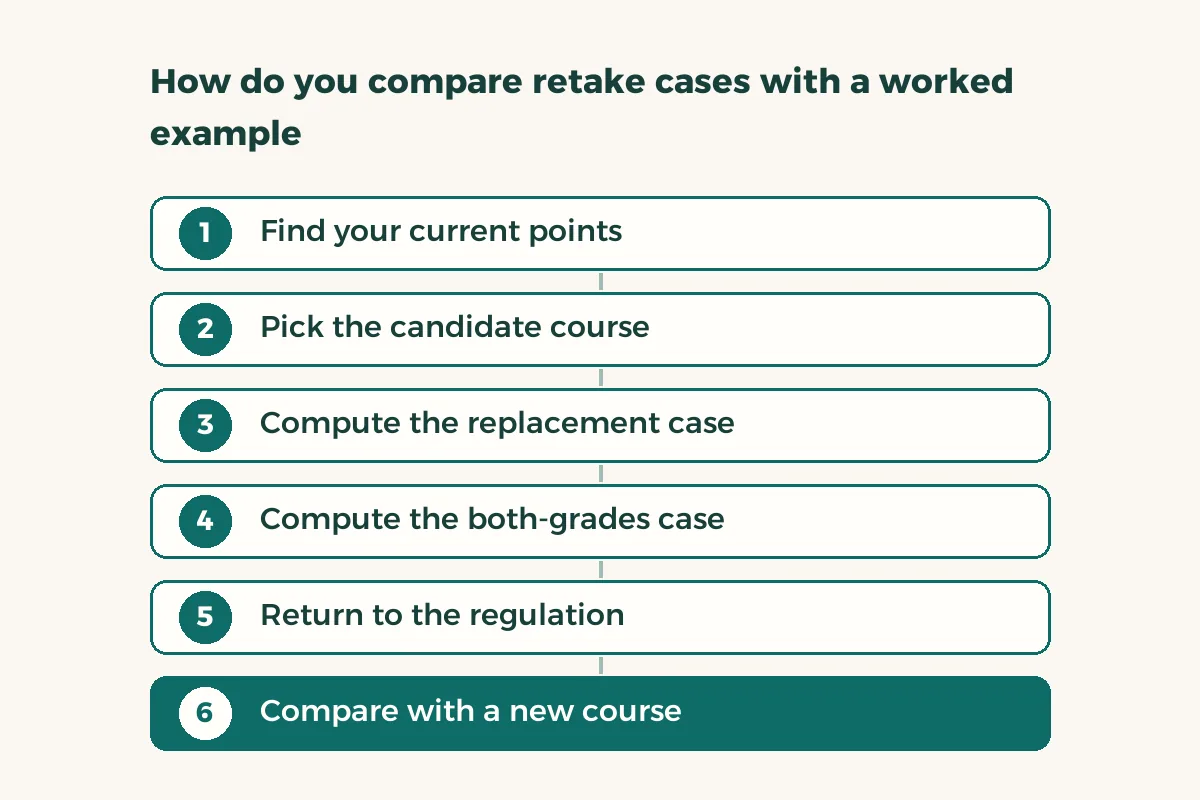
- Find your current points
Cumulative GPA × completed hours.
- Pick the candidate course
Its hours, its current grade points and the realistic grade you expect.
- Compute the replacement case
Remove the old points, add the new, keep the hours the same.
- Compute the both-grades case
Add the new points and the new hours to the totals.
- Return to the regulation
Pick the case the repeat clause describes and ignore the other.
- Compare with a new course
Would a course from your plan raise you as much, with less effort?
Which course should you retake first?
The one with the biggest point gain per hour of study. A two-hour course going from 1.00 to 4.00 adds 6 points, and a three-hour course going from 2.00 to 4.00 adds 6 points too, but the first usually needs fewer hours and less effort. And if the course is a prerequisite for a later one, treat it as a priority whatever its arithmetic effect.
Ask also: do I know why I failed the first time? If not, repeating the course the same way may produce the same grade. Look at your mistakes and revision timing as in the exam error log.
What if your GPA is near the warning line?
Go back to the warning clause in the same regulation and talk to your college’s advisor before registering. To see who the advisor is and how to reach them, read academic advising at King Khalid University; for cases needing a different route, see academic probation. The general calculation is in GPA calculation.
If you are thinking of switching majors because of the GPA, first check whether your courses carry over to the new one, then read internal transfer at King Khalid University.
How do you raise your cumulative GPA with retakes?
Flip the arithmetic. Your GPA is 3.00 after sixty hours (180 points) and the target is 3.50, which is 210 points over the same hours, so you need thirty points. If a retake replaces the grade and each three-hour retake lifts the grade from 2.00 to 5.00, it adds 9 points, so you need roughly four retakes. These are assumed numbers on a 5-point scale, to show the size of the job, not to promise a result.
If the count is more than your plan can carry, break the target into stages: first leave the warning zone, then reach the line a particular requirement sets, then the larger goal. That is easier on morale and clearer to your advisor.
Do not forget what a retake does to your timetable: a repeated course takes a seat in your semester. If it carries many hours, ask whether you can give it more time than the first attempt. Retaking with the same effort produces the same result. Write one line on what you will change this time: revision time, past questions, or office hours with the instructor.
What mistakes come up with retakes?
Retaking on a rumour. Registering the retake in a heavy load and losing both courses. Ignoring add and drop dates. Computing the new cumulative GPA as a simple average rather than points over hours. The biggest is forgetting that a retake is a full course needing full revision; build a plan as in how to raise your GPA.