By the tiswa editorial team, from the official sources listed at the end of this guide. How we write our guides
A student at Hafr Al-Batin University finished four semesters in one college and then moved to another department. The request was accepted and he was delighted. Two weeks later the equivalency sheet arrived: only half his courses counted, and three semesters remained instead of the two he had expected. A map drawn before applying would have shown him that, and he would have decided with the full cost in view.
What is internal transfer at Hafr Al-Batin University?
It is a move from one college to another, or one department to another, inside the same university. The unified undergraduate regulation allows it under rules the university council sets.1 The university publishes each period’s conditions on its official website.2 It differs from moving to another university, which the guide to transferring between universities explains. Read the notice first, then go to the map.
How do you map your courses before transferring?
The map is a table with a few columns: your completed courses, what matches them in the new plan, whether content and hours line up, and what remains. The example below is entirely invented. Its courses are not Hafr Al-Batin’s plan, and its purpose is only to show the method:
| Your completed course | Closest course in the new plan | Rough verdict |
|---|---|---|
| Introduction to Statistics (3 hours) | Principles of Statistics (3 hours) | Similar; ask about equivalency |
| English Language 1 (2 hours) | English Language 1 (2 hours) | General requirement; likely to stay |
| Introduction to Management (3 hours) | No match | Ask whether it counts as an elective |
| Computer 1 (3 hours) | Computer Basics (2 hours) | Fewer hours than yours; ask |
The verdict column is my estimate, not the university’s decision. The decision belongs to the college council under its rules. In Jouf University’s regulation, as an example, the college matches courses a student has studied on the recommendation of the departments, provided the content is similar.1 That is an example and not a Hafr Al-Batin rule, but it explains why you compare content and not names.
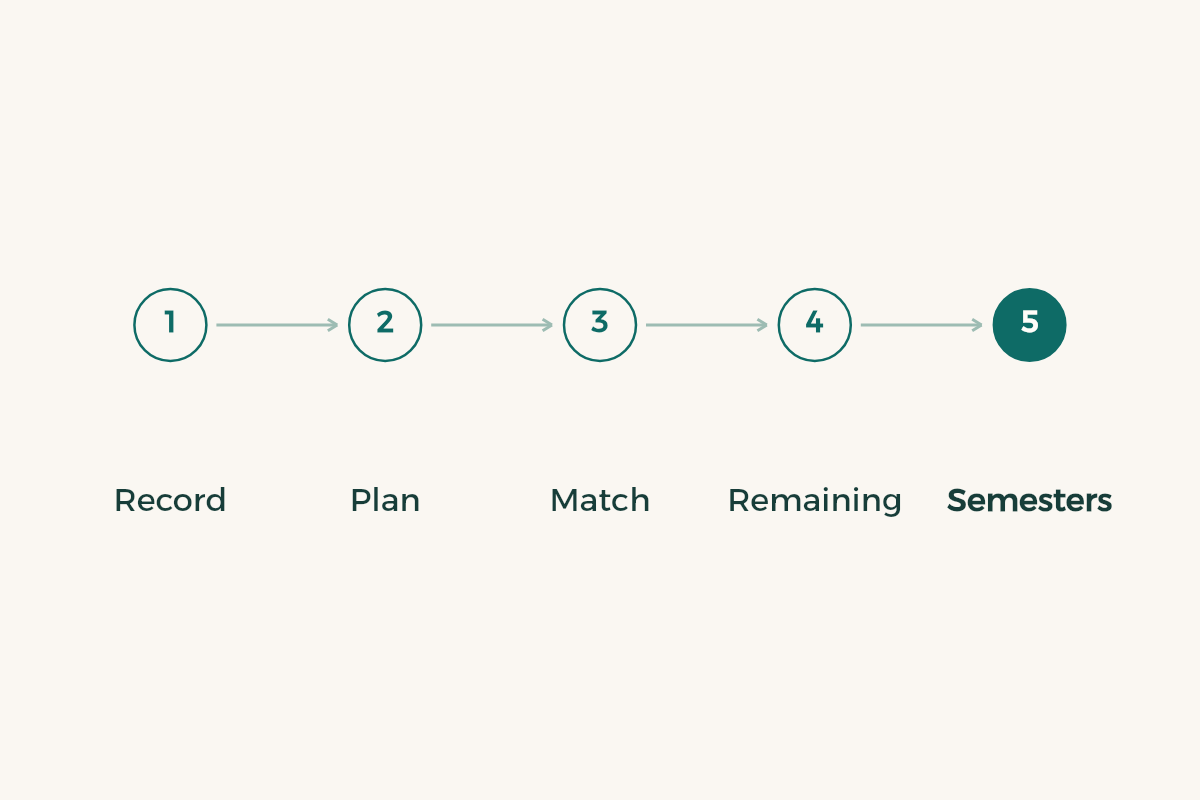
- Pull your record
From the student portal. List every course with its hours, code and grade.
- Pull the new department’s plan
From the university or college site. List every required course with its hours.
- Match course to course
Mark what overlaps in subject and hours, and leave blank what has no match.
- Work out what remains
Add up the new plan’s hours and subtract what you expect to count. The rest is your expected load.
- Divide by a semester load
That tells you how many semesters you need; then ask the deanship to correct the map before you apply.
How do you work out your cumulative GPA after an internal transfer?
In the published Jouf University example, matched courses stay on your record with their grades and count in the cumulative GPA after a transfer inside the university.1 Ask the admissions and registration deanship at Hafr Al-Batin about your case. To see how grades become a GPA, read GPA calculation, and for how hours and plans fit together read the guide to the credit hours system.
What questions do you bring to the deanship with your map?
Do not ask “will my courses be matched?” The answer will be general. Bring the map and ask about each course; a specific question gets a specific answer. Ask about course age too. Some universities cap the age of matched courses, which matters if you took one two or more years ago.
Ask when the matching is done: right after acceptance or at the end of the semester? Under the Jouf example, the college finishes matching within the semester in which the student transferred.1 If your timetable depends on registering next semester’s courses, a late equivalency can disrupt your choices.
Are the best majors in Saudi Arabia a good reason to transfer?
When it shows that the move costs two extra semesters for a small gain in interest. After doing the sums you may find it better to finish your major and chase the new interest through a course, a project or a part-time job. Or you may find the opposite: the move adds one semester and the new plan sits much closer to your career goal. Either way, the map saved you from a blind decision.
To think through the goal itself, see choosing a major. And if you worry that your academic standing could be hit during the move, read about academic probation.
What do you do with courses that have no match?
Courses with no match in the new plan are not necessarily lost. Ask whether one can count as an elective or a free course, because many plans leave room for such hours. If it cannot, learn that before you apply, since those are hours you put effort into that will not show on your graduation record.
Partly matching courses raise another question: is the content enough? Your course may carry fewer hours than its counterpart, and the match is refused. Ask the department for the course descriptions in both plans and compare them yourself. The written description is more exact than the name, and it is what the college council usually relies on.