
By the tiswa editorial team, from the official sources listed at the end of this guide. How we write our guides
Picture a student who finished the first semester of a physical therapy degree and heard in a group chat that clinical training starts two years in, and that some cohorts move to another city. Nobody asked the college at registration because the questions did not occur to them. This example is illustrative, but it matches a pattern in any health degree: the big decision comes before the student knows how they will be trained.
What is clinical training in physical therapy and why ask before you register?
Clinical training is where you move from the classroom to patients: you assess a case, apply exercises and write notes, all under a licensed therapist. World Physiotherapy describes physiotherapist education as supported by several approaches, including practice-based and experiential learning, so theory alone does not carry you through the degree.2 The catch is that this is the part that differs most between colleges, and the part least visible on a brochure.
After graduation, health practitioners are registered with the Saudi Commission for Health Specialties, and employers can check a registration through the commission’s verification service.1 The placement question is not a luxury: it sits on the road to that registration, so ask the college how its training connects to the licensing requirements you will meet later.
Which questions should you ask the college before you decide?
Collect your questions in one file and take it to admissions or the programme coordinator. This list is a starting point; adjust it to your college.
- Where does training take place?
Ask for the names of the sites that train the current cohort: a government hospital, a rehabilitation centre or a sports clinic. Ask which city, because moving changes housing and budget.
- Who picks the site?
Does the college assign you, or do you rank preferences? Are health or family circumstances considered? Ask for a published rule, not a verbal promise.
- When does it start and how long does it run?
Ask for the study plan and look at which semester the training courses appear in. Do not rely on older students, because plans get revised.
- Who supervises you?
Ask whether it is a college lecturer, a therapist on site, or both. Ask how many students work with one supervisor.
- How are you assessed?
Ask for the assessment form: direct observation, a case log or a practical exam. Someone who knows the standard from day one can train for it.
- What if the site falls through?
If a unit closes or an agreement changes, what is the alternative? Does the work you finished count?
- What extra costs come with it?
Transport, uniform, medical checks and the vaccinations that training sites ask for. Request a list of items rather than amounts.
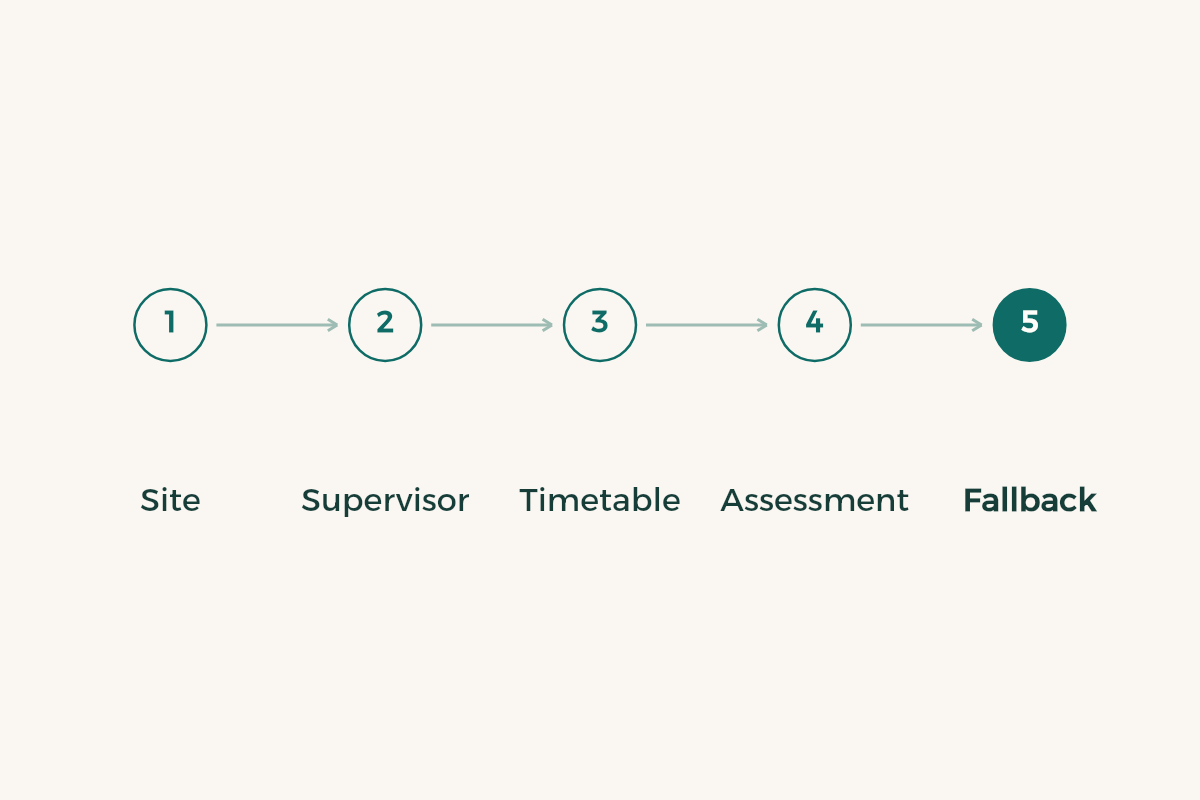
These are questions to ask, not facts about your university. Some answers will be “not decided yet”, and that answer tells you something too.
How do you balance the placement site with your lecture timetable?
Field training clashes with lectures when it is spread across scattered days. Ask whether placement comes in a dedicated block or on set weekdays beside your courses. A block means a long stretch away from the classroom; set days mean constant movement between two places.
Either way, work out the travel time from where you live to the furthest likely site. A student who spends an hour each way loses study hours, and the official timetable will not show it.

Where does physical therapy training in Saudi Arabia take place?
No. Units differ: orthopaedics, neurology, paediatrics, cardiac rehabilitation, sports. A college may place you in some and not others. Ask which units the cohort rotates through and whether every student is guaranteed more than one, so you do not graduate with experience in a single area. If you lean toward a particular field, ask whether students have any say. For the application stage itself, read the guide to physical therapy co-op training skills.
How do you get the answers in a form that protects you?
Write your questions in an email to the programme or admissions coordinator and keep the reply. A college is not at fault when a plan changes, but a written reply gives you something to point to if something you were told shifts. Compare the answers with the study plan published on the college website, and if they disagree, ask why.
If you have not settled on the major yet, read the physical therapy major guide first, then return to these questions when you compare two colleges. If you are close to the project stage, the guide to a physical therapy graduation project question shows how placement feeds your research question.
Which signs call for a pause before a physical therapy major in Saudi Arabia?
Three are enough. First, the college says training is “arranged” without naming one site. Second, admissions and the programme coordinator give different answers. Third, nothing is written about the fallback when a site is unavailable. One sign does not make a college poor, but it means you should ask for clarity before you commit.