By the tiswa editorial team, from the official sources listed at the end of this guide. How we write our guides
A physics major in Saudi Arabia answers an old, simple question: how does the universe work, from a rolling ball to an electron inside an atom? Students who choose it need a liking for maths, patience in the lab and the kind of curiosity that is not satisfied by a law until it knows where the law comes from. This guide covers years and credit hours from official department pages, the difference between physics and medical physics, the core courses, admission, jobs, the teaching licence, and a practical method for solving problems.
How long is a physics degree?
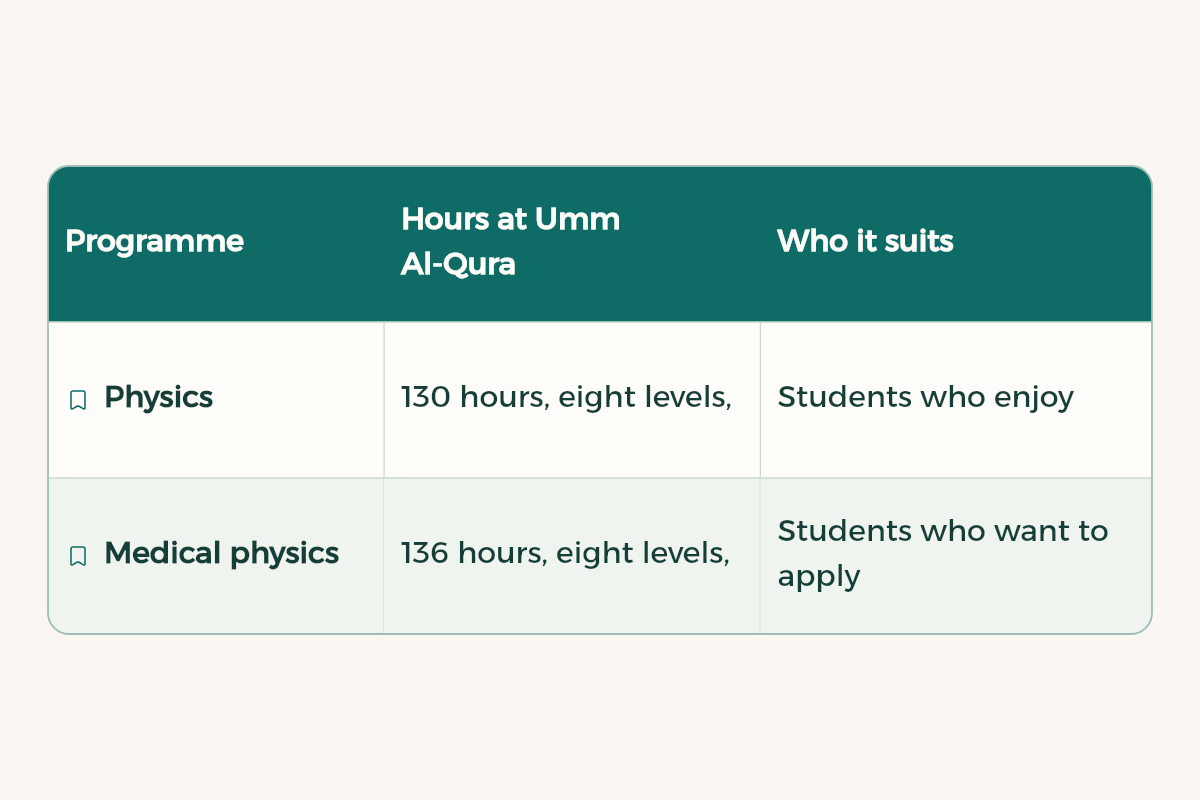
According to the Umm Al-Qura University physics department, the physics bachelor needs 130 credit hours over eight levels across four years. The department runs a second programme in medical physics with 136 credit hours, also over eight levels and four years. Its master's has three tracks: condensed matter physics, nuclear physics and medical physics. Other universities follow a similar shape with different hours and course names, and some add a preparatory or common first year.
| Programme | Hours at Umm Al-Qura | Who it suits |
|---|---|---|
| Physics | 130 hours, eight levels, four years | Students who enjoy theoretical and experimental physics and are thinking about teaching, research or industry |
| Medical physics | 136 hours, eight levels, four years | Students who want to apply physics in medical imaging, radiotherapy and radiation protection |
What do physics students study?
The plan usually starts with general physics, calculus and general chemistry, then moves into the core courses found in the King Saud University physics and astronomy handbook and elsewhere:
- Classical mechanics: motion, energy and momentum in precise mathematical language.
- Electromagnetism: electric and magnetic fields and waves.
- Thermodynamics and statistical physics: heat and energy from a molecular view.
- Quantum mechanics: how tiny particles behave, and for most students the biggest turning point in the plan.
- Nuclear and solid state physics: the basis of energy, electronics and materials applications.
- Mathematical methods and computational physics: differential equations, matrices and programming.
- Labs: in almost every level, and lab reports carry a real share of the grade.
Modern physics leans heavily on computers, so programming in Python or another scientific language helps with simulations and lab data. Start with learn programming from zero, and use Excel for students to plot results and work out errors.
Admission to physics
Most public universities admit science students on a weighted percentage of the secondary school grade, the General Aptitude Test and the Achievement Test, all run by the Education and Training Evaluation Commission. The weight of each part varies by university, so read the admission guide on your university portal before applying. At many universities you enter a common or preparatory first year and are then placed in a department by GPA and preference, so make your first-year GPA a priority. Details are in the preparatory year guide, and if teaching is in English, see STEP or IELTS.
Jobs for physics graduates
The Umm Al-Qura physics page says graduates can teach in universities and schools, work in health institutions, or work with radiation protection bodies. Skills you build during the degree open more paths:
- School teaching after the professional teaching licence.
- Health institutions, imaging and radiotherapy centres, the closest path for medical physics graduates.
- Radiation protection and measurement in organisations and plants that handle radioactive sources.
- Calibration, metrology and quality control labs in industry and energy.
- Data analysis and scientific programming for those who build their computing skills.
- Research and graduate study, then university teaching.
Hands-on experience makes a big difference at graduation. Look for summer training in a lab, hospital or plant, and read graduation project ideas to pick a project close to the field you want to work in.
The teaching licence for physics graduates
If you want to teach in government schools, you need the professional licence from the Education and Training Evaluation Commission, which is required for government teaching jobs according to the commission FAQ. It goes through two tests: the general educational test and the specialised test. If you pass only one, you retake just the other. The licence is valid for five years and then renewed. In the private sector, the employer sets its own conditions.
How to solve physics problems
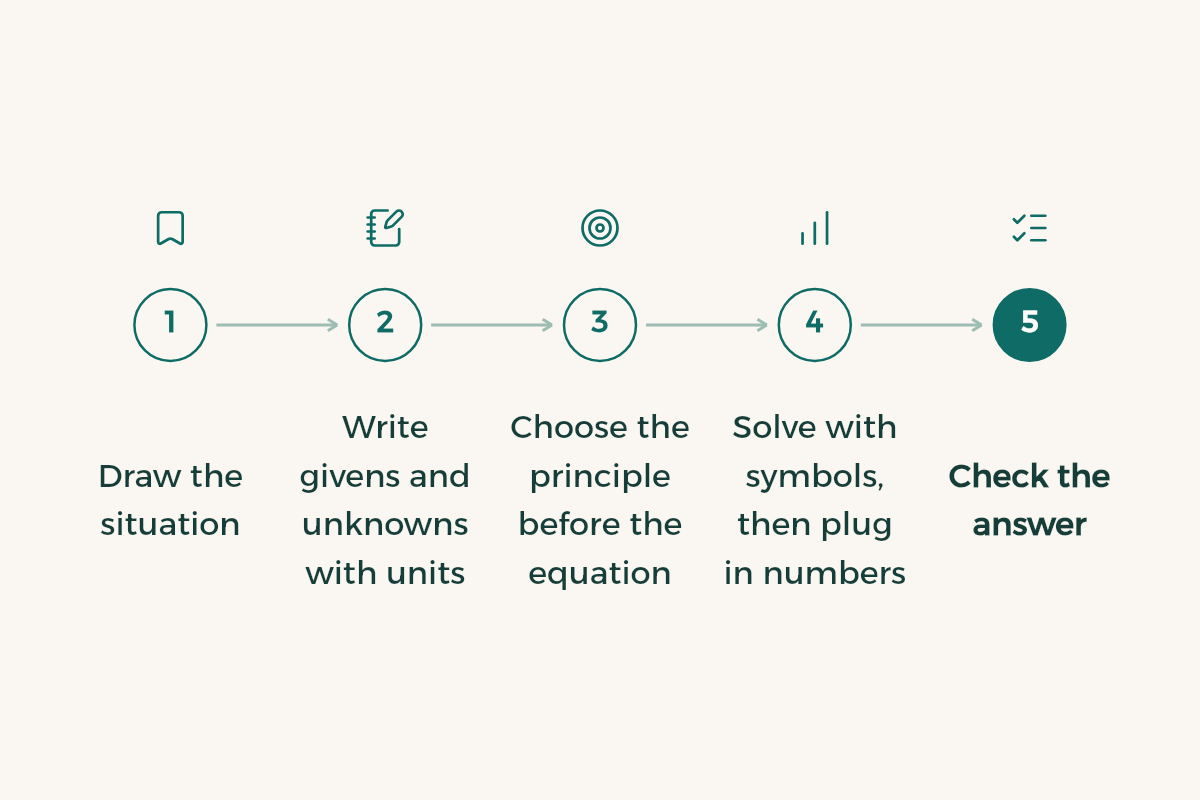
- Draw the situation
Before any equation, sketch the bodies and forces, the circuit or the field. Half of all mistakes come from misreading the situation.
- Write givens and unknowns with units
Convert everything to SI units before calculating.
- Choose the principle before the equation
Is this conservation of energy, momentum or Newton's law? Picking the principle is the skill your professor is testing.
- Solve with symbols, then plug in numbers
You see how the variables relate and catch mistakes easily.
- Check the answer
Check units and whether the size makes sense: a car at the speed of light means something went wrong.
Balance lectures, labs and reports with how to study effectively, and before exams use a final exams revision plan.
A prompt for lab reports
Lab reports take a long time, and an AI tool can help with structure and checking, never with inventing results. Write your measurements yourself, then use this prompt:
I am a physics student. This is my experiment: [name and aim]. These are my actual measurements: [table]. Do not change any number. Help me: order the report sections (aim, theory, apparatus, method, results, discussion), suggest how to calculate the relative error, and list three likely sources of error in this specific experiment. Warn me if any of my measurements look unreasonable.



To compare nearby majors, read mathematics major and chemistry major, and browse the majors section.