By the tiswa editorial team, from the official sources listed at the end of this guide. How we write our guides
The mathematics major in Saudi Arabia is often misunderstood. Many students expect high school maths with bigger numbers, then find in their second year that the answer is no longer a number but a proof written in precise language. This guide covers the years and credit hours, the courses as they appear in official university plans, general admission rules, the jobs open to graduates, the teaching licence for anyone heading into schools, and a study method that suits the subject.
How many years is a maths degree?
A bachelor in a Saudi college of science usually takes four years over eight levels, and some universities add a preparatory or common first year. The Umm Al-Qura University mathematics plan totals 137 credit hours: 21 hours of university requirements, 20 hours of college requirements and 96 hours of department requirements, so about 70% of the plan is pure mathematics. The King Saud University college of science guide sets 136 credit hours for the bachelor. Numbers change between plans and intakes, so always use your own cohort's plan from your department website.
Courses level by level
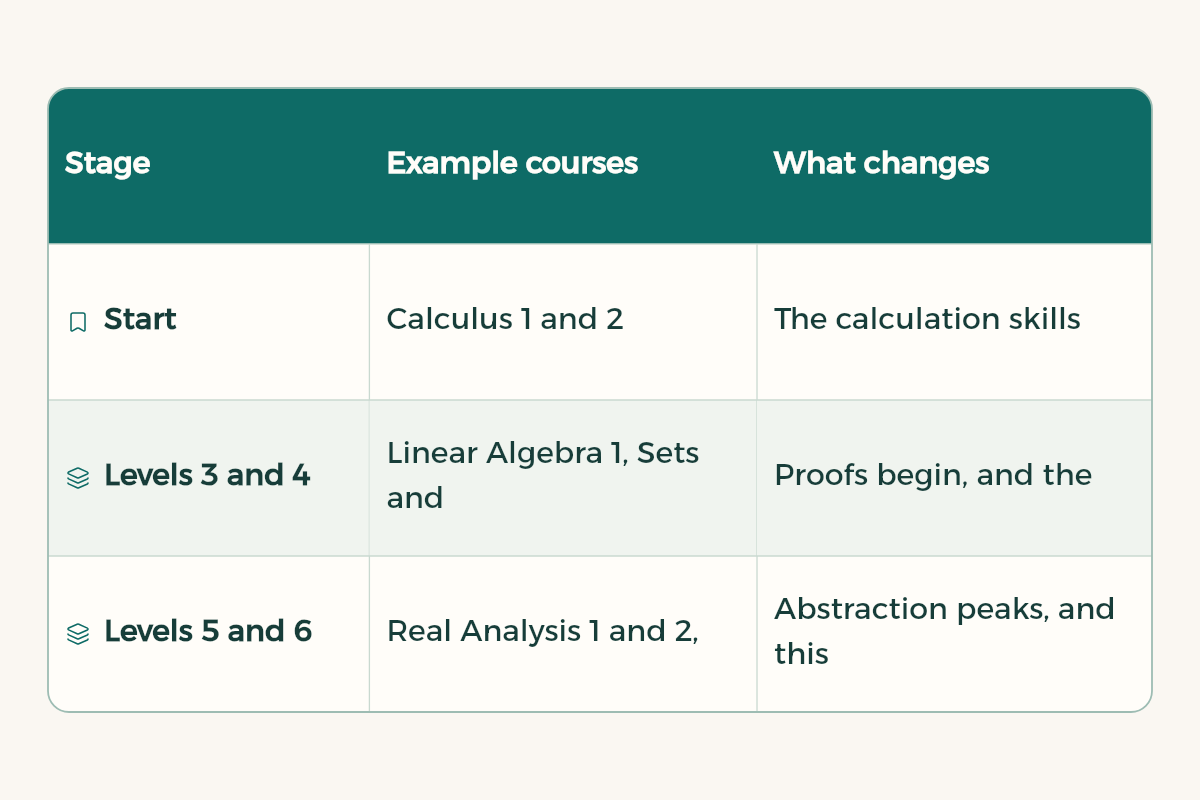
Here is a short table taken from the same Umm Al-Qura plan. It shows how the subject moves from calculation to abstraction:
| Stage | Example courses | What changes |
|---|---|---|
| Start | Calculus 1 and 2 | The calculation skills everything else builds on |
| Levels 3 and 4 | Linear Algebra 1, Sets and Algebraic Structures, Ordinary Differential Equations, Multivariable Calculus | Proofs begin, and the language of sets and functions appears |
| Levels 5 and 6 | Real Analysis 1 and 2, Group Theory, Probability Theory, Partial Differential Equations, Numerical Analysis | Abstraction peaks, and this is where most students stumble |
| Levels 7 and 8 | Linear Programming, Mathematical Statistics, General Topology, Complex Analysis, Measure and Integration, Financial Mathematics, Mathematical Software Packages, Research Project | Applications, narrower topics and a project you write yourself |
The plan mixes pure mathematics (analysis, algebra, topology), applied mathematics (numerical analysis, continuum and fluid mechanics) and statistics. The software packages course means you will write code, so starting programming early pays off. Begin with learn programming from zero.
Admission to a maths degree
Most public universities admit science students on a weighted percentage that combines the secondary school grade, the General Aptitude Test and the Achievement Test, both run by the Education and Training Evaluation Commission. The weight of each part and the minimum score vary by university and by year, so read the admission guide on your university portal. At some universities you enter a general science track or a preparatory year first and are then placed in a department by grade and preference, so your first-year GPA can decide whether you get the department you want. This stage is covered in the preparatory year guide.
Where do maths graduates work?
Mathematics is a foundation degree, and its value in the job market multiplies when you add an applied skill. The main paths:
- School teaching, which needs the professional teaching licence described below.
- Data analysis and statistics, especially if you master Python or R and spreadsheet tools. Start with Excel for students.
- Finance and insurance, where probability, financial mathematics and mathematical statistics help, and some paths need extra professional certificates.
- Research and graduate study, then university teaching.
- Programming and operations research, a natural extension of linear programming and numerical analysis.
The best thing you can do while studying is a summer or co-op placement where you apply what you learned to real data. Read summer training and co-op training, and build a student CV that shows your projects, not only your courses.
The teaching licence for maths graduates
If you want to teach, the professional licence from the Education and Training Evaluation Commission is required for government teaching jobs, according to the commission FAQ. In the private sector the employer sets its own conditions. The licence goes through two tests: the general educational test and the specialised test in your subject. If you fail one, you retake only that one. The licence is valid for five years and then renewed. Check the current rules and dates on the commission website before you register.
How to study university maths
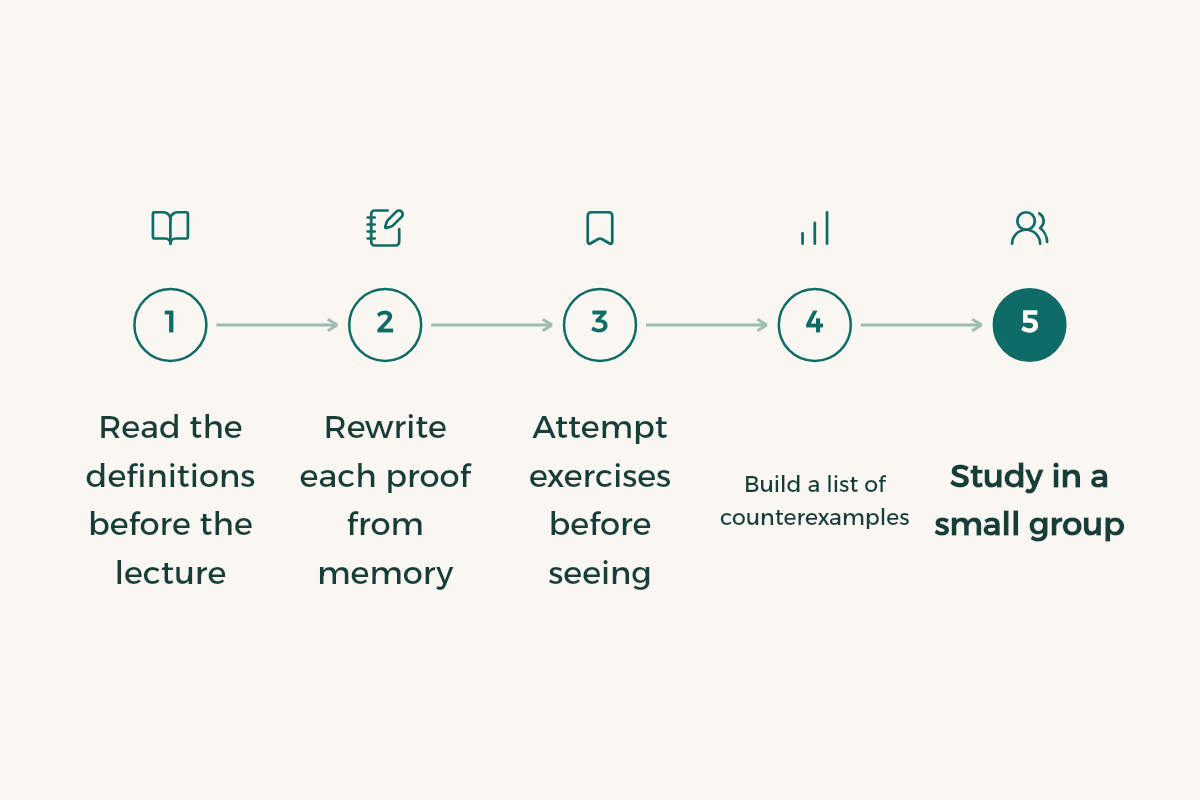
- Read the definitions before the lecture
Five minutes on the coming definitions and theorems turns the lecture into a review instead of a shock.
- Rewrite each proof from memory
After the lecture, close the notes and write the proof yourself. Where you stop is what you have not understood yet.
- Attempt exercises before seeing solutions
Give each exercise at least twenty minutes. Seeing the answer early gives you a false feeling of understanding.
- Build a list of counterexamples
For each theorem, write an example that shows why every condition is needed. The hard exam questions ask exactly this.
- Study in a small group
Explain a proof to a classmate. If you cannot explain it in your own words, you do not understand it yet.
To manage time across heavy courses, try the Pomodoro technique, and before exams follow a final exams revision plan.
A prompt that helps you understand a proof
AI tools sometimes get maths wrong with full confidence, so do not ask them to do your homework. Use them to unpack a proof you half understand, then check every step against your textbook.
I am a mathematics student taking [course name]. Here is a theorem and its proof from my textbook: [text]. Do not write a new proof. Explain each line: which definition or theorem it uses and why it is needed. Then give me a counterexample showing what happens if each condition of the theorem is removed. If you are unsure about a step, say so clearly.




If you are comparing science majors, read physics major and chemistry major, and browse every guide in the majors section.