By the tiswa editorial team, from the official sources listed at the end of this guide. How we write our guides
A GPA under 2 at the end of the preparatory year ends your enrolment at King Abdulaziz University, even if you passed every course.5 That line, from the university's admissions deanship, changes how most students see their first year. It is not a warm-up. It decides your major, and sometimes whether you stay.
What is the preparatory year?
Shared courses you take before entering your college: English, basic sciences and study skills. King Saud University now calls it the Common First Year, and its deanship has departments for Self-Development Skills, English Language Skills and Basic Sciences.2 Names differ between universities; the idea is the same, to arrive at your major ready to study in it.
How long is the foundation year in Saudi Arabia?
Usually two semesters. KAU describes a one-year programme over two semesters, with courses set by your track.5 KSU's admission guide says the length depends on the track, and the health track runs two semesters before competitive allocation.1 Check your own track in your university's guide before you plan around it.
Which tracks are there, and what do you study?
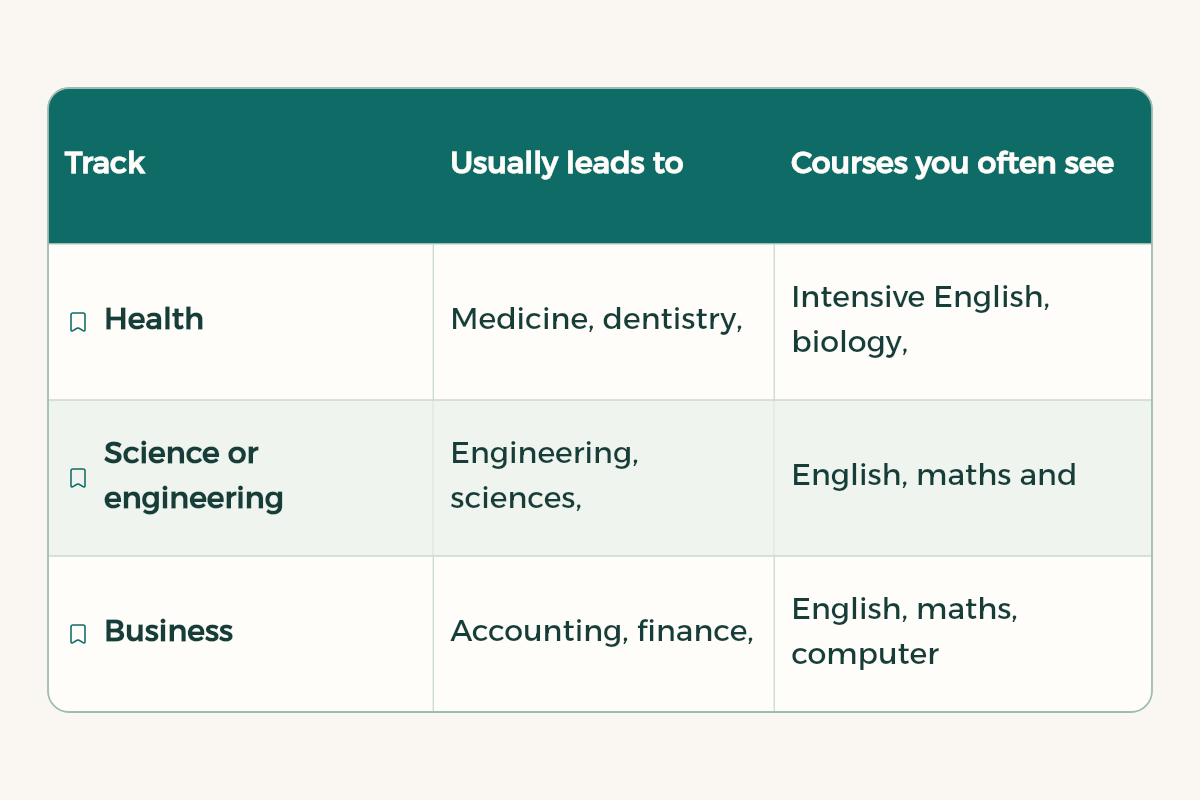
KSU splits the Common First Year into health, science and humanities tracks,8 and KAU into science, administrative and humanities.5 Courses differ by track even inside one department: at KSU, calculus and probability are for the science and engineering track, while humanities students take a separate statistics course.4
| Track | Leads to | Courses you often see |
|---|---|---|
| Health | Medicine, dentistry, pharmacy, applied medical sciences | Intensive English, biology, chemistry, physics |
| Science | Engineering, sciences, computing | English, calculus, physics, chemistry, programming |
| Administrative | Accounting, finance, marketing, management | English, maths, computer skills |
| Humanities | Arts, languages, education | English, statistics, learning skills |
KSU's University Skills course, CI 101, is 3 credit hours, with 45 contact hours across 15 topics.3 It does not sound like a major subject, but those three hours land in your GPA exactly like maths does.
Does the preparatory year count in your GPA?
Yes, and it is the basis for allocation. The health-track preparatory courses make up 33 credit hours of KSU's medical plan,6 so those grades stay in your cumulative GPA until graduation. A four-credit course moves your GPA more than a two-credit one, so split your time by credit hours, not by favourite subject. See GPA calculation and the credit hours system.
How are majors allocated after the preparatory year?
By GPA and seats. KAU says the college you enter after the preparatory year depends on your GPA and the places available in each college.5 Jouf University announced that allocation on one of its tracks went to the highest GPAs within the approved seats.7 KSU's health track starts with an admission weighting of 30% aptitude test, 40% achievement test and 30% high school plus an interview, then directs students to one of four health colleges by preference, GPA and capacity.6 Before you register:
- Read your university's allocation criteria in week one, not at the end of term.
- Ask the admissions deanship what GPAs earlier cohorts needed for each major.
- Rank preferences realistically; your last choice can become your major.
- On the health track, ranking medicine first does not guarantee a seat.
Is the preparatory year hard?
The courses are not the hardest at university; the competition is. Students used to top marks in school find that everyone else on the health track had them too. And the way you study changes: nobody reminds you about assignments, lecturers move faster, and most of the work happens outside the lecture hall.
How should you start your first semester?
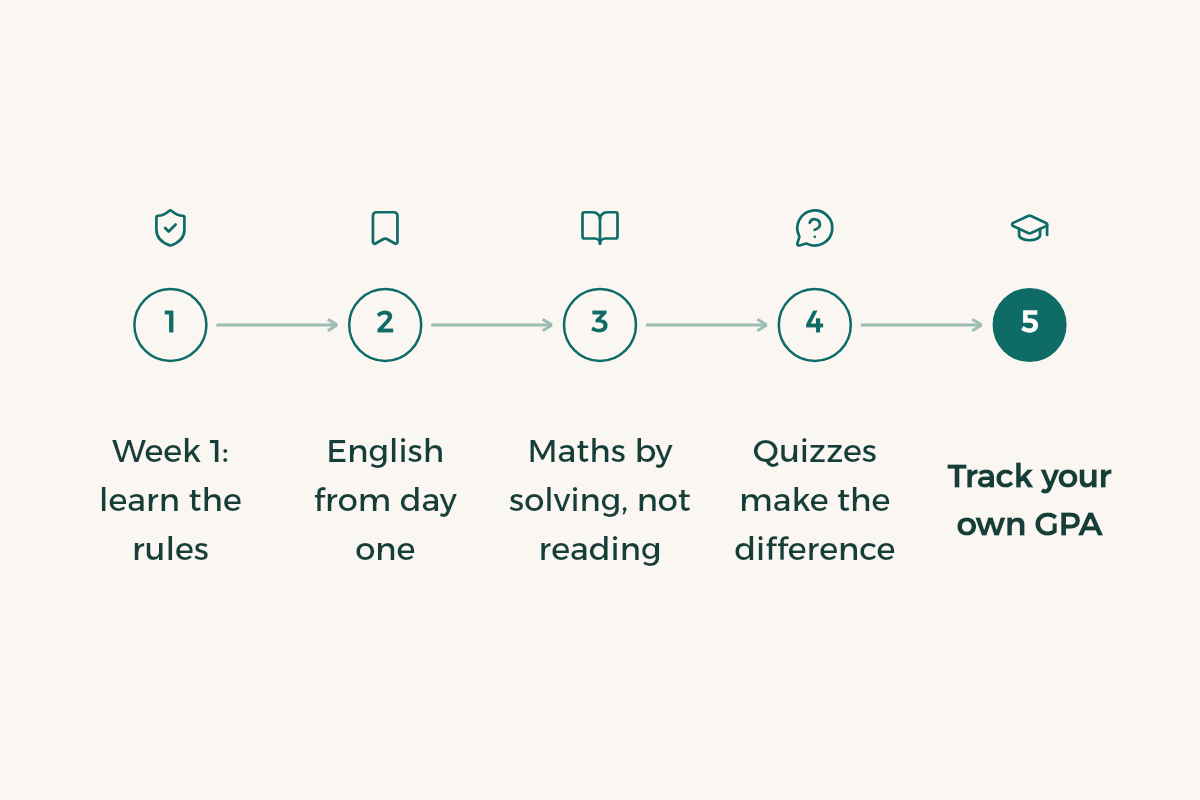
- Read the allocation rules and grade breakdowns
From your university's guide, then log in to the learning system using the Blackboard guide.
- Give English a daily slot
Short and fixed, for vocabulary and listening. Ideas in learn English for university.
- Solve maths problems the day of the lecture
And mix problem types when you review.
- Never miss a quiz
The marks are small but they add up.
- Estimate your GPA after every exam
So you know where you stand for your target major before term ends.
Which skills are not taught but still tested?
Moving from school to university changes how you study before it changes what you study. These separate two students with the same school grades:
- Time management: put every deadline and exam into one calendar in week one; time management apps help.
- Emailing lecturers: a short message from your university address with your name, student ID, section and one clear question.
- Studying after every lecture, not only before exams.
- Asking for help early from your academic advisor and support centres, which exist for first-year students in particular.
Preparatory year timetables are full of gaps. Two hours between a morning lecture and an afternoon lab vanish in the cafeteria unless you pick a fixed spot in the library and use them for that day's problems. Add those gaps up in week one and they come close to a full study day.
Is the health track different?
In two ways. Competition is tighter, since students compete for medicine, dentistry and pharmacy at once, and at KSU they sit a readiness assessment at the end of the year before being directed to the health colleges.6 And at many universities the science textbooks are in English, so weak English shows up in biology and chemistry too. If you are weighing medicine, the years and admission rules are in studying medicine in Saudi Arabia.
Which mistakes cost students their major?
- Treating the year as a warm-up with no weight.
- Putting off English because it is "basic".
- Missing classes; many universities bar you from the final once absences pass the limit in their regulations.
- Cramming cumulative subjects like maths the night before.
- Relying on other people's summaries.
- Counting on the second semester to fix everything, at a university that ends enrolment when the year's GPA is under 2.
What if you do not get the major you want?
Ask the admissions and registration deanship about internal transfer and its conditions, and keep raising your GPA, since most transfer requests depend on it. Two large universities' rules are in KSU internal transfer and KAU internal transfer, and if your GPA dropped, start with how to raise your GPA.
I am a preparatory year student on the [track] track with a current GPA of [GPA] out of [5 or 4].
I am considering these majors: [major 1, major 2, major 3].
Compare them in a table: what the study is like, the hardest expected courses, the skills needed, and job areas in Saudi Arabia.
Then ask me five questions about my interests to help me rank them. Do not invent admission GPAs; tell me where to find them officially.
You will need a device for lectures and some study software; most of it is free with your university email, as listed in free software for students.