By the tiswa editorial team, from the official sources listed at the end of this guide. How we write our guides
STEP vs IELTS starts with one question: who will read your score? STEP comes from Saudi Arabia's Education and Training Evaluation Commission (ETEC, home of Qiyas) and is used by local bodies. IELTS is an international test accepted by universities and organisations abroad and many at home. Pick the wrong one and you pay and study twice.
Side by side
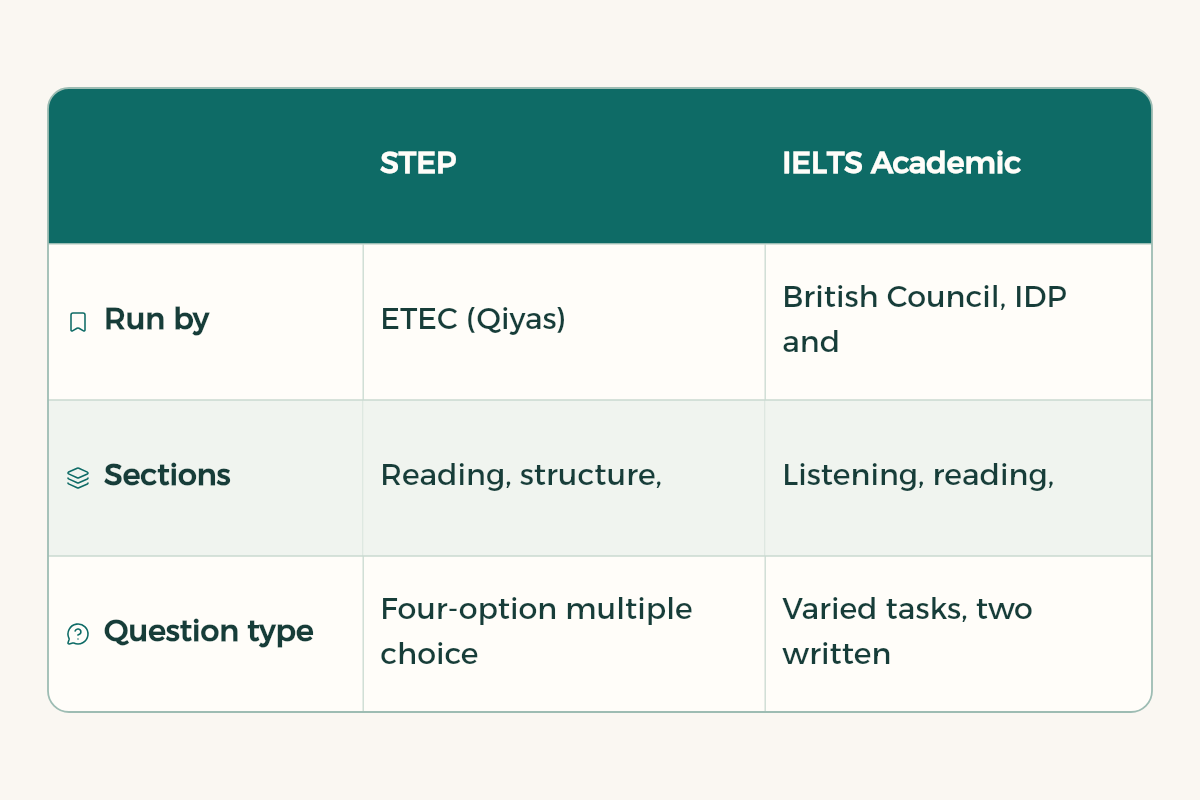
| STEP | IELTS Academic | |
|---|---|---|
| Run by | ETEC (Qiyas) | British Council, IDP and Cambridge |
| Sections | Reading, structure, listening, compositional analysis | Listening, reading, writing, speaking |
| Question type | Four-option multiple choice | Varied tasks, two written pieces, a live speaking interview |
| Score | Out of 100 | Band 0 to 9 per skill plus overall |
| Writing and speaking | No free writing or speaking section | Two separate sections |
| Clearest use | Saudi bodies and universities that ask for it | International universities, scholarships and many Saudi bodies |
STEP: what you need to know
According to the ETEC test page, the Standardized Test of English Proficiency has 100 scored questions plus trial questions that do not count, all four-option multiple choice. Section weights:
| Section | Weight |
|---|---|
| Reading comprehension | 40% |
| Structure (grammar) | 30% |
| Listening comprehension | 20% |
| Compositional analysis | 10% |
Reading and grammar together are 70% of the score, which is where most students win or lose marks. Registration, dates and fees all run through ETEC e-services; check there before booking, since it is the only reliable source for the current fee.
IELTS: what you need to know
The British Council test format page sets out four sections totalling 2 hours 45 minutes. Listening, Reading and Writing run back to back; Speaking can be the same day or up to a week before or after, depending on the centre.
| Section | Time | Content |
|---|---|---|
| Listening | About 30 minutes | 40 questions |
| Reading | 60 minutes | 40 questions |
| Writing | 60 minutes | 2 tasks |
| Speaking | 11 to 14 minutes | 3 parts with an examiner |
In Saudi Arabia the British Council runs the test at its centres, and its official registration page lists IELTS Academic and General Training at SAR 1,636, with a separately priced one-skill retake. Computer-delivered results usually arrive within two days, according to the British Council.
How to choose
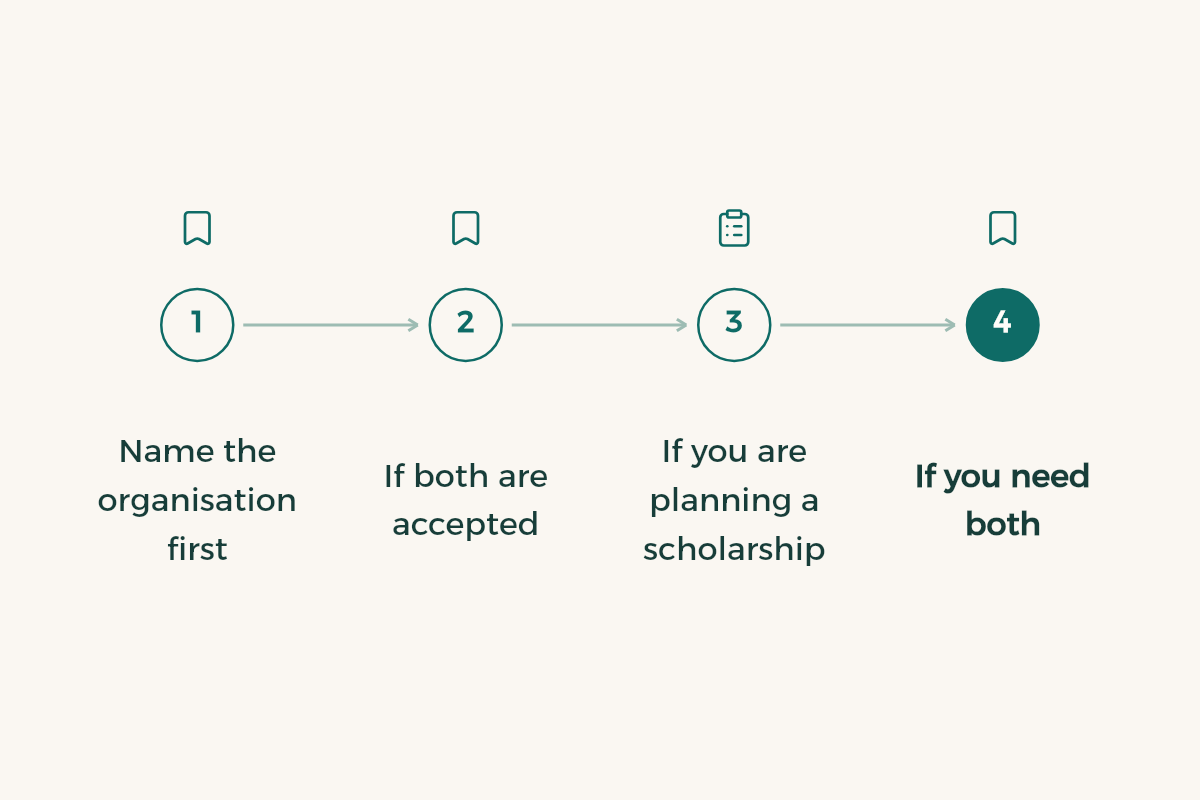
- Name the organisation first
A university, a master's programme, an employer or a scholarship. Open its official requirements and look for the test name and the score.
- If both are accepted
STEP is usually cheaper and has no writing or speaking, so it suits students with strong grammar and reading. IELTS takes longer to prepare for but is accepted in more places.
- If you are planning a scholarship
The Custodian of the Two Holy Mosques Scholarship Program conditions quote IELTS or equivalent, for example 5.5 for a bachelor's preparatory year. Details are in scholarships for Saudi students.
- If you need both
Start with IELTS. Preparing for writing and speaking lifts your reading and grammar; the reverse is not true.
A six-week study plan
| Week | STEP | IELTS |
|---|---|---|
| 1 | Full practice test to find your baseline | Full timed practice test |
| 2 | Grammar: tenses, linking words, pronouns | Listening: practise spelling answers correctly |
| 3 | Reading: one timed passage a day | Reading: managing time across three passages |
| 4 | Listening and compositional analysis | Writing: one task a day, then review |
| 5 | Practice tests and error review | Speaking: record yourself for three minutes daily |
| 6 | Final practice test and rest | Full practice test and weak-spot review |
You are an IELTS Academic writing examiner. Assess the text below against Task Response, Coherence and Cohesion, Lexical Resource, and Grammatical Range and Accuracy. For each criterion give two specific comments with an example from my text, then rewrite my two weakest sentences. Do not give a numeric band.

[Paste your essay here]
This gives you things to fix, but it does not replace a human marker or an official practice test, so do not base your score expectations on it.
After the test
Add the score to the languages line of your CV as shown in CV for students with no experience. It makes a difference in co-op training applications at English-speaking employers.
Mistakes that cost students marks
- Booking before confirming the test name and score your target organisation needs. Read the official requirements first.
- STEP: neglecting grammar because it feels dull, when it is 30% of the score and improves fastest with practice.
- STEP: spending too long on one reading passage. Skip the hard question and come back.
- IELTS: writing far more than needed at the expense of checking, or less than the task's minimum word count.
- IELTS: memorising speaking answers. Examiners notice; practise talking about your real experiences instead.
- Practising without real timing. Untimed mocks give false confidence.
How to handle the reading section in both tests
Reading is where most time is lost: students read the whole passage carefully, then find the questions ask about small details. This method works for STEP and IELTS:
- Read the questions first
Get a quick idea of what is asked and mark key words in each question, such as names and numbers.
- Skim the passage
Read only the first sentence of each paragraph so you know where each topic is.
- Go back to the right paragraph
For each question, go to the paragraph where the answer should be and read it closely.
- Do not get stuck on one question
If a question takes too long, pick the closest answer, mark it and return if time is left.
Test day
- Check your confirmation message the day before: time, place and required documents, and bring the same ID you registered with.
- Arrive early: traffic or a hard-to-find room drains your focus before you start.
- Sleep well the night before: late cramming adds little to a language test, and tiredness costs you in listening.
- Eat something light before the test, especially if it is a long one.
If your goal is a scholarship, see the language conditions in the scholarships guide. For long-term progress, read learning English for university.