
By the tiswa editorial team, from the official sources listed at the end of this guide. How we write our guides
Coop training in Saudi Arabia is the term you spend inside a real organisation as part of your study plan, and many students are hired by the same employer afterwards. The Ministry of Human Resources and Social Development (HRSD) regulates it through a dedicated student training decision and a procedural guide. Know what it says before you start applying.
What co-op training is
The HRSD procedural guide for the student training decision defines it as training within an education system that combines regular study with structured work experience linked to the curriculum, at an organisation, for a set period. A trainee is a student nominated for practical training by a university, college or institute, at diploma, bachelor or higher level.
What employers must do
- Every organisation with 50 or more employees must train co-op students equal to at least 2% of its total workforce each year, counting Saudis and non-Saudis.
- It must have a training plan and publish its places and requirements so qualified students can find them.
- It selects trainees competitively on criteria such as GPA, skills and career interests, and must publish its selection criteria if it turns down a student who meets its stated requirements.
- Training is on the job, inside the organisation, supervised by a specialist employee, and in or close to your field of study.
- You cannot be charged any training costs, even if you stop early.
- It evaluates you after each stage and, at the end, issues a completion certificate stating the profession, skills, duration and overall grade.
The training contract: what to check before signing
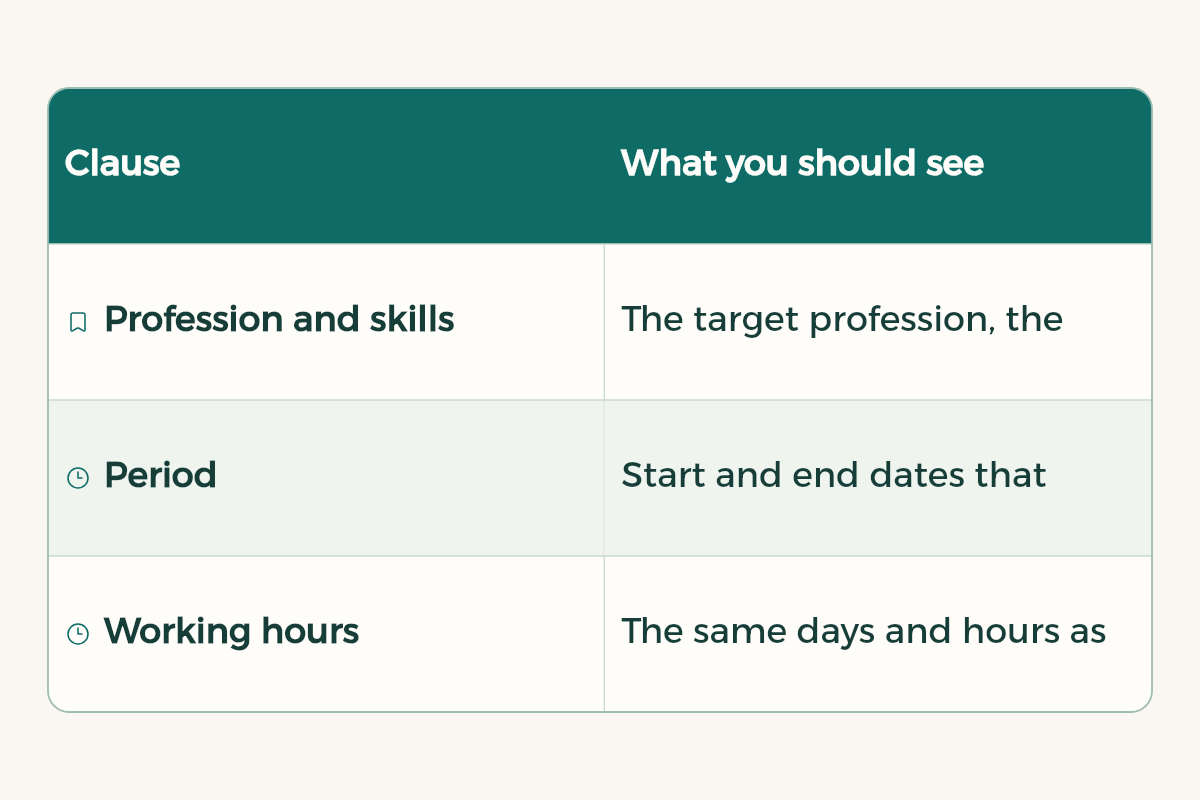
The decision requires a written, documented co-op contract for a fixed period. The model contract attached to the guide covers these clauses; make sure each is filled in:
| Clause | What you should see |
|---|---|
| Profession and skills | The target profession, the skills you will gain and the training location |
| Period | Start and end dates that fit your study plan |
| Working hours | The same days and hours as employees in the same profession, plus the weekly rest day |
| Allowance | Optional: once an amount is written in, it is binding and paid at the end of each month |
| Bank account | Your IBAN, if there is an allowance |
Is co-op training paid?
Not automatically. You are entitled to an allowance if you agree one with the employer and it is written into the contract, and the guide notes that employers can use Human Resources Development Fund support programmes for this. Ask about it clearly and politely before you sign rather than assuming.
Labour Law provisions on annual leave, public holidays, maximum working hours, daily and weekly rest, safety and work injuries apply to you as a trainee. The employer does not have to register you with social insurance (GOSI).
A search plan that works
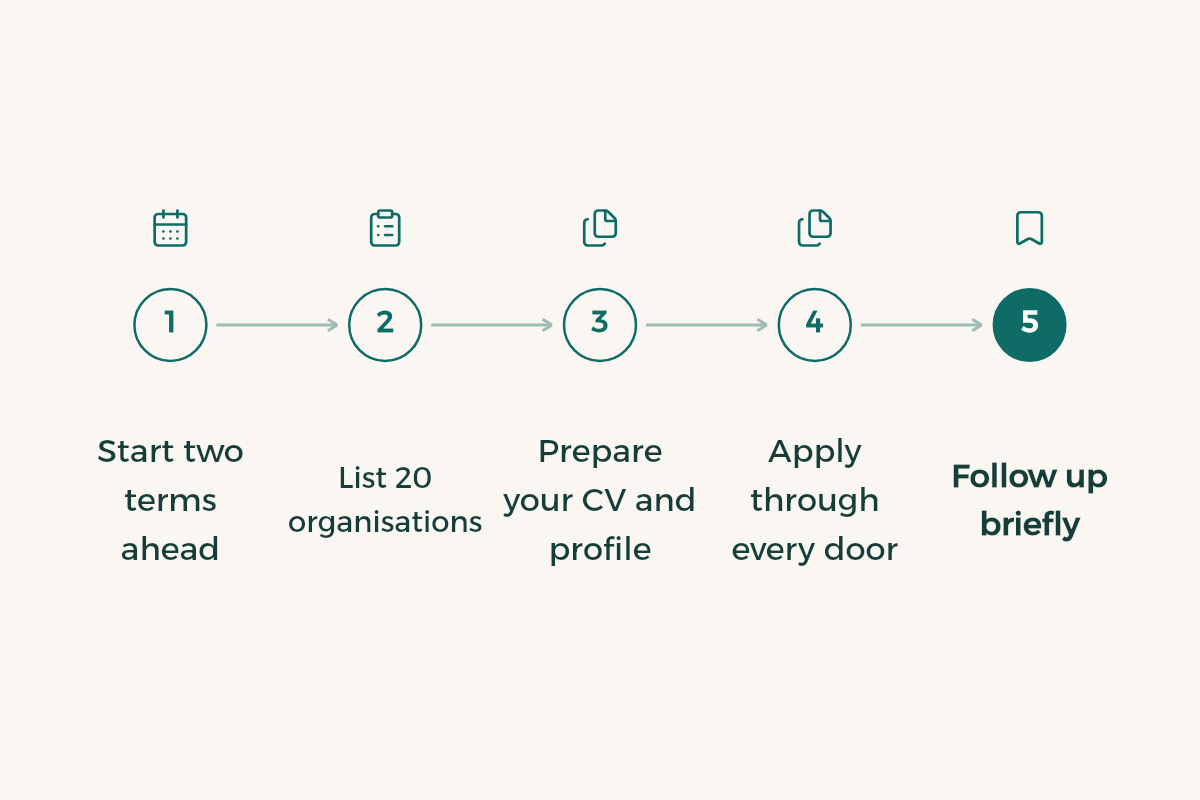
- Start two terms ahead
Large employers open applications early and close when places fill. Ask your college when your co-op term is and which letter it issues to employers.
- List 20 organisations
Half well-known names in your field, half mid-sized firms. Any organisation with 50 or more staff has a training quota, so there are more places than the famous names suggest.
- Prepare your CV and profile
A one-page CV using the template in CV for students with no experience, and a tidy profile following LinkedIn for students.
- Apply through every door
The company careers site, its LinkedIn page, the national platform Jadarat, and your college co-op office.
- Follow up briefly
Two weeks after applying, send the training coordinator or HR contact a three-line message with your major and required training period.
- Prepare for the interview
Most employers interview co-op candidates. Common questions and how to answer them are in job interview questions for students.
Dear [Name],
I am [your name], a [major] student at [University]. I applied for your co-op training programme on [date]. My study plan requires [duration] of training starting in [month], and I can provide my university letter or any document you need.
Thank you.
During the placement: turning it into a job offer
- Write down what you did and learned each week. Those notes become your university report and your updated CV.
- Ask for real tasks. The guide itself requires employers to let trainees carry out actual work.
- Keep your attendance clean and tell your supervisor before any absence, following company policy.
- Do not switch organisation or track without approval from both the employer and your university.
- Before your last week, ask your supervisor for honest feedback and about hiring plans.




The co-op report: a structure that satisfies your college
Most colleges ask for a report at the end, and it counts toward the course grade. Keep weekly notes from day one and the report becomes an edit, not a blank page. A structure that suits most departments; your college guide has the final say:
- The organisation, your department and where it sits in the structure.
- Your tasks week by week, with the tools and software you used.
- One main project in detail: the problem, what you did, the result.
- Links to your courses: where you applied what you studied, and what you needed but had not studied.
- Skills gained, and recommendations for future trainees and the department.
The same points later become CV lines and interview answers, so write them with numbers and results.
The weekly report: a simple template that saves your final weeks
Most universities ask for weekly reports or a regular summary, then a final report. Students who write the weekly one consistently find the final report almost done. Each week, write five short paragraphs:
- Tasks
What you worked on this week, specifically, not in general.
- What you learned
A new skill, program or procedure, and how you used it.
- A problem you faced
How you handled it, and who helped.
- Link to your courses
Which course showed up in your work, and how.
- Next week's plan
One task or skill to focus on.
A good tasks sentence looks like: "Entered 120 invoices into the company system, reconciled them against the account statement, and found three discrepancies that I reported to my supervisor." That sentence works later in the final report and on your CV.
Working with your company supervisor
- In week one, ask for a short meeting to agree on what is expected of you and how you will be assessed.
- Send a three-line weekly summary even if nobody asks. It shows you are serious.
- Ask when you do not understand, but group your questions and try to find the answer first.
- Before the end, ask for honest feedback, and whether you may list them as a reference.
Turn the placement into CV lines
Right after the placement, write three achievements with numbers where you can, add them to your CV using the student CV guide, and update your LinkedIn profile the same week, because details fade fast.