By the tiswa editorial team, from the official sources listed at the end of this guide. How we write our guides
A business student sits in front of two interviewers, one from HR and one from sales. They ask about the graduation project. The student starts with the semester and the names of five teammates, drifts into survey details, and five minutes later nobody knows what the student personally did. This is an invented example, but it is a known pattern. Interviewers for training placements are not looking for a great project. They want a student who can say what they did and why.
What do interviewers look for in a co-op interview?
NACE defines an internship as experiential learning that connects classroom knowledge to a professional workplace, and says it should have a position description, learning objectives and direct supervision.1 So the employer in front of you is judging whether you will learn and whether you will be useful, not whether you are fully ready. The hidden question behind each question: if we put you on the team, can you understand the task and ask for help in time?
Three kinds of question come up again and again: about you (why this major, why this employer), about a project or course (what did you do), and situational (what if your task is blocked). For general answers see the guide to interview questions; here we focus on the project.
How do you explain a university project in two minutes?
- The problem in one sentence
“We had to find why orders were late at a small online shop.” Start with the question, not the semester or the course name.
- Your own role
“I collected the data and analysed delivery times.” The “I” sentence is what the interviewer wants, so drop “we did” when you mean yourself.
- One decision and its reason
“I used the median instead of the average because a few extreme values skewed it.” One small decision with a reason beats five tasks with none.
- What you learned or would change
“If I did it again I would clean the data before analysing.” Honesty here persuades more than a perfect result.
- Rehearse aloud
Set a two-minute timer and record yourself. Reading in your head feels ready; speaking shows the gaps.

The example above is purely illustrative, so replace its topic with yours. Never quote figures you did not measure or results you did not get.
Prepare two versions: two minutes for the open question and ten seconds for a quick introduction: “I worked on a project about X, and my part was Y.” You will need the short one when the interviewer cuts in, and many do.
What are the common co-op interview questions?
| Question | What they mean | An idea for the answer |
|---|---|---|
| Tell us about yourself | Can you speak clearly and briefly? | Major, one project, what you want from the placement |
| Why this employer? | Did you read about it? | One fact from its official page tied to a course you took |
| Tell us about your project | What was your role? | The four sentences above |
| What if you do not understand a task? | Will you ask at the right time? | Try for half an hour, then ask a specific question |
| What is your weakness? | Do you know yourself? | A real, small one and what you do about it |
| When can you start? | Does your schedule fit? | Your term dates as you know them, and what your department says about credit |
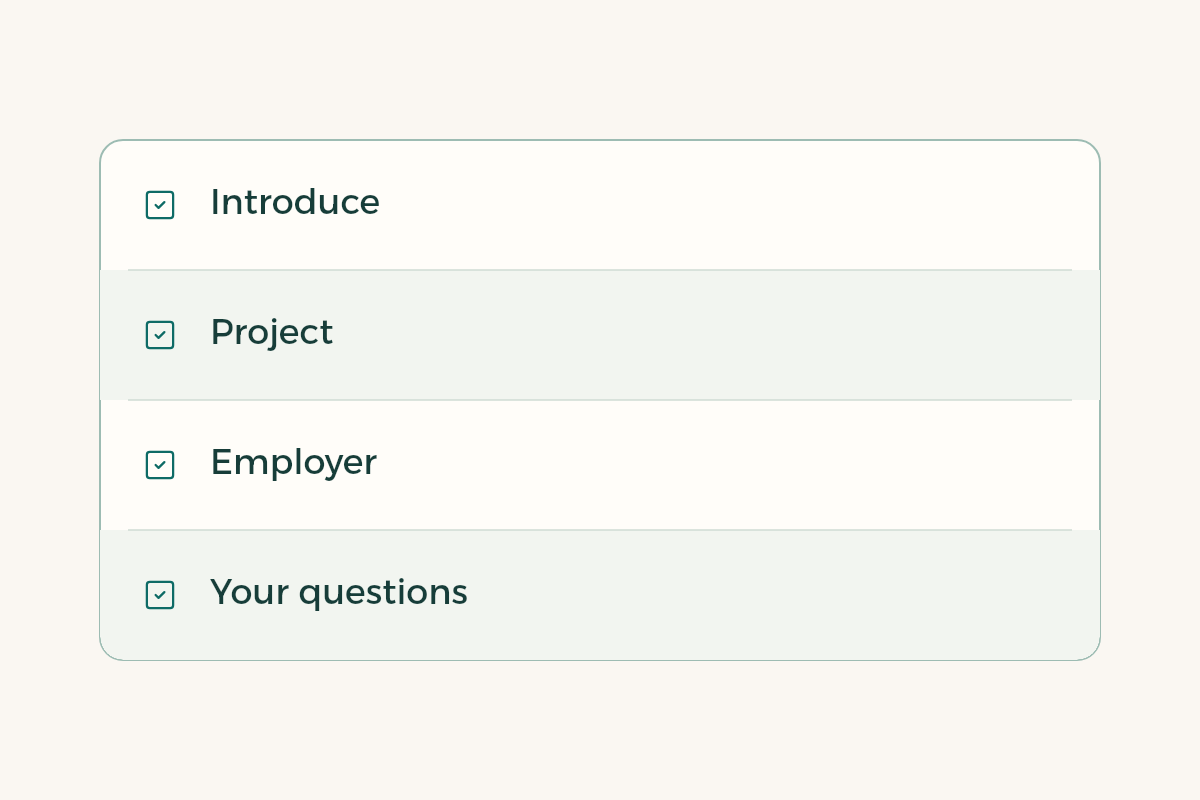
The table is a rough guide for your thinking, since every employer asks in its own way. The shared rule: answer first, add an example, and stop when the answer is done.
Should you research the employer before the interview?
Yes, from an official source. The employer’s careers page tells you what you need: the type of organisation, the kinds of training, what the application asks for. The Advanced Electronics Company careers page, for example, shows a form asking for university, major, graduation date and GPA, and offers training either full time or part time, lasting from two to seven months.3 Do not invent interview stages and do not rely on an unsourced post. Write three facts from the official page and one question about each.
What should you ask the interviewer at the end?
An interview is an assessment in both directions, and your question shows seriousness. Ask about what good training looks like: what tasks to expect, who supervises and gives feedback, and how the placement is assessed.1 Avoid asking about pay or leave in a first interview unless the interviewer raises it. Ask two questions, not five.
How do you handle an online interview?
Sit down ten minutes early, test the sound and camera, and silence notifications. Keep a small note of your four sentences in front of you, but do not read from it. If the connection drops, rejoin at once and send a short apology; it happens, and a serious panel will not hold it against you.
What do you do after the interview?
Send a short thank-you the same day. Career writing guides say a thank-you letter should show appreciation for the employer’s time, restate your interest in the position and remind them who you are.2 If the reply is slow, read the guide to following up on a co-op application, and for your rights in the contract see co-op training in Saudi Arabia.
Right after the interview, write down what you were asked, what you answered and what you wish you had said. You will need that page before the next interview, and it is the best review you can give yourself.