By the tiswa editorial team, from the official sources listed at the end of this guide. How we write our guides
An interviewer at a transport company, an invented one for this example, asked a student a single question: “A shipment arrives short. What do you do?” It was not about the shipment. The interviewer wanted to see whether the student began by checking or by blaming, and whether they knew whom to tell. The student answered from an inventory course: compare the quantity with the receiving document first. That is what a logistics interview is: a small situation and a question about how you think.
What do interviewers look for in a logistics internship interview?
NACE defines an internship as experiential learning that connects classroom knowledge to a professional workplace, with learning objectives and direct supervision.2 So the interviewer weighs two things: will you learn, and can you help the team with early tasks. Those early tasks are usually modest: updating a spreadsheet, matching documents and tracking shipment status.
The CSCMP glossary defines logistics management as the part of supply chain management that plans and controls the forward and reverse movement and storage of goods, services and information from origin to consumption.1 Build your preparation on that sentence. Every question will touch movement, storage or information.
What are the common logistics internship interview questions?
Wording differs from one company to another, but the patterns repeat. The table sums them up with what the interviewer means and an idea for an answer. Do not memorise sentences. Memorise examples.
| Question | What they mean | An idea for the answer |
|---|---|---|
| Why logistics? | Did you choose the field on purpose? | A course or project that pulled you in, and what you enjoyed |
| A shipment arrives short. What do you do? | Do you check before acting? | Compare with the receiving document, record the gap, tell the supervisor |
| How do you organise tasks when they pile up? | Can you set priorities? | A list of deadlines and owners, starting with the nearest deadline |
| Tell us about teamwork | What was your part? | A university project and your specific role in it |
| Which spreadsheet tools do you use? | Do you know the basics? | Name only what you used in a course or project |
| What do you know about our company? | Did you read about us? | One fact from its official page tied to a course you took |

How do you turn a university course into an interview answer?
- Pick one course or project
Inventory, transport, procurement or the graduation project. One is enough.
- State the situation in a sentence
“In the inventory project our item list kept repeating errors.”
- Name your role
“I checked the quantities against the source.” Say “I” when you mean yourself.
- Give one decision and its reason
“I grouped items by how fast they sell, since slow ones take more shelf space.”
- Say what you learned
“Next time I would standardise item names first, because time went on duplicate entries.”
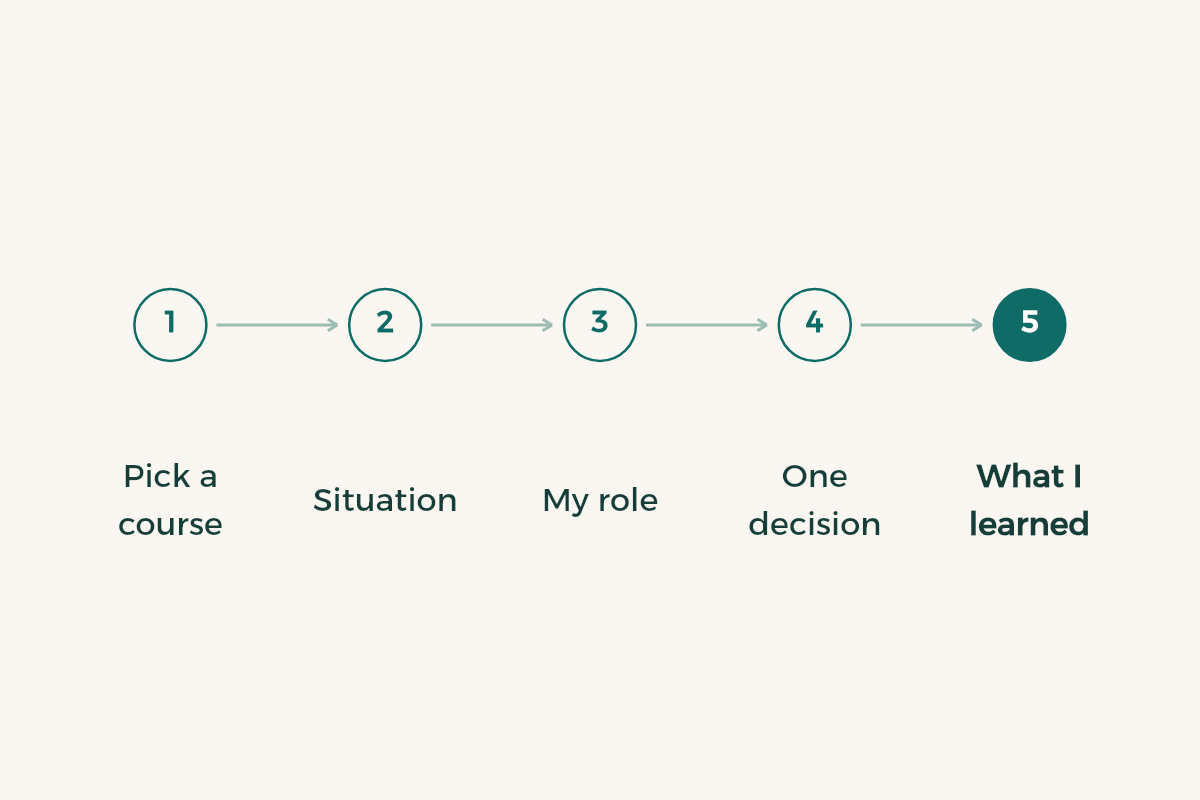
This example is invented, so replace its subject with your own. Do not state numbers or results you did not get. The interviewer may ask for details, and you cannot explain what you did not do.
For a method to explain projects in two minutes read how to explain your project in a co-op interview, and for general questions see job interview questions.
What do you say if you have no experience in the field?
Say it directly, then move to what you know. “I have not worked in a warehouse, but I studied inventory management and analysed an item list in a project.” Most interviewers accept that sentence because it is honest and has evidence. Claimed experience collapses at the first detailed question.
It also helps to prepare one story about a mistake: a late project submission, a lost file or a task you misunderstood. Describe the mistake in a sentence, then what you fixed, then what you changed in your habits.
Which Excel formulas make a good practice sheet?
Many interviewers ask about spreadsheets because early placement tasks rest on them: item lists, shipment tables and weekly reports. You do not need every function. Sorting, filtering, conditional sums and a lookup are enough, plus one example where you used one of them in a course or project.
If you find a ready-made warehouse template online, try it for learning, but do not present it as your own work. Open its columns and ask why they were laid out that way. An interviewer may ask you to change a formula in front of them, and that is where someone who understood the sheet differs from someone who copied it. Practise on a small example a week before the interview.
How do you research the company before the interview?
Open the company’s official careers page and do not rely on a social media post. Note what it does: transport, storage, distribution or freight. Then read the training titles in its postings and take two or three words to echo in your answers. It also helps to have your LinkedIn profile in order, because an interviewer may open it. LinkedIn’s Help page says a good profile is complete and representative of you.3 The guide to a profile with no experience has a table you can run through in ten minutes.
What should you ask the interviewer at the end?
Ask about the daily shape of the placement: who supervises you, which tasks you start with and how your performance is assessed. Skip pay and leave in a first interview unless the interviewer raises them. After the interview send a short thank-you the same day, and if the reply is slow read following up on a co-op application.
Tools for slides and CVs may need a subscription, so compare offers first in the student discount index.