By the tiswa editorial team, from the official sources listed at the end of this guide. How we write our guides
Picture a political science student sitting before a panel of three who ask, “How would you evaluate a government programme?” She began explaining theories from her course, then stopped and said, “I have not evaluated a real programme, but in my analysis course I compared three indicators for a hypothetical one.” Suppose the panel relaxes more at that answer than at all the theory. An interview in this field tests how you think more than what you memorised, and honesty draws you closer rather than pushing you away.
Which public policy internship interview questions should you expect?
Questions vary by host and there is no fixed script. Still, these six recur in different wording across internship interviews, and they suit the field because they expose your ability to analyse and write. The US employer association NACE lists critical thinking, communication and teamwork among its career readiness competencies, and interview questions usually probe those three.1
| Question | What it tests | Example to prepare from university |
|---|---|---|
| Why public policy? | Real motivation | A course or issue that made you care |
| Analyse a public problem you know | Order of thinking | A term paper on transport, education or health |
| What do you do when data is missing? | Honesty and caution | An exercise with incomplete data |
| How would you brief a busy official? | Brevity | A one-page paper you wrote |
| Tell us about teamwork | Collaboration | A course project with your role stated |
| What do you not know about our work? | Humility and curiosity | A real question about the host |

These are examples of the kinds of question, not scripts anyone has memorised. That is why we say: prepare examples, not sentences.
How do you answer “analyse a public problem”?
- Name the problem in one sentence
“Morning parking around campus.” A problem that is too big wastes your minutes.
- Say who is affected and who decides
Students and nearby residents are affected; the university and the municipality decide.
- Give one piece of evidence and its limits
What you observed or a published figure, and why it cannot stand alone.
- Offer two options, not one
For instance more parking or an internal shuttle. Compare them on a stated measure such as cost or effect.
- End with what you would do next
“Before recommending either, I would look for actual congestion data.”
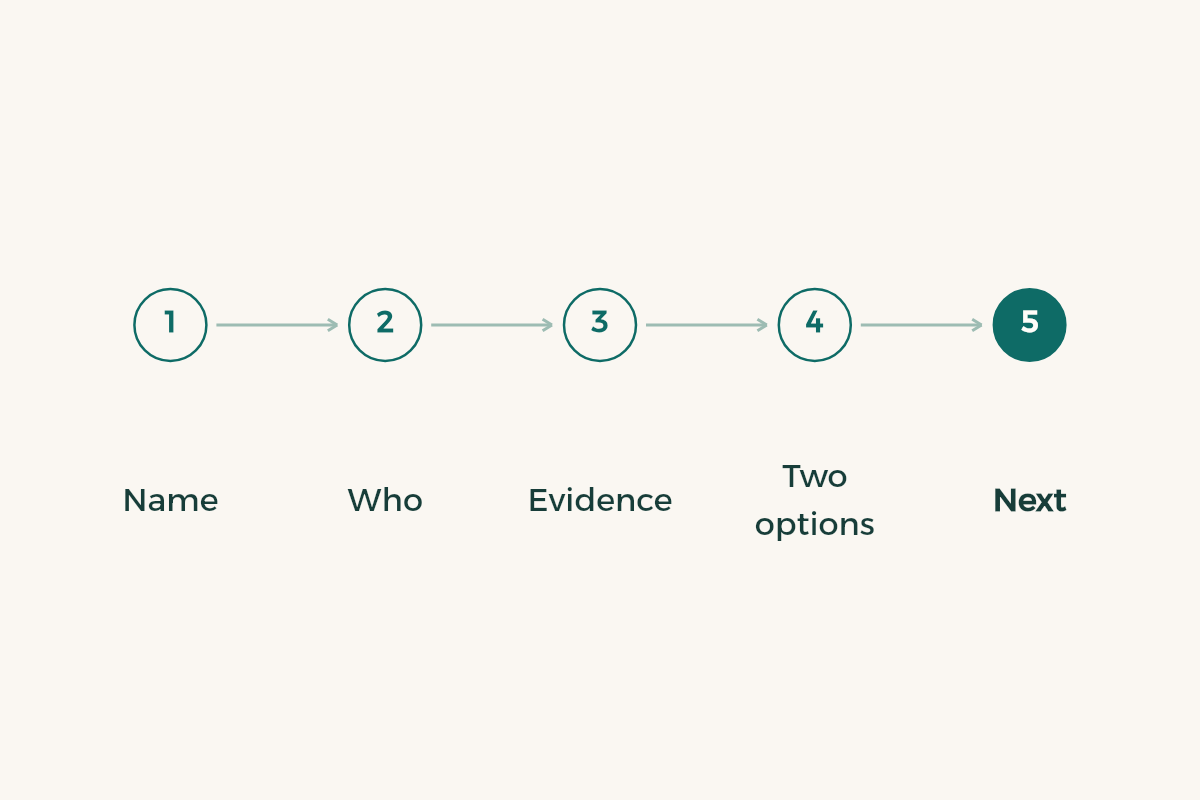
This is a method example; we are not saying the problem exists at any particular university. You will pick a problem from your own course. The point is that the panel hears an order: definition, parties, evidence, options, next step.
How do you talk about missing data without guessing?
Say what you have and what is missing, and do not fill the gap with an estimate that sounds scientific. Saudi Arabia’s national open data platform publishes government datasets for anyone to use,3 which makes it a good place to practise reading real data and noticing what it lacks. If the panel asks where your data came from, name what you actually opened. If you have not opened anything, say you would start there.
Add a sentence of caution: “This data is not enough to say the programme worked, but it is enough to say that this indicator moved.” That kind of sentence separates a student who understands from one who repeats.
How do you read a host’s direction before the interview?
Saudi Vision 2030 publishes its programmes and reports on its official site,2 which is useful because you will hear its vocabulary at almost any public body. Read the programme closest to the host you are meeting and note three terms and one sentence you actually understand. Do not claim to know the host’s detailed plan if you have not read it; stay with what you did read.
If the host is not governmental, read its published reports and its about page. Follow-up questions are usually built on what you said in the first three minutes, so do not say anything you cannot defend.
How do I apply for an internship in Saudi Arabia and prepare for the interview?
Start by writing six examples, one for each question in the table. Then say each answer aloud in one minute and record yourself; you will hear the padding. After that, ask a friend to throw in an unexpected follow-up, because the real interview moves quickly from your prepared answer to something else. To rehearse explaining your own project, read how to explain your project in an interview.
If the interview is in English, review interviewing in English and prepare your terms. For the general questions that appear in any interview, see job interview questions. And if you have started building something to show, this portfolio guide helps.
Some mistakes repeat in these interviews. Memorising a long answer and losing the thread at the first side question. Quoting a number you once heard without knowing its source, so the interviewer asks “where from?” and you have nothing. Criticising a policy without offering an alternative, which sounds like complaint rather than analysis. Talking ten minutes about one project and forgetting the panel wants more than one angle. The usual fix is simple: an answer of thirty seconds to a minute, one example, then stop and let them ask the next thing.
Can I do an internship in Saudi Arabia as a student, and is it ever required?
Your college decides whether co-op or an internship is required in your programme and how long it lasts, so the first step is not an interview but a conversation with the training office. If you have never applied before, begin with the co-op training guide to understand the frame, then come back to the table above. A quick test before any interview: could you explain this answer if they asked two follow-up questions? If not, cut it.
On the day itself, arrive fifteen minutes early, bring a copy of your CV and note the panel’s names if they are given. Write down what you were asked straight afterwards; those notes help the next interview. If you are asked something you do not know, do not bluff. Say, “I do not know, but this is what I would do to find out.”