By the tiswa editorial team, from the official sources listed at the end of this guide. How we write our guides
The worst reason to pick an English test is that a friend passed it. IELTS Academic and TOEFL iBT test the same four skills, but they feel nothing alike on the day. In IELTS you speak to an examiner sitting across the table. In TOEFL you speak to a microphone, and the whole test runs about 45 minutes shorter. The numbers below come from the official sites, ielts.org and ets.org, and the last steps give you a two-day way to settle it.
Rule one: the requirement
Before comparing anything, open the admission page of your university or the scholarship requirements. Some accept both, some prefer one, and some set a score per section. If yours accepts both, the choice is about you: which question style suits you and which speaking format you are comfortable with.
Comparison table
| IELTS Academic | TOEFL iBT | |
|---|---|---|
| Run by | IELTS partners | ETS |
| Total time | About 2 hours 45 minutes | About 2 hours |
| Listening | About 30 minutes, 40 questions | About 29 minutes, 47 items |
| Reading | 60 minutes, 40 questions | About 30 minutes, 50 items |
| Writing | 60 minutes, two tasks | About 23 minutes, 12 items |
| Speaking | 11 to 14 minutes with an examiner | About 8 minutes on the computer |
| Scores | 0 to 9 in half bands | 1 to 6 per section, with a 0 to 120 comparable for a transition period |
| Overall | Average of skills rounded to the nearest half | Average of sections rounded to the nearest half |
| Where | Official centre or online | Test centre or at home (Home Edition) |
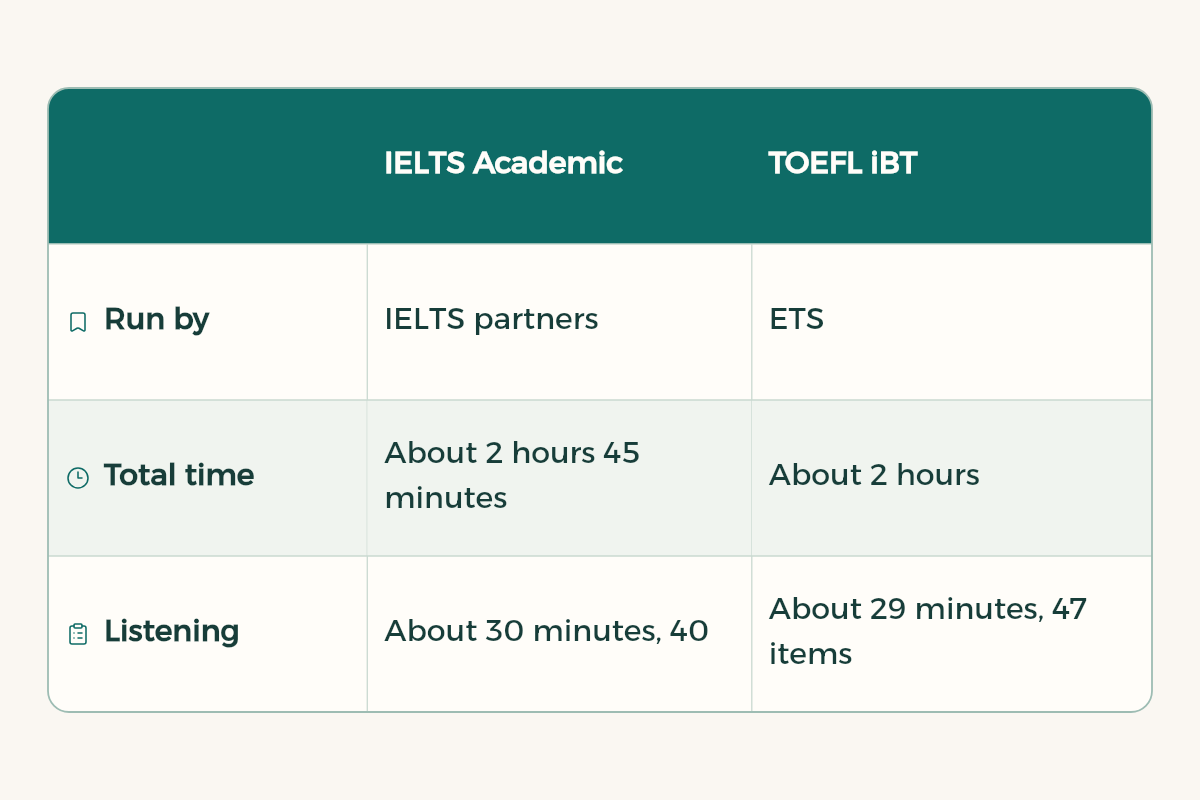
Figures are from the official content and scoring pages. TOEFL is about 45 minutes shorter with shorter, more numerous tasks, while IELTS has longer texts and longer writing tasks.
What is the difference between IELTS and TOEFL speaking?
This is the difference students feel most. In IELTS you sit with a real examiner for a face-to-face interview of 11 to 14 minutes.1 In TOEFL you speak to the computer: listen and repeat sentences, then answer recorded interview questions. Some students prefer a human because it feels like natural conversation; others relax more at a computer with no one watching.
How does IELTS writing differ from TOEFL writing?
IELTS Academic Writing is two tasks in 60 minutes, and Task 2, an opinion or discussion essay, carries more weight. TOEFL Writing is shorter tasks: building sentences, writing an email and writing for an academic discussion that answers a professor and classmates. If you like long, structured writing, IELTS may suit you; if you are quicker at short replies, TOEFL may.
How reading and listening differ
IELTS Reading is three long passages with varied question types such as true, false or not given and matching headings. TOEFL Reading is shorter and varied: completing partly missing words, daily-life texts and an academic passage. In IELTS Listening you write short answers during the recording, so spelling matters; most TOEFL Listening is multiple choice.
How are IELTS and TOEFL scored?
IELTS gives a band from 0 to 92, and university requirements are usually written that way, such as 6.5. TOEFL now gives 1 to 6 per section plus an overall average, with a comparable score on the old 120 scale for a transition period. TOEFL scores are valid for two years per the official scores page4; for IELTS, each organisation sets how long it accepts a result, so check the requirement.
TOEFL scores appear in your account about 3 days after the test, and you can send 4 free reports if you choose recipients by 10 p.m. on test day. For IELTS, receiving and sending results follows the system of the centre you booked with.
How to choose, step by step
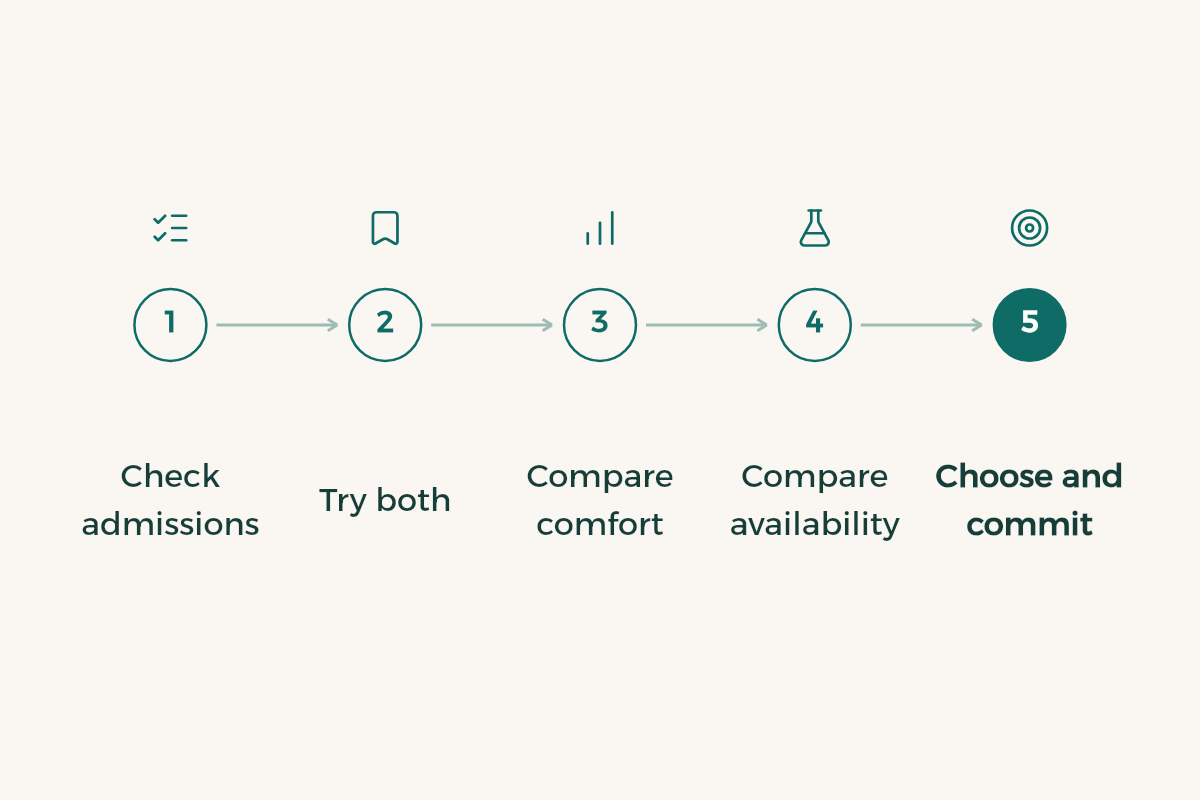
- Check admissions
Write down the accepted tests and the required score per section for each place you apply to.
- Try both
Do the official IELTS samples from the sample questions page and the TOEFL sample questions on the ETS prep page.
- Compare comfort
Which test did you finish with better focus? Which speaking format felt easier?
- Compare availability
Centres and dates near you, and fees from each official booking page.
- Choose and commit
Do not switch tests mid-preparation; each has its own skills.
I am a Saudi student applying to these universities or programmes: [names]. Accepted tests and required scores: [list]. My rough level: reading [ ], listening [ ], writing [ ], speaking [ ]. I am more comfortable: [speaking to a person / speaking to a computer]. Help me compare IELTS Academic and TOEFL iBT using only this information, suggest which to start with and a four-week plan. Do not mention prices.
Which is easier, IELTS or TOEFL?
| IELTS may suit you if | TOEFL may suit you if |
|---|---|
| You are comfortable talking face to face | You are comfortable speaking to a computer |
| You like long, structured essays | You are quicker at short back-to-back tasks |
| You read long texts with focus | You prefer a shorter test with varied tasks |
| Your requirement is written in bands | Your requirement is written in TOEFL scores |
If your organisation is in the Kingdom and accepts STEP from Qiyas, also read STEP vs IELTS. Details of each test are in IELTS in Saudi Arabia and TOEFL in Saudi Arabia.
Common mistakes when choosing
- Booking the test a friend passed, without trying its format yourself.
- Trusting an unofficial IELTS-to-TOEFL conversion table. Your university's written requirement is the only number that counts.
- Preparing for both at once.
- Watching the overall score and forgetting the per-section minimum. A 6.5 overall with a 5.5 in writing still fails a requirement of 6.0 in every band.
Once you choose, build your plan in short sessions as in the Pomodoro technique, and get ready with the exam day checklist. For scholarships that ask for an international English test, read scholarships for Saudi students.