By the tiswa editorial team, from the official sources listed at the end of this guide. How we write our guides
A free IELTS practice test is the best way to learn your level before paying for the real thing. The good news is that the official site, ielts.org, offers free sample questions for all four skills and describes a free IELTS Trial Test at participating official centres, marked by an examiner. This guide covers each source, how to mark yourself and how to turn the result into a plan.
Source one: official sample questions
The Academic sample questions page has questions for Listening, Reading, Writing and Speaking, with answers for Listening and Reading. This is your most important source because it shows the same question types you will meet: multiple choice, sentence completion, matching headings, true, false or not given, and more.
Do not finish them all in one day. Use the first set as a full timed diagnostic and keep the rest for the middle and end of your preparation, so you measure progress with questions at the same level.
Source two: the IELTS Trial Test
Per the official IELTS Trial Test page, it is a free practice test offered at some participating official centres. It covers Listening, Reading and Writing, not Speaking, is marked by an examiner, and results arrive within 13 days. The result is not official and organisations do not accept it, but it gives a real estimate under near-test conditions.
How to run a practice test at home
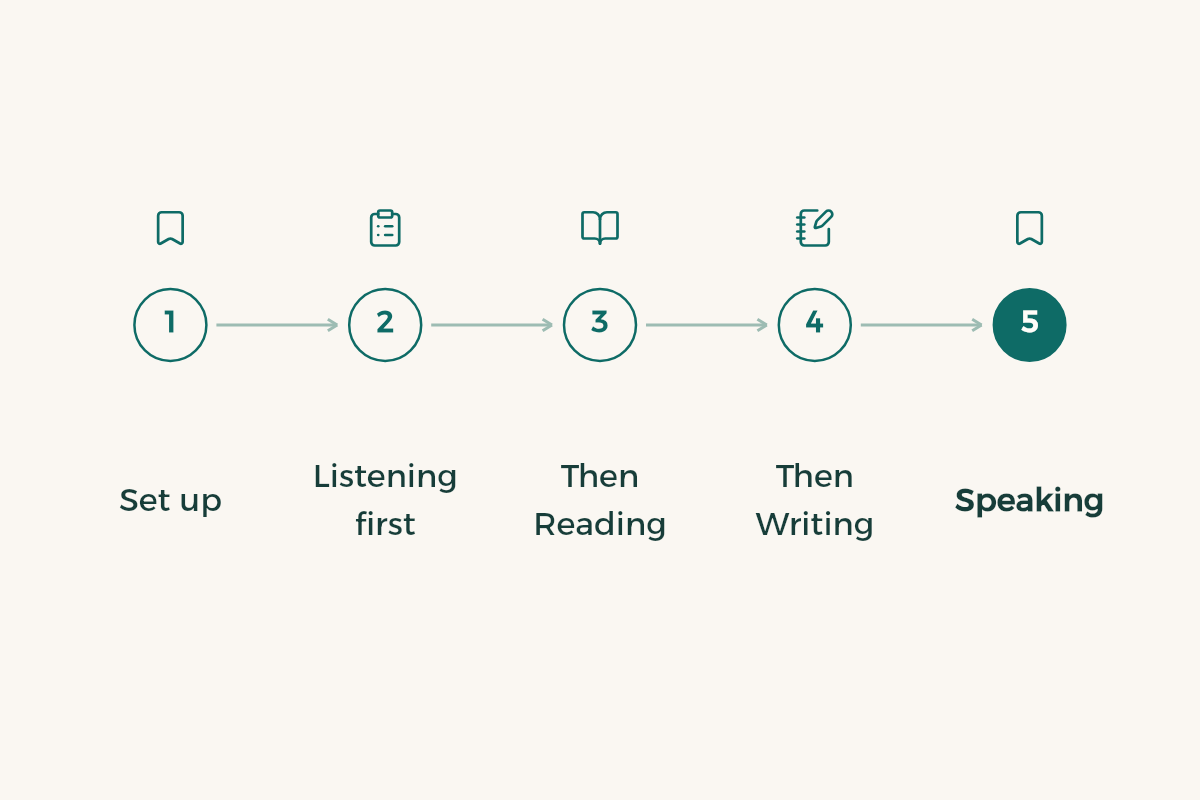
- Set up
A quiet room, headphones for Listening, a timer, an answer sheet and no phone.
- Listening first
About 30 minutes. Play the recording once and do not pause it.
- Then Reading
60 minutes for all questions, with no extra transfer time.
- Then Writing
60 minutes: about 20 for Task 1 and 40 for Task 2.
- Speaking
Record yourself answering the sample questions for 11 to 14 minutes.
- Mark another day
Fresh eyes mark more accurately, especially Writing.
Convert correct answers to a band
The official scoring page gives approximate examples for converting correct answers out of 40 into a band. Note that General Training Reading needs more correct answers for the same band:
| Correct of 40 | Listening | Academic Reading | General Training Reading |
|---|---|---|---|
| 15 or 16 | 5 (at 16) | 5 (at 15) | 4 (at 15) |
| 23 | 6 | 6 | 5 |
| 30 | 7 | 7 | 6 |
| 35 | 8 | 8 | 7 |
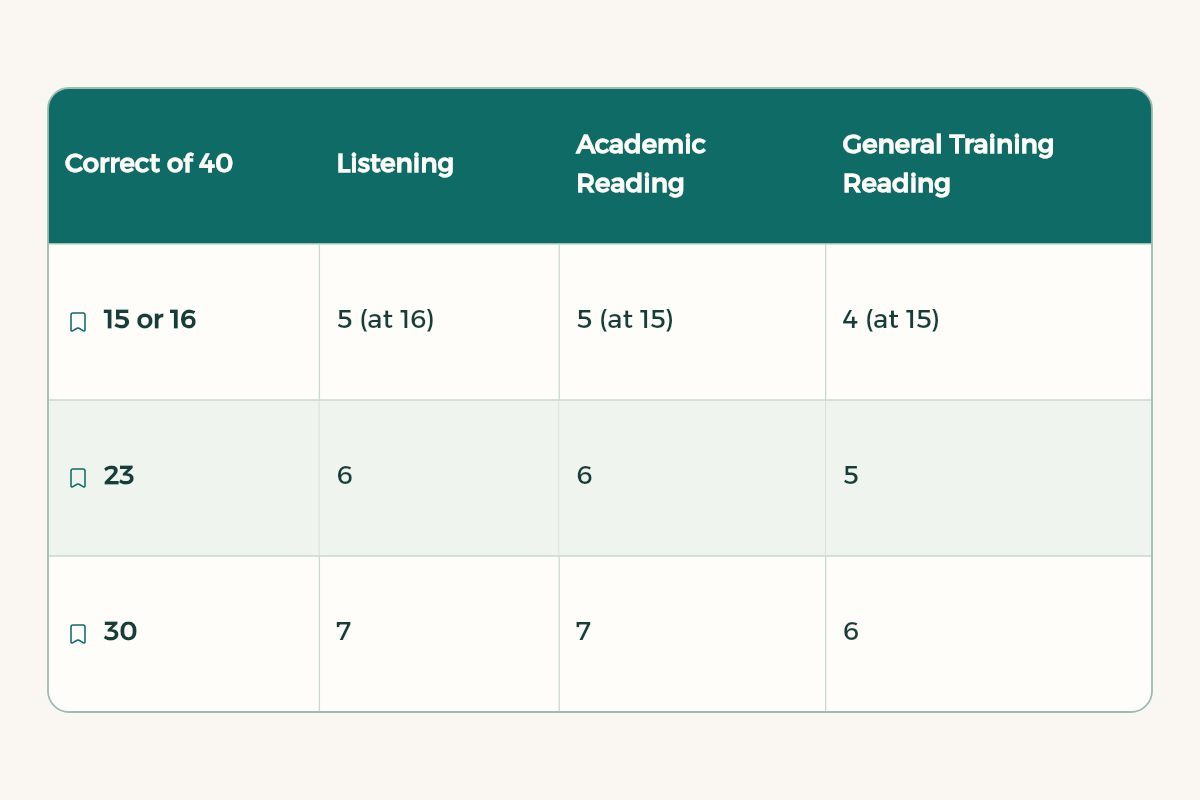
These are approximate and can vary slightly between test versions. Use them to locate yourself and set a target: if you score 23 in Reading and need a 7, you need about seven more correct answers.
Question types to practise
When you work through the official samples, tag each mistake by question type, because each type needs a different approach:
| Question type | Where | How to handle it |
|---|---|---|
| True, false or not given | Reading | Not given means the text says nothing about it, not that it is false |
| Matching headings | Reading | Read the first and last sentence of each paragraph to find its main idea |
| Sentence or table completion | Listening and Reading | Watch the word limit and predict the word type first: noun, number or adjective |
| Multiple choice | Listening and Reading | Wrong options often reuse words from the text with a different meaning |
| Short answers | Listening and Reading | Copy the word as it appears, spelled correctly |
After three or four samples you will find most mistakes cluster in one or two types. Give that type ten minutes a day of extra questions and your next practice score will show it.
Marking Writing and Speaking
These two are harder to self-mark. Read the model answer on the official sample page and compare: did you answer every part of the question? Does each paragraph have one clear idea? Did you vary vocabulary and structures? For Speaking, listen to your recording: did you pause a lot? Were your answers too short?
I am preparing for IELTS. Here is a transcript of my recorded answer to this question: [paste question]. My answer: [paste transcript]. Assess it on the general Speaking criteria: fluency and coherence, vocabulary and grammar. Give an estimated band for each, suggest three better phrases, and write an improved version using my ideas. Make clear the band is an estimate, not official.
AI is useful for catching obvious mistakes and suggesting vocabulary, but it is not an examiner, which is why the IELTS Trial Test is valuable: a real examiner marks your Writing. For more study prompts, read ChatGPT study prompts.
From practice result to plan
| Result | What to do |
|---|---|
| A full band or more below the target | A six- to eight-week plan before booking |
| Half a band below | Two to four weeks on the weakest skill, then another practice test |
| At or above the target | Book, and practise weekly until test day |
Sections, timing and booking are covered in IELTS in Saudi Arabia. If your organisation accepts more than one test, compare in IELTS vs TOEFL.
Mistakes that make practice useless
- Pausing and replaying Listening, which inflates your score.
- Stretching Reading by a few minutes, so the result misses the time pressure.
- Marking your own Writing generously because you know what you meant.
- Redoing the same sample and counting it as progress when you remember the answers.
- Skipping Speaking because it is hard to mark, though it is a quarter of the overall band.
A practice test is a measuring tool, not a goal. The real value is the hour after marking: classify each mistake, understand why, and write the correct rule or word in a notebook. Make that notebook your main reference in the final week instead of new books. To structure sessions, read how to study effectively.