By the tiswa editorial team, from the official sources listed at the end of this guide. How we write our guides
TOEFL is a common choice for students applying to universities in the US, Canada and elsewhere, or to programmes that ask for an international English test. The main version is TOEFL iBT, run by ETS. This guide covers sections and tasks, the new scoring, validity, fees and free official practice, all from ets.org.
What is TOEFL iBT?
It measures your ability to use English at university and in daily life across four skills: reading, listening, writing and speaking. Parts of the test are adaptive, so question difficulty changes with your performance. You can take it at a test centre or at home with the Home Edition and a live proctor, depending on what is available when you register.
First, check your university or scholarship requirement: does it accept TOEFL, and what score does it need per section and overall? Some organisations state scores on the new 1 to 6 scale; some still use 0 to 120.
Sections, tasks and timing
| Section | Tasks | Items | Approx. time |
|---|---|---|---|
| Reading | Complete the Words, Read in Daily Life, Read an Academic Passage | 50 | About 30 minutes |
| Listening | Listen and Choose a Response, Conversation, Announcement, Academic Talk | 47 | About 29 minutes |
| Writing | Build a Sentence, Write an Email, Write for an Academic Discussion | 12 | About 23 minutes |
| Speaking | Listen and Repeat, Take an Interview | 11 | About 8 minutes |
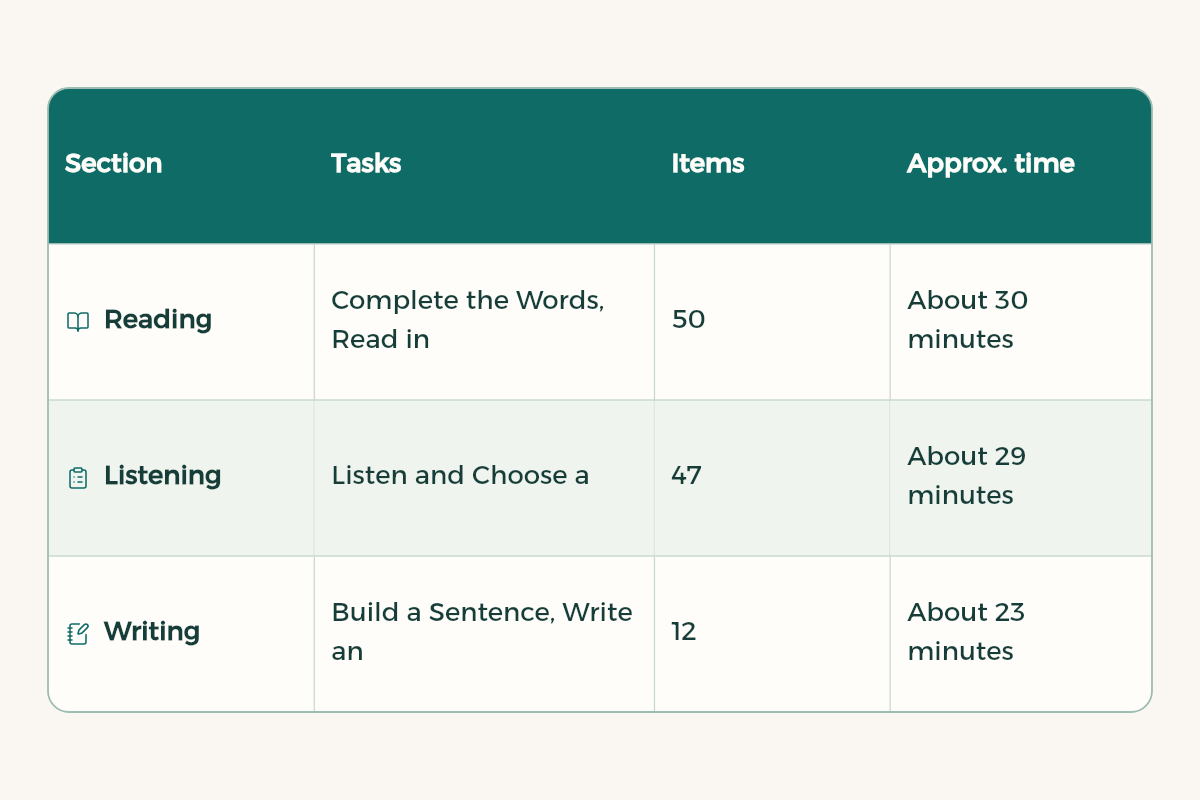
Allow about two hours in total, per the official content page. There are no breaks between sections, but note-taking is allowed. The tasks are short and varied, so switching quickly between types is part of your preparation.
- Complete the Words: a paragraph with partly missing words to finish, testing vocabulary and grammar together.
- Read in Daily Life: short texts such as a notice, email or schedule, with questions on information or purpose.
- Listen and Choose a Response: hear a line and pick the best reply, like a real conversation.
- Build a Sentence: order words into a correct sentence.
- Write an Email: a message with a clear purpose such as a request, apology or suggestion.
- Write for an Academic Discussion: respond to a professor and classmates with your view and reason.
- Listen and Repeat: hear a sentence and repeat it accurately.
- Take an Interview: answer personal or general questions naturally.
How scores work
Per the official scores page, each section gets a score from 1 to 6, and the overall score is the average of the four rounded to the nearest half. For a transition period, the report also shows a comparable score on the old 0 to 120 scale, so organisations that still use it can read your result.
Scores appear in your ETS account about 3 days after the test, with a PDF report about a day after that, and they are valid for two years. ETS also offers MyBest scores, your best section scores across valid tests; each organisation decides whether to accept them.
Registration and fees
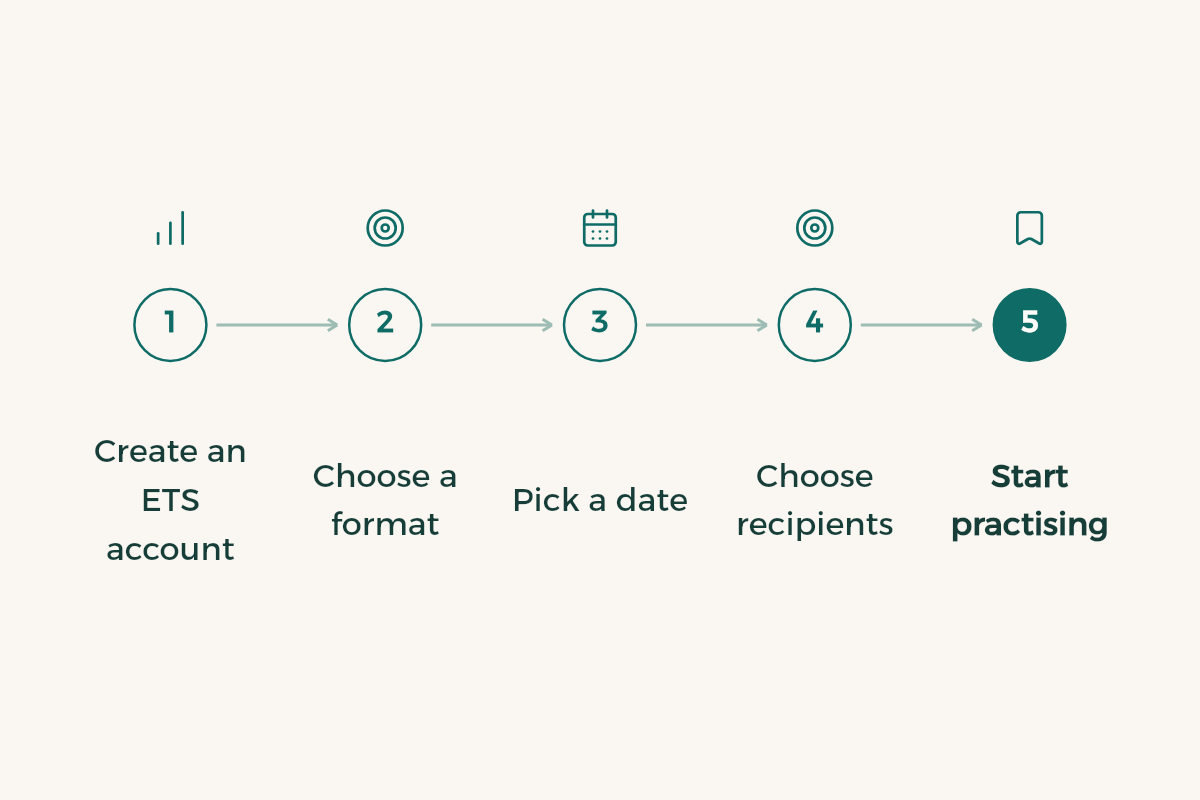
- Create an ETS account
On ets.org/toefl, using your name exactly as on the ID you will bring.
- Choose a format
Test centre or Home Edition; if home, check the device and room requirements.
- Pick a date
And check the registration fee by selecting Saudi Arabia on the official fees page.
- Choose recipients
You can send 4 free score reports if you choose them by 10 p.m. on test day.
- Start practising
With the free ETS prep planner and its sample questions.
The base registration fee varies by country, so take it from the fees page with Saudi Arabia selected. Some extra fees are listed in US dollars on the same page:
| Service | Fee per the ETS page |
|---|---|
| Extra score report after the free ones | US$25 per recipient |
| Express registration within 7 days of the test | US$49 |
| Speaking or Writing score review | Fee applies, within 30 days of the test |
Free official prep
The official preparation page offers the TOEFL iBT Test Prep Planner, a free eight-week plan with tips, skill-building activities and sample test questions. Use its sample questions as a diagnostic, then focus on the tasks you missed most. A structured self-practice routine with an error log is in STEP practice tests and works for any language test.
I am preparing for TOEFL iBT. Write me a professor's question in a university discussion forum on a general topic, with two short opinions from students. I will write my reply in about 10 minutes. Then review it for a clear opinion, reason and example, vocabulary and grammar, give three specific notes and an improved version of my paragraph. Make clear the review is an estimate, not official.
A six-week plan
| Week | Focus |
|---|---|
| 1 | Official sample questions and learning each task type |
| 2 | Complete the Words and daily-life reading: vocabulary and grammar |
| 3 | Listening: short conversations and talks every day |
| 4 | Writing: an email and an academic discussion on alternate days |
| 5 | Speaking: repeat and interview tasks, recording yourself |
| 6 | Mistake review and test-day preparation |
Split study into short blocks as in the Pomodoro technique. If you have not chosen between TOEFL and IELTS, the full comparison is in IELTS vs TOEFL.
Common mistakes
- Relying on old books written for the previous test format; the tasks have changed.
- Not choosing recipients before test day, then paying for reports.
- Neglecting Speaking because it is short, though it is a quarter of the overall score.
- Choosing Home Edition without testing your device, internet and room against the rules.
- Entering an account name that differs from your ID.
Before test day, check the exam day checklist, and for scholarships that may ask for TOEFL, read scholarships for Saudi students.