By the tiswa editorial team, from the official sources listed at the end of this guide. How we write our guides
Many students choose the English language major in Saudi Arabia because their English is already good, then find the major asks for something different. You study how language itself works: its sounds, word forms, syntax and meaning. You read novels, plays and poetry and analyse them, and you translate between two languages. Fluency is only the starting point. What makes a standout graduate is deep understanding and strong academic writing.
Two programmes at one university: an example of the difference
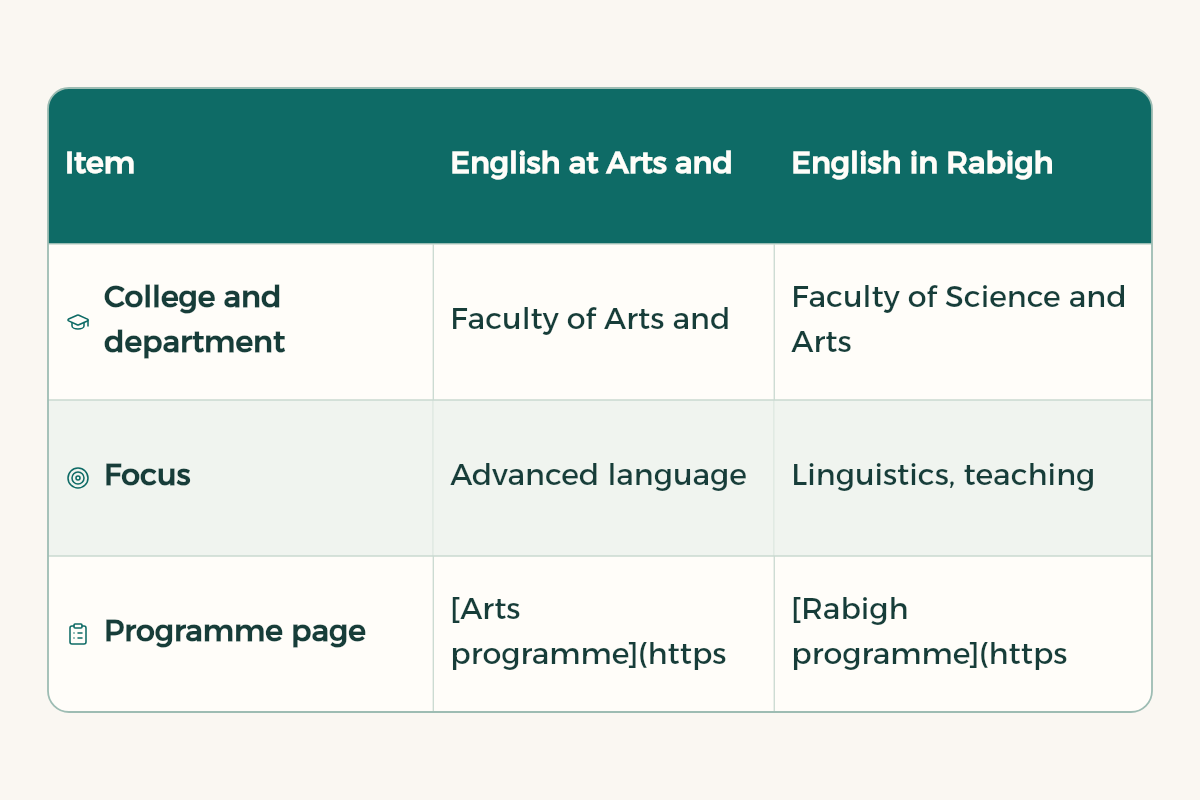
King Abdulaziz University runs two English programmes with different focus. Both are 4 years and taught in English:
| Item | English at Arts and Humanities | English in Rabigh |
|---|---|---|
| College and department | Faculty of Arts and Humanities, Department of Modern Languages and Literatures | Faculty of Science and Arts in Rabigh, Department of English |
| Focus | Advanced language proficiency, linguistics, translation and English literature | Linguistics, teaching English as a foreign language (TEFL) and translation |
| Programme page | Arts programme | Rabigh programme |
Before you pick a university and programme, open the study plan and count how many courses are literature, how many linguistics and how many translation. That balance shapes your four years more than the programme name.
Courses: what you will actually study
Courses in the KAU Arts and Humanities programme include:
- Skills: advanced reading and advanced writing.
- Introductions: introduction to linguistics, introduction to literature and introduction to translation.
- Linguistics: phonetics and phonology, morphology, syntax, semantics and pragmatics, sociolinguistics, psycholinguistics, and second language acquisition.
- Literature: the novel, drama, poetry, Shakespeare, literary theory and the history of English literature.
- A third language: French courses.
Notice the third language in the plan. Learning a new language while you study linguistics is useful, because you live through what you read about in second language acquisition.
How to do well in the major
- Read daily beyond the syllabus
A novel or a long article in English every week. Wide reading lifts your writing without you noticing.
- Write regularly, and academically
Literary and linguistic essays have structure, argument and citation. Learn referencing early with APA citation, and check which style your department wants.
- Practise phonetics with your own voice
Record yourself and compare your pronunciation with the phonetic symbols. The course gets easier when you hear it, not only read it.
- Translate something real
A short article or a web page, then compare your version with a published translation. You learn more from the gap than from any lecture.
- Speak at every chance
Conversation clubs, presentations and class discussion. Confidence in speaking is part of how the job market judges you.

If you are still building your base before admission, start with learning English for university, and to compare language tests read STEP vs IELTS.
Translation: more than moving words
Students in introduction to translation quickly find that word for word translation rarely works. A good translator carries meaning, tone and purpose, and knows when to reorder a sentence or swap a cultural expression for its equivalent. That is why you need Arabic as much as English: a translation into weak Arabic loses its value however well you understood the original. If you are considering translation as a career, pick a field to specialise in early, such as legal, medical or audiovisual translation, and build a glossary and work samples in it.
Jobs after graduation
The two programmes list a wide range of careers, including:
- Education: English teacher and curriculum development.
- Translation: written translation, interpreting and audiovisual translation.
- Media and content: journalism, content writing, editing and proofreading.
- Public relations, marketing and business.
- Tourism, including tour guiding.
- Sales and customer service.
- The police and armed forces.
The key point is that most of these jobs need one more skill on top of the language: teaching needs pedagogy, translation needs a subject specialism, and content needs a portfolio. Start building that skill from year two.
If you want to teach: the professional licence
The Education and Training Evaluation Commission offers an Issuance of the Professional License service, an e-service that lets graduates and education professionals get their professional licence once all requirements are met. Read the requirements and documents on the service page, and start preparing for its tests before graduation, not after.
A weekly routine that lifts your level
One hour a day is enough: read a chapter of the set novel or play on Sunday, write an analytical paragraph about it on Monday, listen to an academic lecture or podcast in English on Tuesday, translate a short passage and compare it with a published translation on Wednesday, and review the mistakes your lecturers corrected on Thursday. It covers reading, writing, listening and translation, and if writing is your weak point, put extra time into Monday and Thursday.
AI in English studies
AI is a patient conversation partner and a fast writing checker, but it can polish your style until your voice disappears. Use it to point out errors, not to rewrite. Our ready prompts tied to CEFR levels are in AI for English language students.
I am an English major. Analyse this sentence for my [syntax or semantics] course: [sentence]. Give me its structure step by step, name each phrase and clause, and point out any ambiguity. Do not simplify the terms, I need them for my exam.
To plan for postgraduate study and scholarships after graduation, see scholarships for Saudi students.