By the tiswa editorial team, from the official sources listed at the end of this guide. How we write our guides
ChatGPT for English students is a chance no earlier class had: a speaking partner that never gets tired, a marker that explains every error, and someone to argue with about the novel you just read. But your major is also the one where instructors spot generated text most easily, because your own writing voice is what gets graded. The goal of this guide is for your English to improve, not for a text the tool wrote to look better.
Set the tool to your level
The Common European Framework of Reference for Languages (CEFR) from the Council of Europe describes language proficiency in six levels: A1 and A2 for the basic user, B1 and B2 for the independent user, and C1 and C2 for the proficient user. The Council notes that the levels are broad bands rather than absolute cut-offs, and that C2 does not imply native-speaker competence. Naming your level in a prompt changes the answer completely: the tool picks vocabulary and structures closer to what you need and pushes you toward the next level.
Speaking: a daily voice routine
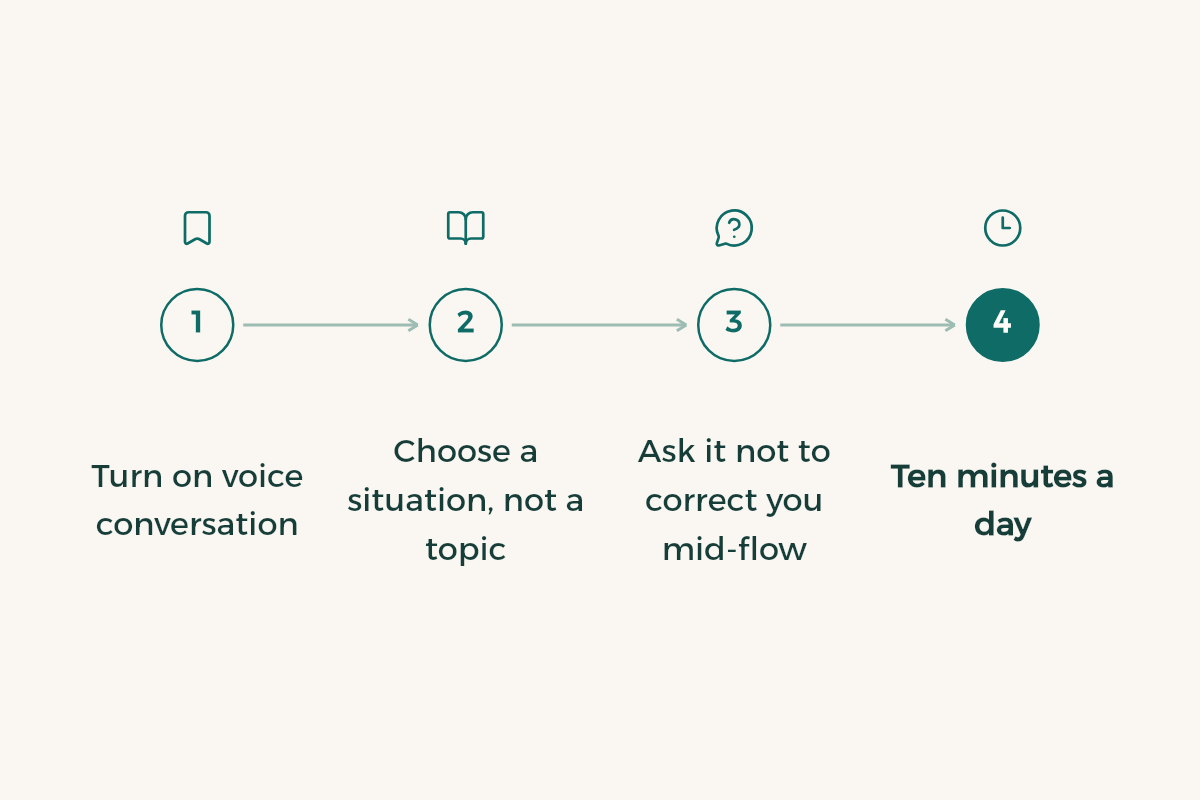
- Turn on voice conversation
Most chat tools support voice in their phone apps. Pick a voice with an accent you want to get used to.
- Choose a situation, not a topic
A training interview, a seminar discussion, or a call to an admissions office abroad.
- Ask it not to correct you mid-flow
Constant correction kills fluency. Ask for a summary of mistakes at the end.
- Ten minutes a day
Consistency beats length. Log your repeated mistakes in one file and review them weekly.
You are my English speaking partner. My level is [B1]. Role-play this situation: [a co-op training interview at a Saudi company]. Ask one question at a time and wait for my answer. Do not correct me during the conversation. When I say finish, give me my five most important mistakes with the correct version and one new phrase I could have used.
Essays: feedback that teaches instead of rewriting
The common mistake is pasting your essay and asking the tool to improve it. You get back a version in a voice that is not yours. A better way is to ask for error codes and fix them yourself.
I am an English major. Here is my argumentative essay: [essay]. Do not rewrite it. Mark each error in place with a code: [GR] grammar, [VOC] word choice, [SP] spelling, [PUN] punctuation, [COH] coherence. Then give me three comments on my thesis statement and paragraph structure. I will fix the errors myself and send it back.
This is my thesis and my three supporting points: [thesis and points]. Act as a critical professor. Give me the strongest counterargument to each point, and tell me which point is weakest and why. Do not write any sentences for my essay.
Before you submit anything, read AI detection at university to see how universities treat generated text.
Literature: close reading, not summaries
AI tools can invent quotations and page numbers, and mix up the plots of two novels. So paste the passage you are analysing from your set edition, and ask the tool to work only on that.
Here is a passage from [work and author] that I am studying: [passage]. Ask me five close-reading questions about imagery, tone, point of view and structure, one at a time. After I answer, tell me what I missed, quoting only words from the passage above.
Explain how a [feminist / postcolonial / formalist] reading would approach this passage: [passage]. Give me three questions that reading would ask of the text, not the answers, so I can build my own argument.
Linguistics and phonetics
- Ask for IPA transcription exercises with the answers hidden, and check them against a reliable dictionary, because the tool sometimes gets symbols wrong.
- Ask for sentences to parse into syntax trees, draw the tree yourself, then ask for a step-by-step review.
- Ask for morphology practice: breaking words into morphemes, then compare with the examples from your course.
- In sociolinguistics, ask for comparisons of pronunciation and vocabulary across varieties of English, with examples.
Translation between Arabic and English
In translation courses, do not ask for a ready translation. Translate first, then use the tool to compare choices.
Here is an Arabic source text: [Arabic]. Here is my English translation: [mine]. Compare my translation with the source sentence by sentence. Point out any meaning I lost or added, any collocation that sounds unnatural in English, and any cultural term that needs a translator note. Do not give me a full translation of your own.
Example: essay feedback that teaches
You wrote a 300-word essay on how social media affects students. Do not ask the tool to "correct the essay". Ask for feedback sorted into grammar, word choice, paragraph flow and the clarity of each topic sentence. Ask it to name the rule behind each mistake and give a correct example, without rewriting your essay. Then fix it yourself and send the new version for a second round. The second round has fewer, sharper notes, and you remember the rules because you applied them by hand.
A vocabulary notebook that sticks
- Write each new word with a sentence from its original context and a sentence of your own.
- Ask for three near-synonyms and the precise difference between them, such as affect, influence and impact.
- Review by recall: cover the meaning and try to remember it, as in how to study effectively.
- Focus on words from your major and courses more than on general lists.
A balanced weekly routine
- Three days
A short voice conversation on a course topic, then ask for a list of your repeated mistakes.
- Two days
Write one paragraph and get feedback as above.
- One day
Read a literary text or long article and summarise it in your own words without help.
Common mistakes
- Accepting every style suggestion: some change your personal voice, so keep what sounds like you.
- Relying on the tool for graded work: professors compare an assignment's style with how you write in class.




Plans after graduation
If you are thinking about teaching, postgraduate study or a scholarship abroad, you will probably need a proficiency test. Read STEP vs IELTS, for a full improvement plan see learn English for university, and for internships see a CV for students with no experience.