By the tiswa editorial team, from the official sources listed at the end of this guide. How we write our guides
ChatGPT for nursing students is useful for a few specific jobs: building a practice patient for a care plan, asking "who do you see first?" across four patients, and listening to your handover before you give it to your preceptor. Doses and bedside decisions belong to your approved references and your team, not a chatbot.
What the SNLE asks of you
The Saudi Nursing Licensure Examination (SNLE) is run by the Saudi Commission for Health Specialties (SCFHS). According to its applicant guide: 200 multiple-choice questions (up to 10% may be pilot items), in two parts of 100 questions with 120 minutes each and a 30-minute break. The sections are weighted like this:
| Section | Weight | Example topics |
|---|---|---|
| Nursing Fundamentals | 20% | Physical assessment, pharmacology, quality and safety, health education |
| Adult Nursing | 40% | Medical, surgical, critical care, community and mental health nursing |
| Maternal-Child Nursing | 30% | Maternity, gynecology, neonatal, pediatric medical and surgical |
| Nursing Management and Leadership | 10% | Coordinating care, frontline safety, nursing teams, nursing informatics |
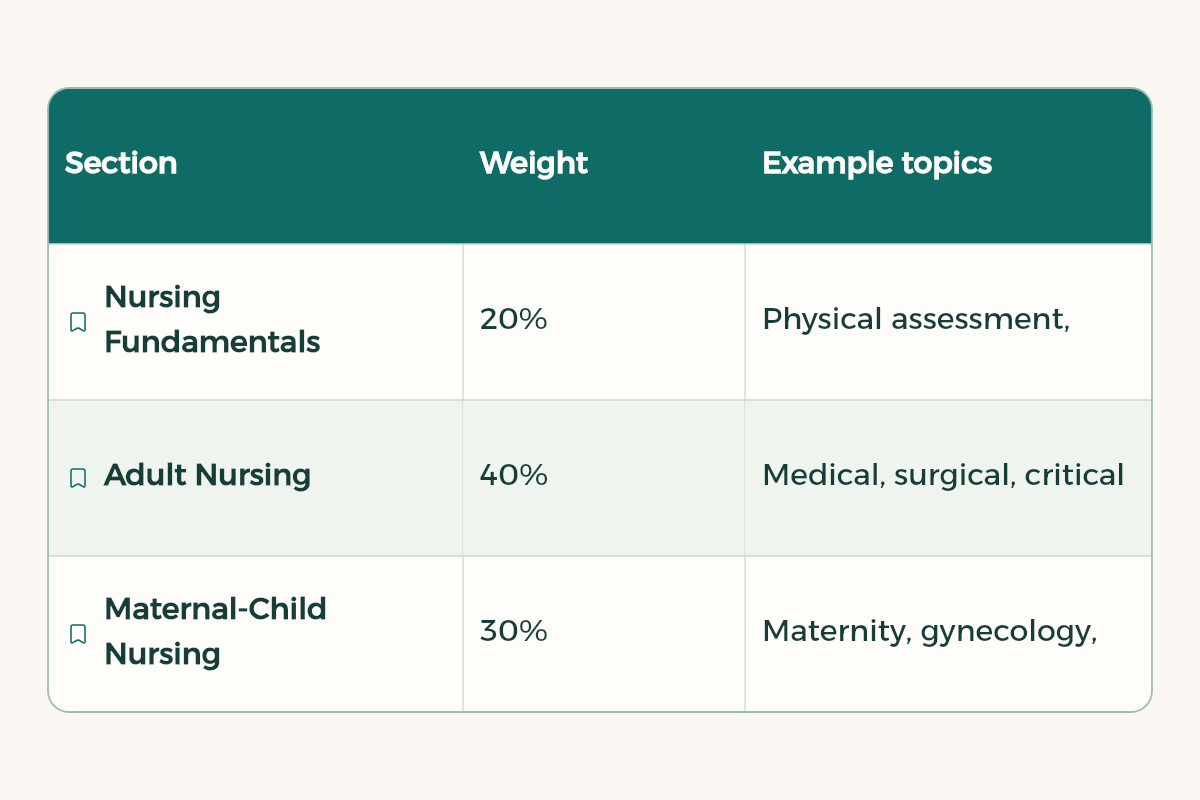
Adult Nursing alone is 40%, and the guide defines Fundamentals as including prioritisation of care delivery. So "who first" questions are central to the exam, and they are one of the best things to practise with AI.
Before you lean on AI questions, know that SCFHS offers a mock test drawn from the SNLE item bank on its website, and that is the real measure of where you stand. Use AI questions for daily practice on your weak sections and the mock test to track progress. The SCFHS guide also forbids reproducing exam questions from memory or sharing them, so never ask any tool for "real SNLE questions".
Prompt: a priority question
You are a nursing tutor preparing me for the SNLE. Write one priority question in [Adult Nursing, surgical]: four patients on one ward with a short description each, asking "Which patient do you assess first?". Do not give the answer until I reply. Then explain it using ABC and Maslow, and why the other options are lower priority.
A nursing care plan on a practice case
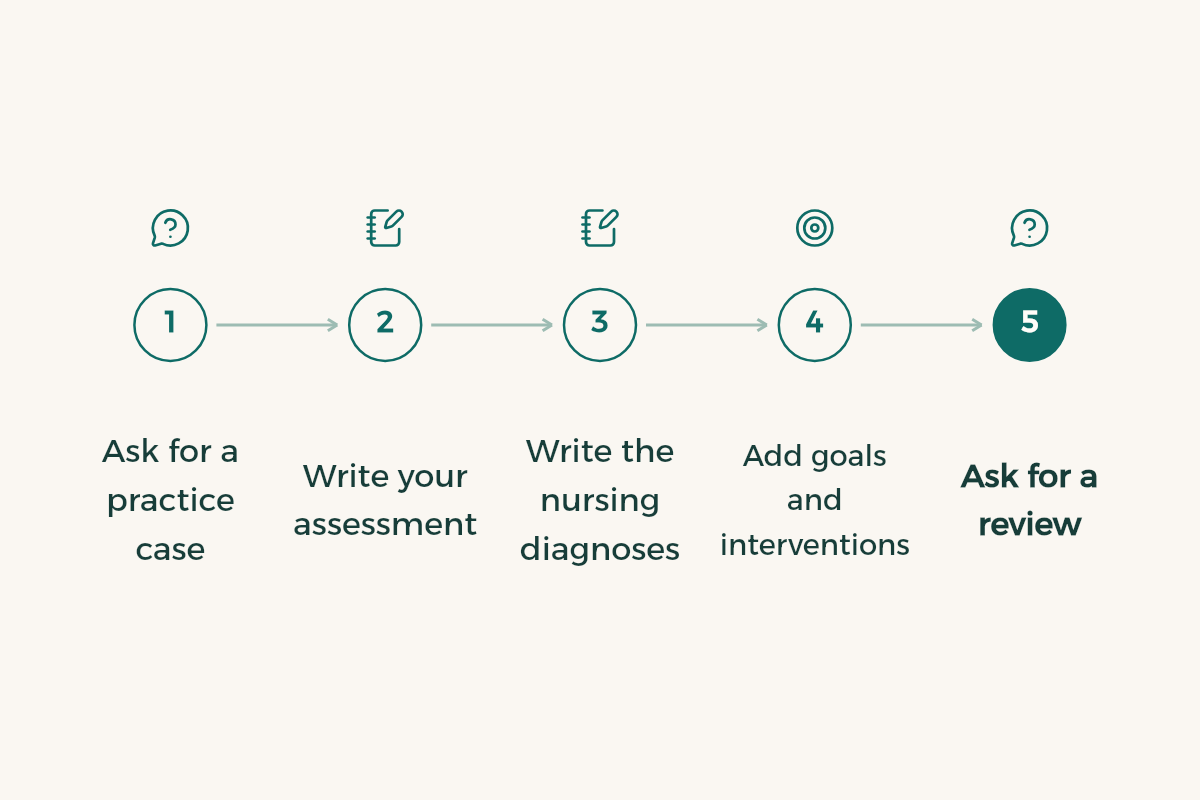
Care plans eat a lot of a nursing student's time. The right way is that you write the plan and the tool reviews and questions it, not the other way round:
- Ask for a practice case
Set the condition and age, and ask for full assessment data: vital signs, complaint, findings and history.
- Write your assessment
Sort subjective and objective data yourself before asking anything.
- Write the nursing diagnoses
Two or three, in the format your department uses, ranked by priority.
- Add goals and interventions
One measurable goal per diagnosis, and a rationale for every intervention.
- Ask for a review
Paste your plan and ask the tool to question its weak points instead of rewriting it.
Here is a nursing care plan I wrote for a practice case: [paste case and plan]. Do not rewrite it. Ask me three questions that expose the weakest point in my diagnoses, goals or interventions, then tell me which goal is not measurable and how I could fix it myself.
This also keeps you on the right side of academic integrity, because the work is yours. If your university checks assignments with detectors, read AI detection in university assignments.
Practise SBAR handover
The SNLE guide lists nursing teams and interprofessional relations under Management and Leadership, and shift handover only gets better with repetition:
Play the nurse taking over the next shift. I will give you an SBAR handover (Situation, Background, Assessment, Recommendation) on a practice patient after [an appendectomy]. Afterwards ask me two questions a real nurse would ask, then grade me: was it short and clear, and what important detail was missing?
Drug calculations: you calculate, the tool checks
Pharmacology sits inside Fundamentals, and dose and infusion-rate calculations worry most students. Do not ask the tool for the answer, because language models sometimes get arithmetic wrong. Work it step by step yourself, then ask it to check your steps and write similar practice problems with different numbers. Always compare with the method in your department's textbook.
Write 5 practice problems on IV infusion rates (mL per hour and drops per minute) with made-up numbers, easiest to hardest. Do not include solutions. When I send my working, check each step and tell me where I went wrong, without solving it for me.
Health education in plain language
Health education and promotion is a Fundamentals competency. Ask the tool to simplify instructions for a practice patient (for example, wound care after discharge), then check them with your preceptor or the hospital's approved leaflets before you use a single line. WHO warns these models can give incomplete or inaccurate information, so the check is required, not optional.
Tools and offers for nursing students
Keep summaries and shift schedules in one notes app; see Notion for students. For general study prompts across every subject, see ChatGPT prompts for studying. These tools are free for university students in Saudi Arabia through tiswa:




Before your first clinical day
Hospital training is not the lecture hall, and good preparation takes a lot of the stress away. Use the tool to prepare without relying on it for any decision about a real patient:
- Ask for the questions supervisors usually ask on day one in your unit, such as medical or surgical, and prepare answers from your references.
- Review vital signs and their normal ranges from your course textbook, and ask the tool to quiz you with short cases.
- Practise communication: how to introduce yourself, ask the patient's permission and explain a simple procedure in plain language.
A drug card you repeat for every medicine
| Field | What to write |
|---|---|
| Name and class | Generic name and drug group |
| Reason for use | Why this patient in particular takes it |
| What to monitor | Vital signs or labs to check before and after giving it |
| Key side effects | What must be reported to the nurse in charge at once |
| Patient teaching | Two sentences in plain language |
Fill the card from your approved reference, then ask the tool to quiz you on it. If the tool and your reference disagree, the reference wins every time.
Common mistakes
- Typing anything that identifies a patient into an AI tool. Turn it into a hypothetical case first.
- Relying on the tool for a dose calculation. Work it out yourself, then double-check with a classmate or supervisor as you were taught.
- Memorising answers without understanding the priority. Always ask: what is the most immediate threat to the patient's life?
- Studying in bursts. Plan your week with how to study effectively.