By the tiswa editorial team, from the official sources listed at the end of this guide. How we write our guides
For a psychology student, AI is a study tool, not a therapist. It helps you compare therapy schools, build a fictional case to practise assessment and differential diagnosis, and explain SPSS output before you write your results chapter. This guide organises that work around the SPSLE licensing exam blueprint, with prompts you can copy as they are.
What does the SPSLE ask of you?
The Saudi Psychology Licensing Exam (SPSLE) is run by the Saudi Commission for Health Specialties. According to the applicant guide it has 200 multiple-choice questions (up to 10% may be pilot items) in two parts of 100 questions and 120 minutes each, and the passing score is 500 on a scale up to 800. The sections are weighted like this:
| Section | Weight | Example topics |
|---|---|---|
| Biological, social and cognitive-affective bases of behavior | 15% | Brain and behaviour, cognition, emotion, social psychology |
| Growth and lifespan development | 10% | Childhood, adolescence, adulthood, ageing |
| Psychopathology | 15% | Disorders, their criteria and causes |
| Assessment and clinical decision making | 30% | Interviewing, psychological tests, differential diagnosis |
| Treatment, intervention and prevention | 20% | Therapy schools, therapeutic alliance, psychopharmacology |
| Ethics and professionalism | 10% | Confidentiality, client rights, professional boundaries |
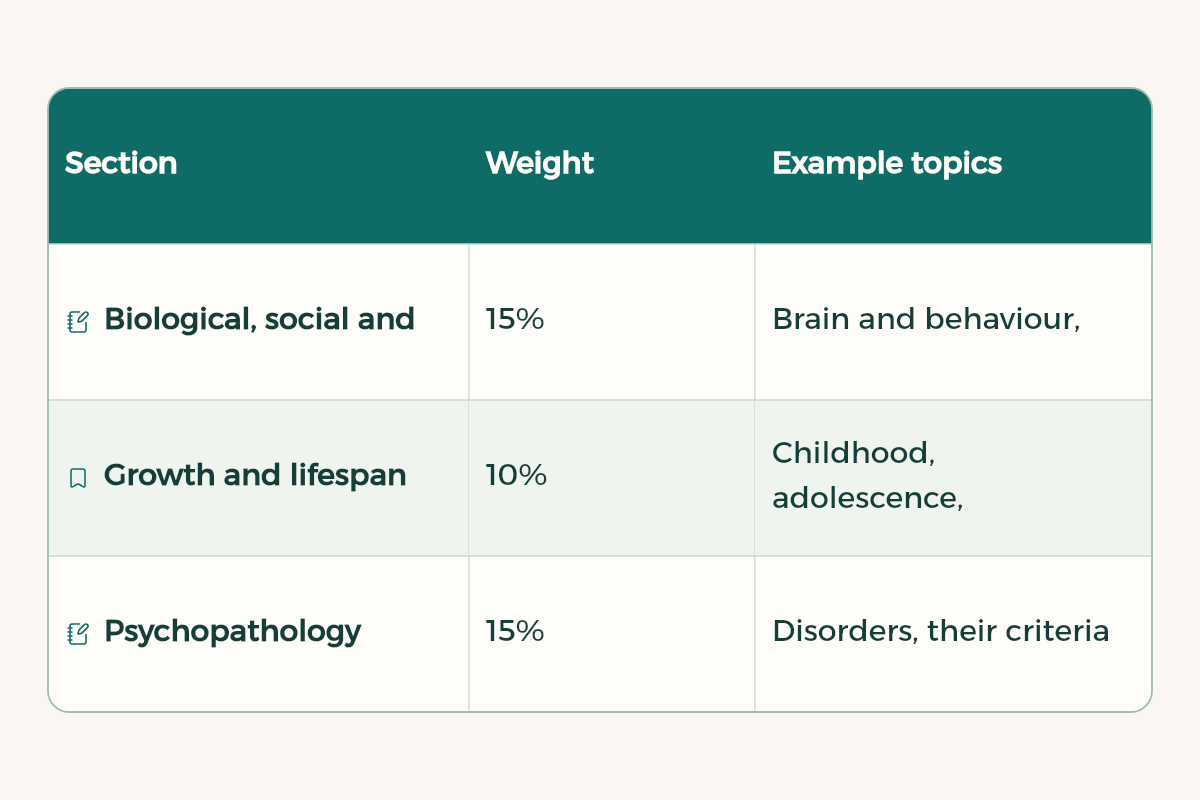
Assessment and clinical decision making is the largest section at 30%, so questions like "what is the most likely diagnosis?" and "which test fits here?" are the core of the exam. That is exactly what you can practise with fictional cases written by AI, as long as you check every answer against the reference your course uses.
Compare therapy schools in one table
Many students learn each school on its own and then mix them up on comparison questions. Ask for one table that compares three schools on the same columns, then cover a column and fill it in from memory.
I am a psychology student. Make a table comparing cognitive behavioural therapy, psychodynamic therapy and person-centred humanistic therapy.
Columns: view of what causes the problem, role of the therapist, best-known techniques, usual length of treatment, a common criticism.
Keep each cell to one line.
After the table, ask me 5 multiple-choice questions comparing them, and do not give the answers until I reply.
Practise assessment on a fictional case
Since assessment is 30% of the exam, have AI write a short case in the exam style while you name the most likely diagnosis, the differentials and a suitable assessment tool. Ask it to tie each answer to specific criteria, and then check those criteria yourself in the diagnostic manual your course uses.
Write a short fictional case (6 lines) of an adult client at a psychology clinic, in the style of SPSLE licensing exam questions.
Then ask me in order:
1. What is the most likely diagnosis?
2. Which two differential diagnoses must be ruled out, and why?
3. Which assessment tool would you start with?
Wait for my answer to each question before the next, then correct me and name the criteria you used so I can check them in the reference.
Counselling skills: empathy and reflection
The SPSLE guide lists skills such as empathy, reflection and building the therapeutic alliance. You learn these by repetition, and AI can play a fictional client so you can practise phrasing your responses before real supervised sessions.
Play a fictional client in a first counselling session: a university student who feels pressure from studying. Write one sentence at a time.
I reply with a reflection or an empathic response.
After each reply, rate it: did it reflect feeling or content? Did it judge or give advice too early? Suggest a better phrasing.
After 6 exchanges, summarise my strengths and what I need to practise.
Statistics and the graduation project
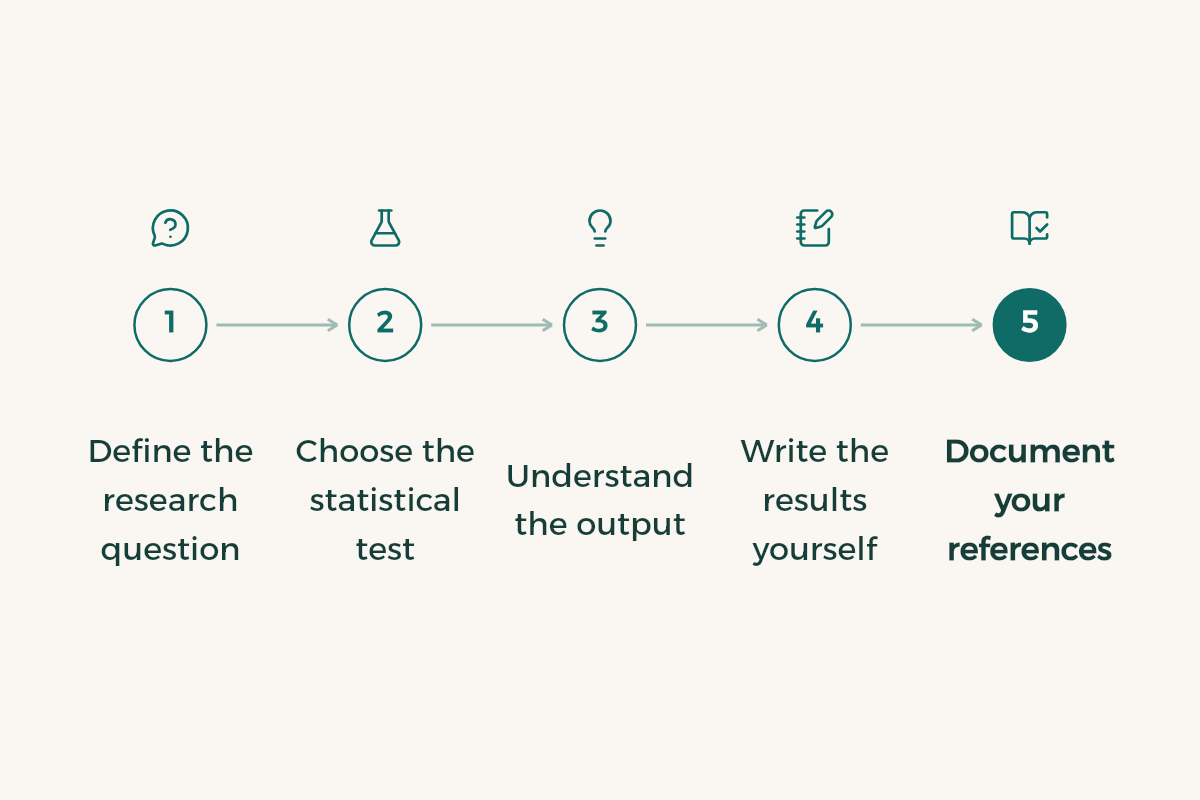
Most psychology departments have a research methods and statistics course and a graduation project. AI is excellent at explaining here, but it does not analyse your data or write your chapters for you. Use it in these steps:
- Define the research question
Write your question and hypothesis, and ask it to name the independent and dependent variables and the type of each.
- Choose the statistical test
Ask: I have two independent groups and one continuous variable, which test fits and why? Confirm the answer in your course textbook.
- Understand the output
Paste the SPSS output table without anything that identifies participants, and ask what each number means.
- Write the results yourself
Write the paragraph in your own words, then ask it to check only the APA reporting format, without rewriting it.
- Document your references
Every source you cite must be one you actually read from the library database. Never rely on references suggested by AI without checking them.
I am a psychology student. Here is an SPSS independent-samples t-test output table (no participant data):
[paste the table]
Explain every number: the means, Levene's test, the t value, degrees of freedom, significance level and effect size if shown.
Then show me how to report the result in one APA-style line, and leave the interpretation for me to write.
For references, use the APA citation guide, and for the whole project read how to write a research paper.
Ethics is 10%: do not skip it
Ethics and professionalism is small in weight, but its questions are direct and easy marks. Ask AI for short scenarios on confidentiality and its limits, informed consent, dual relationships and client rights, answer them, then compare with the ethics code your course uses. The same principles apply to how you use AI itself: anything about a real client is confidential and has no place in any AI tool.
A weekly plan built on the exam weights
Split your time by weight. Two days for assessment and decision making, one day for treatment, intervention and psychopharmacology, one day for psychopathology, one day for biological bases and development, half a day for ethics and half a day for a full practice exam. Put your notes into one source in NotebookLM and ask it for questions from your own files, and for more ready-made formats see study prompts.
If your major sits close to medicine, the guide to AI for medical students applies the same method to the SMLE.