By the tiswa editorial team, from the official sources listed at the end of this guide. How we write our guides
ChatGPT for accounting students explains well and calculates badly. It can give you a clear explanation of accrual accounting, then write an entry where debits do not equal credits, or add up five numbers wrong. So the division of labour in this guide is simple: the tool handles logic, explanation and practice problems, Excel handles the numbers, and you handle professional judgement.
What it is good for and what not to trust
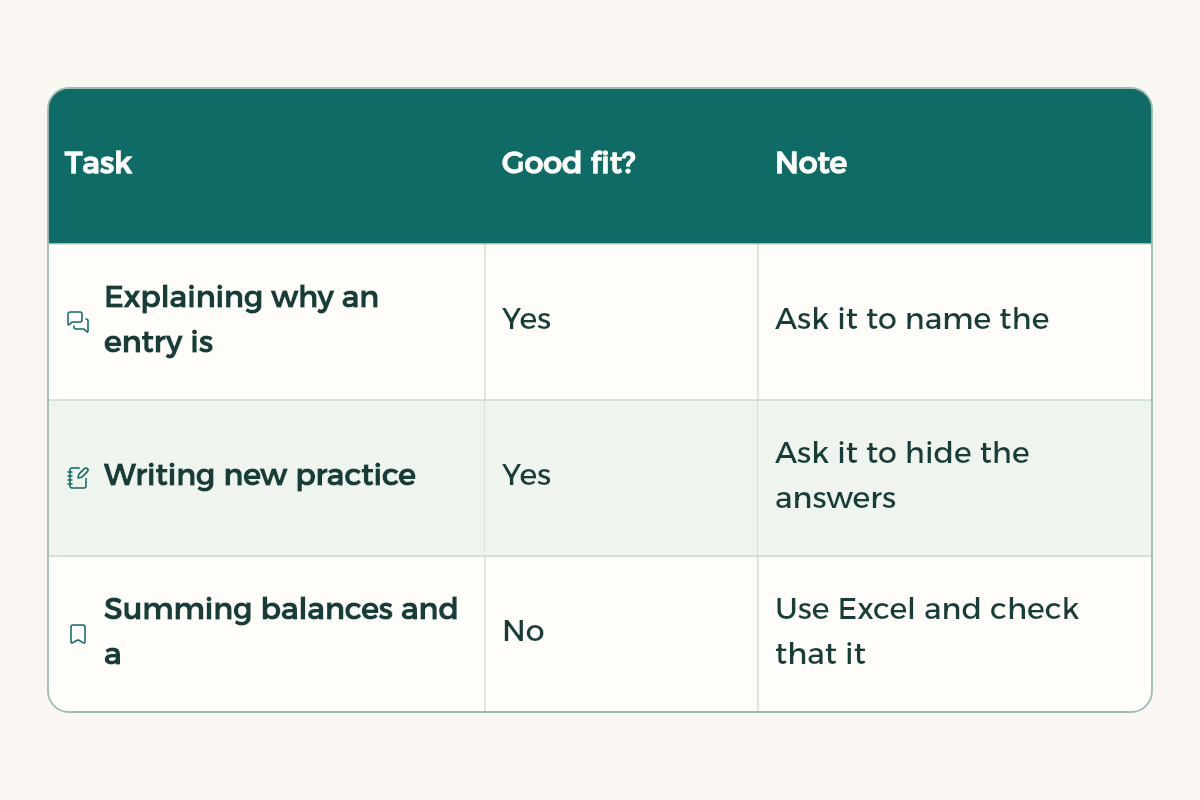
| Task | Good fit? | Note |
|---|---|---|
| Explaining why an entry is made | Yes | Ask it to name the principle behind the entry |
| Writing new practice problems | Yes | Ask it to hide the answers until you try |
| Summing balances and a trial balance | No | Use Excel and check that it balances |
| Depreciation schedules | Formulas only | Ask for Excel formulas, not final figures |
| Cost accounting variances | Yes | Check the sign of each variance: favourable or unfavourable |
| Audit risk assessment | For discussion only | Professional judgement is part of what the exam tests |
Prompts written for accounting courses
I am an accounting student. Here are a trading company transactions for one month: [transactions]. Here are the journal entries I wrote: [entries]. Review each entry: are the accounts right, are debit and credit on the correct side, does it balance? Do not write the correct entry. Explain the mistake using the accounting principle and let me fix it myself.
Write five transactions that need year-end adjusting entries: a prepaid expense, accrued revenue, depreciation, a provision and an accrued expense. Use simple numbers. Write the problems only, and put the solutions at the end under the heading Solutions so I do not see them before I try.
I have an asset with cost [cost], salvage value [value] and a useful life of [years]. Design a depreciation schedule in Excel using straight-line and declining balance. Give me the formula in each cell rather than numbers, and explain when you would choose each method.
Here are the standard and actual costs for a product: [data]. Walk me through calculating the price and quantity variances for materials and labour, give the formula for each, then ask me to interpret each variance before you give your interpretation.
Auditing: working papers and sampling
Auditing differs from other courses because it tests how you think more than how you calculate. Use the tool to turn an audit case into a list of procedures for each line in the financial statements, such as customer confirmations and inventory counts, then ask what evidence each procedure produces. Ask it for short cases with risk indicators, like a sudden change in gross margin, so you practise spotting them yourself before you read the answer.
SOCPA: the professional reference for accounting students
SOCPA, the Saudi organization for auditors and accountants, is an official government body, and its website is a core reference for any accounting student for two reasons: standards and the career path.
- Professional standards: accounting standards, auditing standards, quality standards, professional conduct, practical clarifications and professional inquiries.
- Memberships, including a student membership alongside associate, professional and full membership.
- The SOCPA Academy: training courses, professional tests, an accounting education section, a digital library and a readiness programme (Jahiziya) for accountants entering the job market.
- Certificates and exams: the fellowship exam, the Accounting Technician certificate, the VAT Specialist exam, the IFRS exam and the Financial Fraud Examiner certificate.
- SOCPA has announced that students can sit the exams for four professional certificates before graduating.
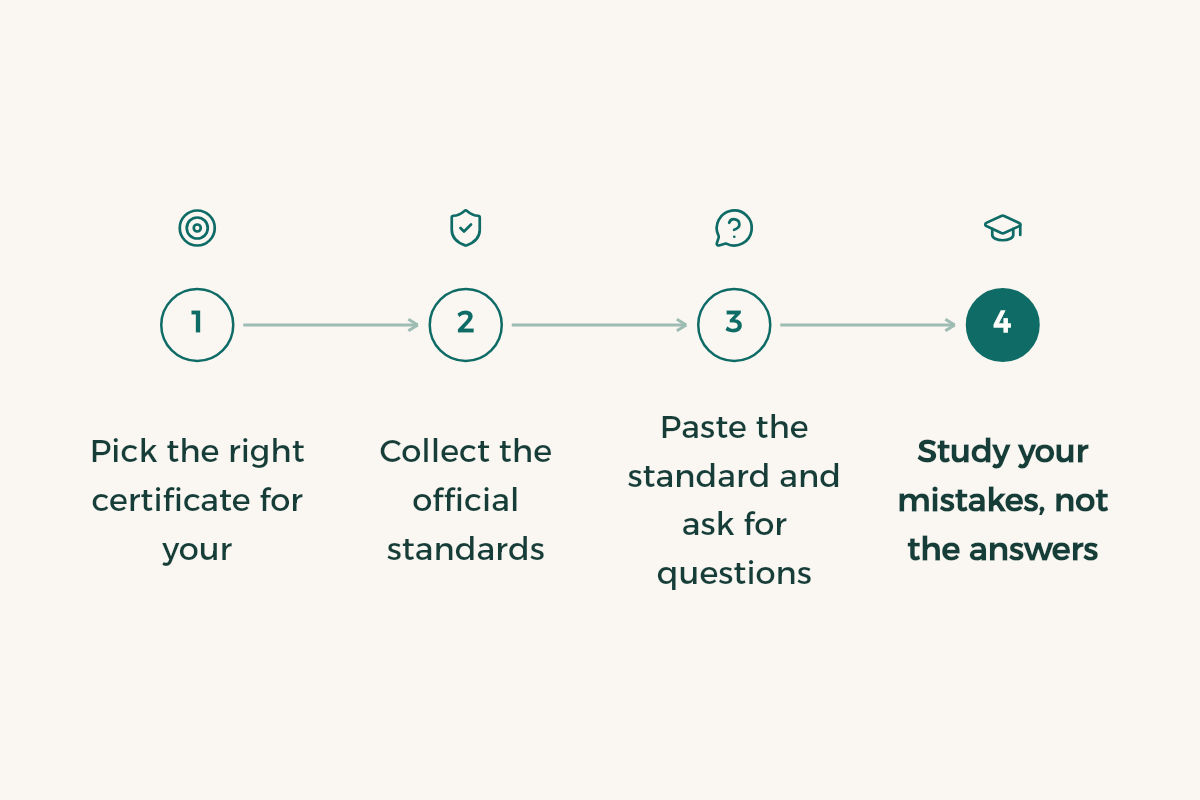
- Pick the right certificate for your level
Read the requirements for each certificate on the SOCPA site and compare them with the courses you have finished.
- Collect the official standards
Download the standard text from the SOCPA site. Do not rely on a summary the tool writes from memory.
- Paste the standard and ask for questions
Ask for multiple-choice questions on the pasted text only, with an explanation of why each wrong option is wrong.
- Study your mistakes, not the answers
Keep a list of the questions you got wrong and retest yourself on them every week.
Worked example: a journal entry you check with the tool
Take a simple textbook transaction: a company buys office furniture for 20,000 riyals, paying half in cash and the rest on account. The entry: debit Furniture 20,000; credit Cash 10,000 and Accounts Payable 10,000. Write your entry first, then ask the tool to check it and explain the effect of each side on the accounting equation: assets rise by the furniture and fall by the cash, and liabilities rise by the payable. Do not ask it for the entry from scratch, because in the exam you write it alone.
Mistakes accounting students make with AI
- Accepting unchecked numbers: the tool can add wrongly or swap debit and credit, so recalculate in Excel.
- Mixing standards: always ask which standard your course uses, because tools sometimes blend different frameworks.
- Memorising theory answers: exam questions apply rules to a case, so practise cases, not just definitions.
- Pasting real data from your training placement: client and payroll data are confidential, so swap in made-up figures first.
A weekly plan for an accounting course
- Right after the lecture
Solve the new chapter's exercises by hand before opening any tool.
- Midweek
Ask for five similar exercises with different figures, solve them, then ask for a review of your steps.
- End of week
Summarise the chapter rules in a small Excel sheet with a cell that checks total debits equal total credits.
- Before the exam
Go through your list of repeated mistakes and follow the final exams revision plan.
E-invoicing: a topic you meet in training before the exam
The Zakat, Tax and Customs Authority (ZATCA) launched the e-invoicing (Fatoora) requirements and rolled them out in two phases. The aim is to turn paper invoices and notes into an electronic process covering invoices, credit notes and debit notes between buyer and seller. The developer portal publishes the specifications, including the Electronic Invoice Data Dictionary, the Electronic Invoice XML Implementation Standard and the Security Features Implementation Standards. Taxpayers can use any solution provider that meets the requirements.
Here is part of the Electronic Invoice Data Dictionary published by ZATCA: [text]. Turn it into a simple table with the field name, what it means in plain accounting-student terms, where it comes from in the accounting cycle, and a made-up example value.
Excel is your real partner
Anything involving numbers should go through a spreadsheet you build yourself, with the tool writing and explaining the formulas. Start with Excel for students, and if you do not have Office yet, read Office free for students.




Before finals, see final exams revision, and for general study prompts see ChatGPT study prompts.