By the tiswa editorial team, from the official sources listed at the end of this guide. How we write our guides
A special education major in Saudi Arabia prepares teachers to work with students who need teaching designed for them: a child who struggles to read, a blind student, a child on the autism spectrum, a gifted student who needs more challenge than the regular class. It is as human as it is professional, and it calls for patience, careful observation and the ability to break a plan into small steps. This guide covers the years and tracks from official department pages, the courses, the practicum, admission, jobs, the teaching licence and tips to succeed.
How long is a special education degree?
The bachelor usually takes four years. According to the King Saud University special education department, the department was founded in the 1404-1405 AH academic year, and its degree takes four years, after which students graduate in one of its specialised tracks. Under the Umm Al-Qura University special education study system, students take eight levels as regular full-time students, and graduation requires passing every course with a cumulative GPA of at least 2.00 out of 5.00. Hours and plans are updated, so use your cohort's plan from your department website.
Special education tracks
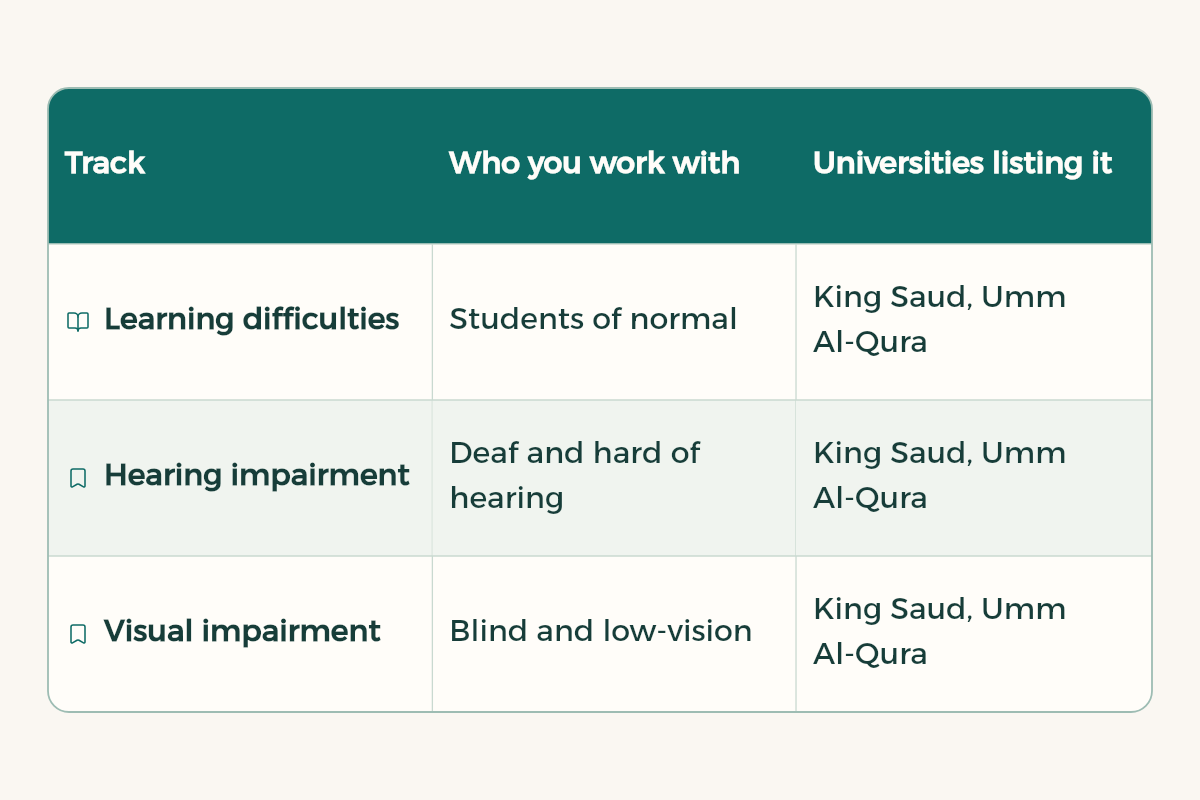
The biggest decision in this major is the track, because it decides which group of students you will work with. King Saud University lists five bachelor tracks, and the Umm Al-Qura page lists six:
| Track | Who you work with | Universities listing it |
|---|---|---|
| Learning difficulties | Students of normal intelligence who struggle with reading, writing or maths | King Saud, Umm Al-Qura |
| Hearing impairment | Deaf and hard of hearing students, including sign language and communication methods | King Saud, Umm Al-Qura |
| Visual impairment | Blind and low-vision students, including Braille and mobility | King Saud, Umm Al-Qura |
| Intellectual disability | Students who need adapted curricula and life skills | King Saud, Umm Al-Qura |
| Giftedness | Gifted students who need enrichment and acceleration | King Saud (giftedness and innovation), Umm Al-Qura (giftedness and talent) |
| Behavioural disorders and autism | Children on the autism spectrum and with behavioural disorders | Umm Al-Qura |
What will you study?
The Umm Al-Qura page splits the plan into four main areas: general preparation, educational preparation in education and psychology, specialised preparation in special education, and then the track courses. Most plans include courses such as:
- Introduction to special education: categories, definitions and the history of services.
- Developmental and educational psychology: how children develop and learn.
- Assessment and diagnosis: identifying a student's needs with standardised tools and structured observation.
- Behaviour modification: analysing behaviour and building plans to change it.
- The individual education plan: writing measurable goals for each student and tracking them.
- Track courses: such as teaching students with learning difficulties, Braille, sign language or autism intervention programmes.
- Practicum: real supervised teaching at a school or centre in the final year.
Admission to special education
Most public universities admit to colleges of education on a weighted percentage of the secondary school grade and the General Aptitude Test, and the Achievement Test may count depending on the university. At some universities you take a common first year in the college of education track and are then placed in departments by GPA and preference, and an interview may be required. Read your university's admission guide, see the first year in the preparatory year guide, and learn how GPA calculation works.
Jobs for special education graduates
- Special education teacher in inclusive schools and public or private special education programmes, depending on your track.
- Resource room teacher for students with learning difficulties.
- Specialist at rehabilitation and early intervention centres.
- Teacher in gifted programmes.
- Assistant in assessment and diagnosis teams after the required training.
- Researcher or specialist after graduate study, such as a master's in your track or a higher diploma in applied behaviour analysis.
Your practicum experience is the strongest part of your CV at graduation. Document the individual plans you wrote (with student details removed) and the aids you designed, and read student CV and job interview questions.
The professional teaching licence
Government education jobs require the professional licence from the Education and Training Evaluation Commission, according to the commission FAQ. In the private sector, the employer sets its own conditions. The licence needs two tests: the general educational test and the specialised test. If you fail one, you retake only that one, and the licence is valid for five years and then renewed. Check on the commission website which specialised test matches your track before registering.
How to do well in the major
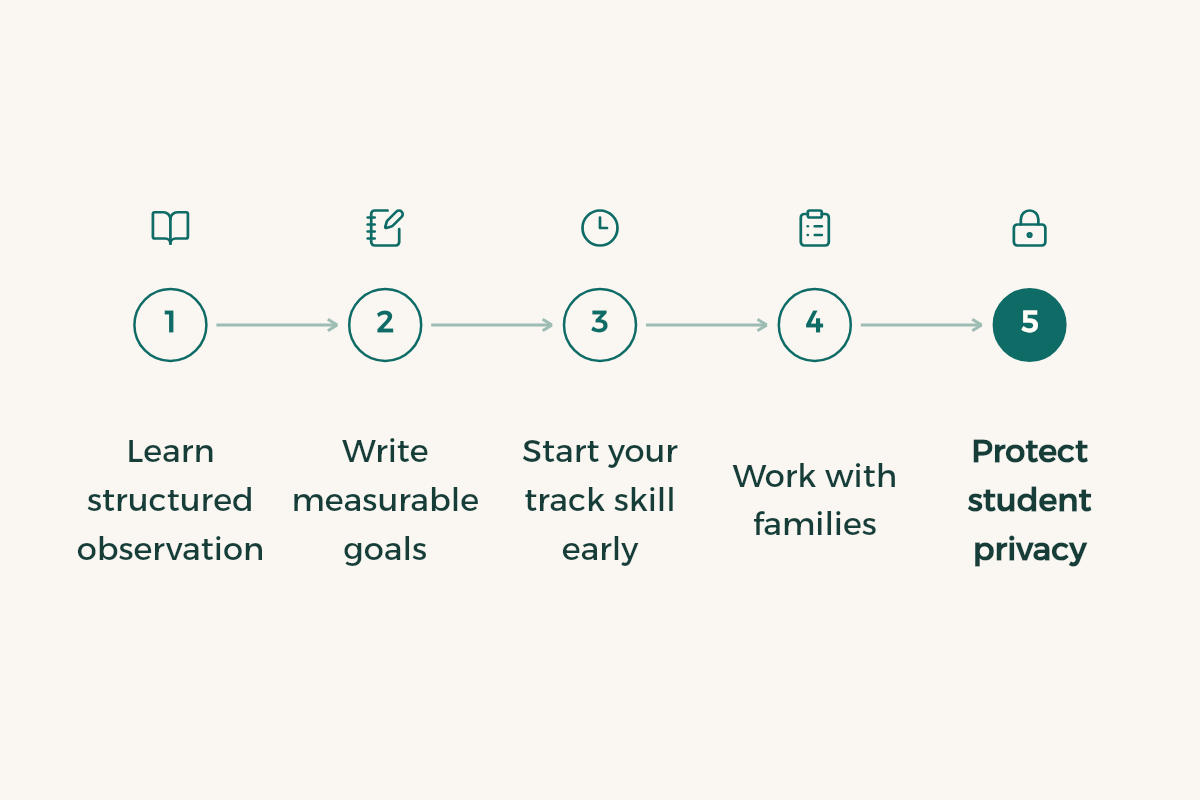
- Learn structured observation
Record behaviour precisely: what happened before, the behaviour itself, and what happened after. Every plan rests on this.
- Write measurable goals
Instead of "improves in reading", write "reads ten words from a set list with 80% accuracy in three sessions in a row".
- Start your track skill early
Braille and sign language need daily practice, not just study before the exam.
- Work with families
Families are partners in the plan. Practise explaining a child's progress in simple, reassuring language.
- Protect student privacy
Never share photos, names or details of your students anywhere, even in assignments.
A prompt for writing individual plan goals
AI helps you phrase and organise goals, but never enter anything that identifies a student. Describe the case in general terms only:
I am a special education student in the [track] track. I am practising writing an individual education plan for a hypothetical student aged [age], current level: [general description with no names or personal data]. Suggest three long-term goals, each with two measurable short-term objectives stating the behaviour, the condition and the success criterion. Then suggest a simple way to record progress weekly. Do not assume any diagnosis beyond what I stated.




If you are comparing education majors, read early childhood major, and browse the majors section.