By the tiswa editorial team, from the official sources listed at the end of this guide. How we write our guides
A second-year student has four final exams in eleven days. In week one the student revises the course that is enjoyable, the one already half known, and leaves statistics for the last three days. The outcome is clear before the results are posted. The problem was not effort. He split his hours by feeling.
Where do you find the King Abdulaziz University final exam schedule?
Trust what the university itself publishes. KAU posts its academic calendar on its website,1 and students use the Odus Plus system to see their own courses and schedule.2 The exact slot for each course, meaning room and hour, can change between semesters and between sections, so do not copy it from a friend or an old screenshot.
Take a screenshot of your personal schedule the moment it appears and note when you last checked. If two exams collide, the official route is your college’s student affairs office, not an agreement with the instructor in the corridor. Other dates, such as add and drop, are covered in the King Abdulaziz University academic calendar guide.
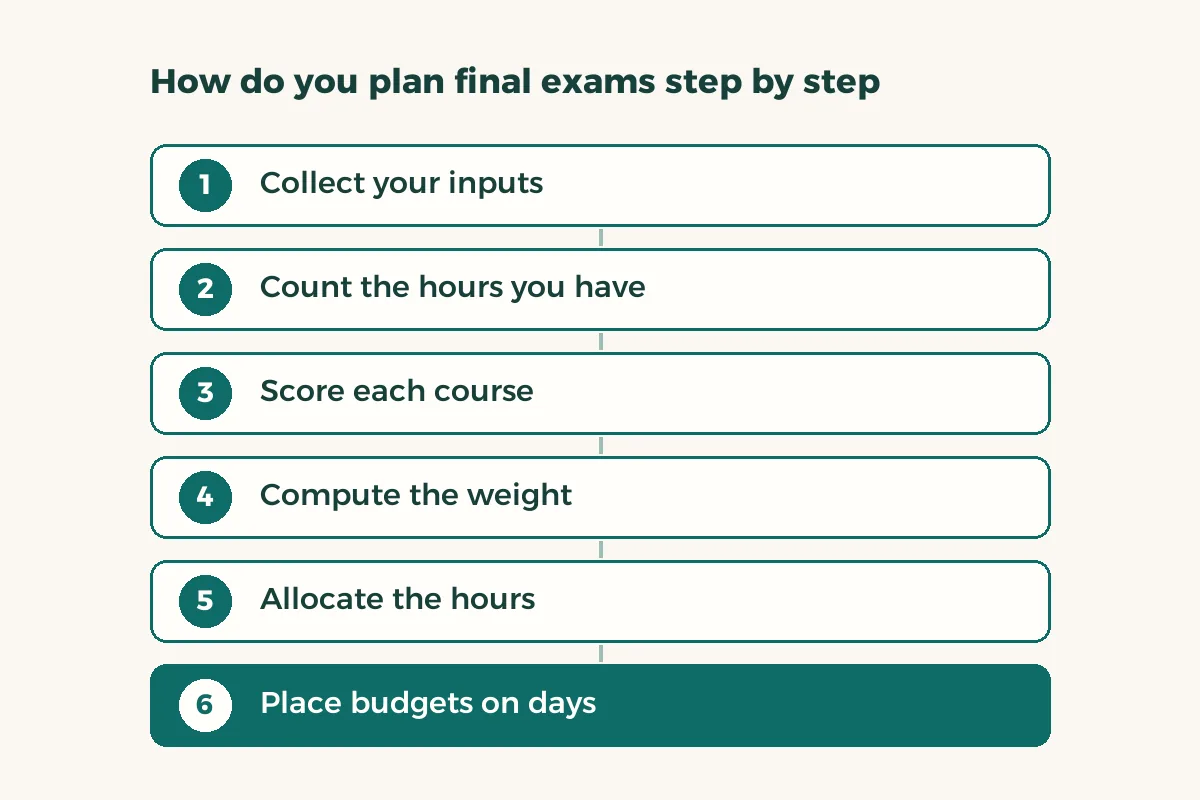
How do you plan final exams step by step?
- Collect your inputs
Write your courses, their credit hours and each exam date on one sheet.
- Count the hours you have
Count the days from today to the last exam, subtract blocked days, and multiply what is left by the study hours you can honestly do per day, usually three to five.
- Score each course
Give 1 to a course where you stand on solid ground, 2 to a middling one and 3 to one you struggled in. Use the midterm result, not the course’s reputation.
- Compute the weight
Multiply credit hours by the difficulty score, add the results and divide each course’s weight by the total.
- Allocate the hours
Multiply each share by your total available hours. That is each course’s budget.
- Place budgets on days
Put the nearest exam first, but do not leave the heavy course for the day before its paper.3
- Review halfway
After half the time, self-test every course. If a course changed, change its score and recompute.
How do you split study hours across courses, with a worked example?
This is an illustration with invented numbers, not real courses. Say you have four courses and forty hours of study available:
| Course (example) | Credit hours | Difficulty | Weight | Share of 40 hours |
|---|---|---|---|---|
| Course A | 4 | 3 | 12 | about 19 hours |
| Course B | 3 | 2 | 6 | about 10 hours |
| Course C | 3 | 1 | 3 | about 5 hours |
| Course D | 2 | 2 | 4 | about 6 hours |
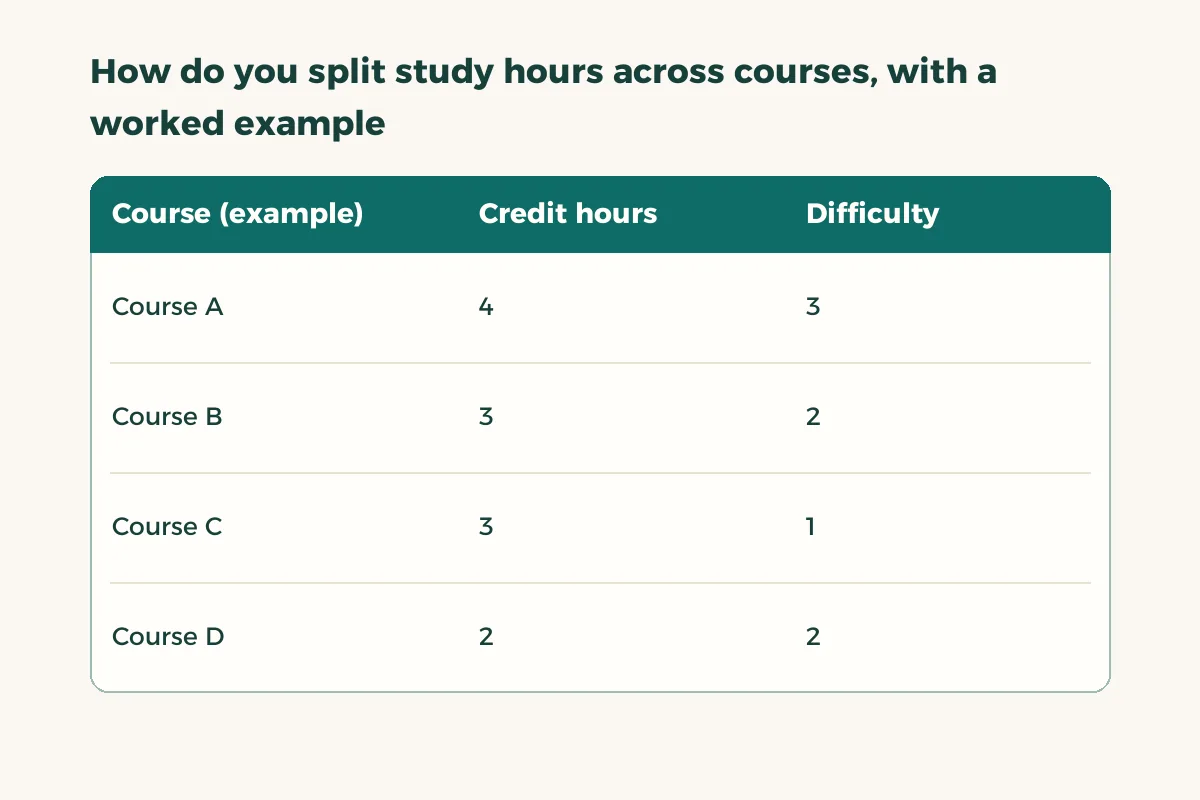
The weights total 25. Course A gets 12 of 25, which is 48% of your hours, and the lightest course C gets 12%. If five hours for Course C looks too few, that is the point: a course you already control does not need hours in proportion to its credits. It needs a short review and practice questions.
Treat the numbers as a starting point, not a law. If your mark in a course sits on the edge of passing, raise its difficulty to 3 even if it feels light. The same plan in a generic format is in the study plan template if you want a ready copy.
What do you do on the empty days between two exams?
They are not holidays. Split them in two: half for the next paper, half for a light review of one that passed or one still to come. University learning centres advise realistic schedules that include breaks and practice questions rather than unbroken reading.34 Keep the final 24 hours before each exam for light review only, never new material.
If your exams come on consecutive days the method shifts a little, and revising for back-to-back exams covers it.
When should you change the plan midway?
When review shows you what instinct did not. Test yourself after half the time with closed-book questions and log the misses in an error log. If you missed questions in a course you thought was easy, raise its score and move hours to it from one that beat your expectations. A change at the halfway point is nearly free. A change in the last week is expensive.
Another trigger is a moved or clashing exam. Go back to the official schedule, count the remaining days again and redistribute all the budgets with the same rule. Do not patch the old plan.
How do you protect yourself when one course goes wrong mid-season?
A course can go off script: a hard paper, an exhausting day. Keep fifteen percent of your hours unallocated and reserve them for what the halfway review uncovers. If you do not need them, they go to the heaviest course. After each paper write two lines: what did the instructor ask that I did not expect? Those lines help with the remaining papers, since lecturers in one department tend to share a question style.
In the last week do not change your whole method. A student used to summaries stays with summaries, but adds past questions if the department provides them. A big change in the final days confuses more than it helps.
What mistakes come up again and again in final exam planning?
The first is counting time in weeks instead of real hours, so a student believes there are three weeks when there are forty usable hours. The second is starting with the course you like. The third is filling every hour of the day and collapsing on day four. The fourth is forgetting sleep, which is part of the plan, as sleep and studying explains.
And do not forget the day itself: documents, pen and arrival time. Sort that out in the exam day checklist before the night before, and check the night before an exam guide for what to do then.