By the tiswa editorial team, from the official sources listed at the end of this guide. How we write our guides
You have four exams. The first is in three days, the second two days after that, the third three days later, and the last three after that. A schedule like this does not work with “one course a day”, because the days are unequal and so are the courses. What works is giving each day one clear job.
Where do you find final exam dates at King Faisal University?
The first reference is the academic calendar published on the pages of the Deanship of Admission and Registration.1 It gives the frame of the semester. Your personal timetable, with rooms and hours, is in your account on the electronic registration system, and that is the version to trust if it differs from anything forwarded around. The university’s published study and examination regulations remain the reference for absences and clashes.2
Write your four exam dates in order on one sheet before building any plan. For add and drop and semester excuses, the King Faisal University academic calendar guide has the detail, so we do not repeat it here.
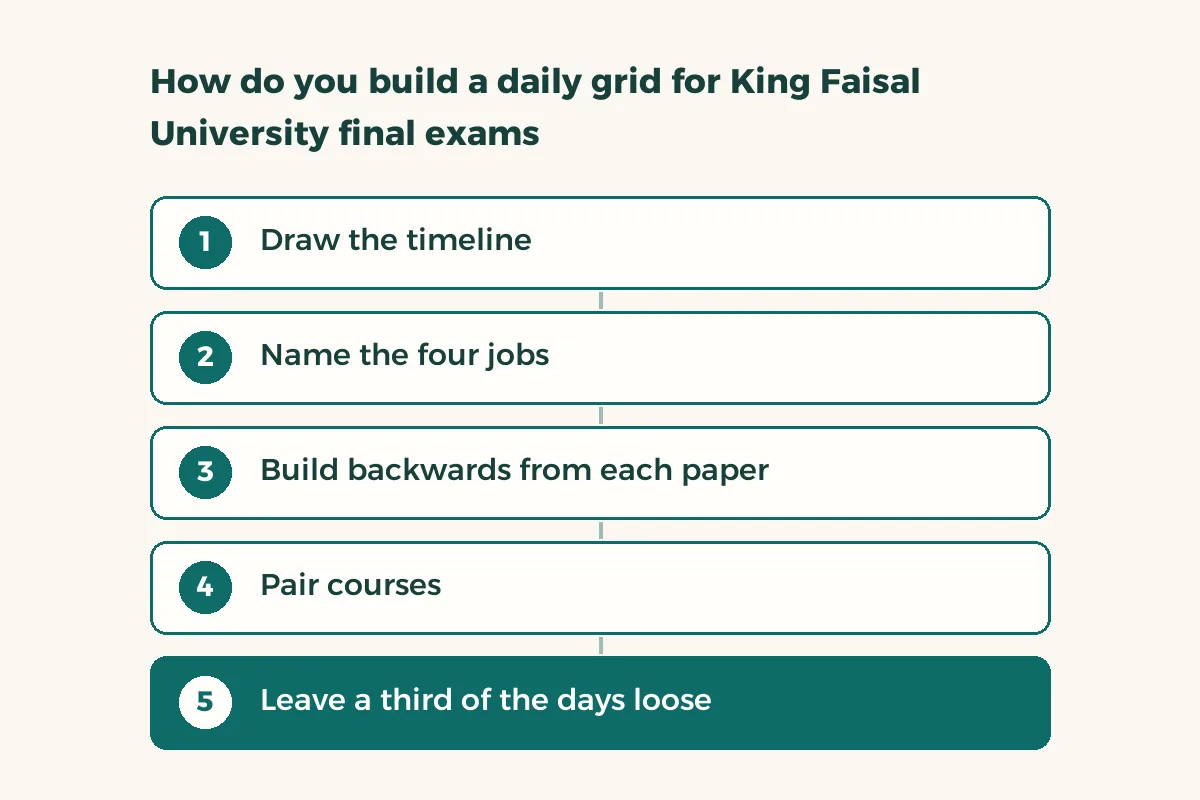
How do you build a daily grid for King Faisal University final exams?
- Draw the timeline
Write the days from day one to the last exam and mark every paper on it.
- Name the four jobs
Learning: read and summarise. Practice: answer questions without the book. Error review: read only what you got wrong. Rest: sleep and move.
- Build backwards from each paper
The last day before a paper is error review. The day before that is practice. Anything earlier is learning.3
- Pair courses
On the day of a paper do not study a heavy course after it. Use the evening for a light pass on an upcoming one.
- Leave a third of the days loose
One day in three stays relatively empty for whatever did not get done.
What does a twelve-day, four-exam grid look like?
This is an illustration with symbolic courses, not the university’s timetable. Exam A falls on day 4, B on day 6, C on day 9 and D on day 12:
| Day | Main block | Light block |
|---|---|---|
| 1 | A: learn the material | B: skim the contents page |
| 2 | A: practice questions | none |
| 3 | A: error review | B: start learning |
| 4 | Paper A | evening: B for one hour |
| 5 | B: practice questions | C: skim the contents page |
| 6 | Paper B | evening: rest |
| 7 | C: learn the material | D: skim the contents page |
| 8 | C: practice questions and error review | none |
| 9 | Paper C | evening: D for one hour |
| 10 | D: learn the material | none |
| 11 | D: practice questions and error review | early sleep |
| 12 | Paper D | none |
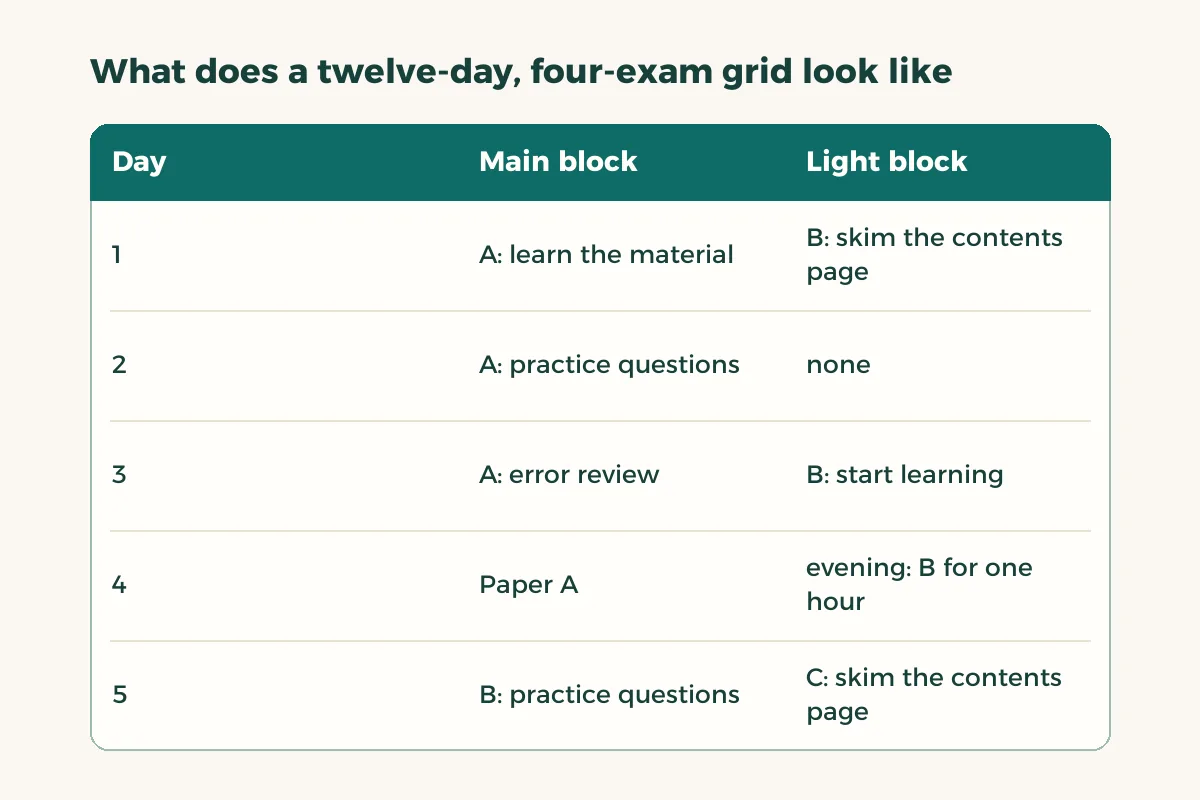
Notice that day 5 combines practice for B with a skim of C, and day 3 carries error review for A together with the start of B. Those doubled days are the price of a short gap. In the long gap between C and D you can afford a full day separating learning from practice.
Why do practice questions beat rereading?
Because memory keeps what it retrieves, not only what it reads. A widely cited review of study strategies found that self-testing and spreading study across days rank among the most useful techniques, while highlighting and rereading help less.3 That is why the grid above gives a full day to questions before the error-review day. To build a self-test from course objectives, read self-testing before the final exam.
On every question day, write what you got wrong in one notebook. It becomes the material for error-review day. The method is in the exam error log guide.
What if the exams come back to back with no gaps?
Merge the jobs. In the morning, practice questions for the next course; on the evening of a paper, error review for the one after. What can be learned shrinks, so the choice becomes what to leave out. Leave the chapters with small weight on the paper and protect those that carry more marks. For this case see revising for back-to-back exams.
If your exams are scattered across two weeks, the risk is the opposite: you forget what you studied first. Bring back a few short questions for each course three days before its paper, even if you once mastered it.
How do you adjust the grid when a day goes wrong?
It will happen: illness, a family trip, a day when nothing got done. The rule is to cut new learning, never error review. Squeeze what you missed into the empty rest day, and if there is none, drop a low-weight section. Do not try to make up eight hours in one night, because tiredness lowers what you retain.
If you finish faster than the grid, do not add a new course. Add a second round of practice questions for the heaviest one. That round is what exposes the gaps you did not know about.
What mistakes show up in final exam grids?
Filling every day with nine hours, so the plan collapses on day three. Postponing practice questions to the final night. Studying a heavy course after a paper while exhausted. Trusting a timetable that arrived in a group chat without checking it. And above all, too little sleep, which is why the grid puts an early night before the last paper; sleep and studying explains why.
Prepare the day of the paper the day before: your card, pen and departure time, then run through the exam day checklist.