By the tiswa editorial team, from the official sources listed at the end of this guide. How we write our guides
The Study in Saudi Arabia platform is the official portal run by the Ministry of Education for international students who want to study at Saudi universities and institutions. If you arrived here from a general search, know first that the platform does not admit you directly. It works as a bridge between you and the university you want. So the process starts with your account on the platform, continues with your application to the university, and ends with the university and the Ministry completing admission together. This guide explains the steps as the platform itself describes them, and what to check before you begin.
What the platform is
The platform is registered with the Digital Government Authority. It lists the programmes and universities open to international students, with details for each programme. It also shows three funding routes: fully funded scholarships, partially funded scholarships, and self-funded programmes. Its homepage says fully funded scholarships cover study at Saudi universities in various specialisations, and that partially funded scholarships cover part of the tuition. It does not spell out what a full scholarship covers in detail, or what share of tuition a partial scholarship pays, so ask the university about every item before you rely on it.
What you need before you start
You will need an email address you can access throughout the process, a valid passport, and your secondary school certificate or its equivalent. Some universities ask for certificates to be attested by the authorities in your country. King Saud University, for example, requires that certificates and supporting documents be properly attested by the authorities it determines. If your certificate needs attestation, start that first, because it is often the step that takes longest.
The platform states one clear rule: your personal profile must be complete before you can apply to any programme. So do not wait until you find the perfect programme to begin. Complete the profile first, then search.
Application steps on the platform
- Create an account and complete your profile
Register with your email and password, then complete your personal details. You cannot apply to a programme until the profile is complete.
- Start your application
Press the button to start an application, then choose the programme and the university. Check that your field is offered at that university.
- Apply to the university
Scholarships are obtained through the university. You submit an admission application to the university, which reviews it and issues its initial decision.
- Wait for the university to approve
After university approval, the university and the Ministry of Education complete final admission. This can take time, so do not assume silence means refusal.
- Follow your status on the platform
The status stays under review until a final decision is issued. Check your account regularly and answer any request for information quickly.
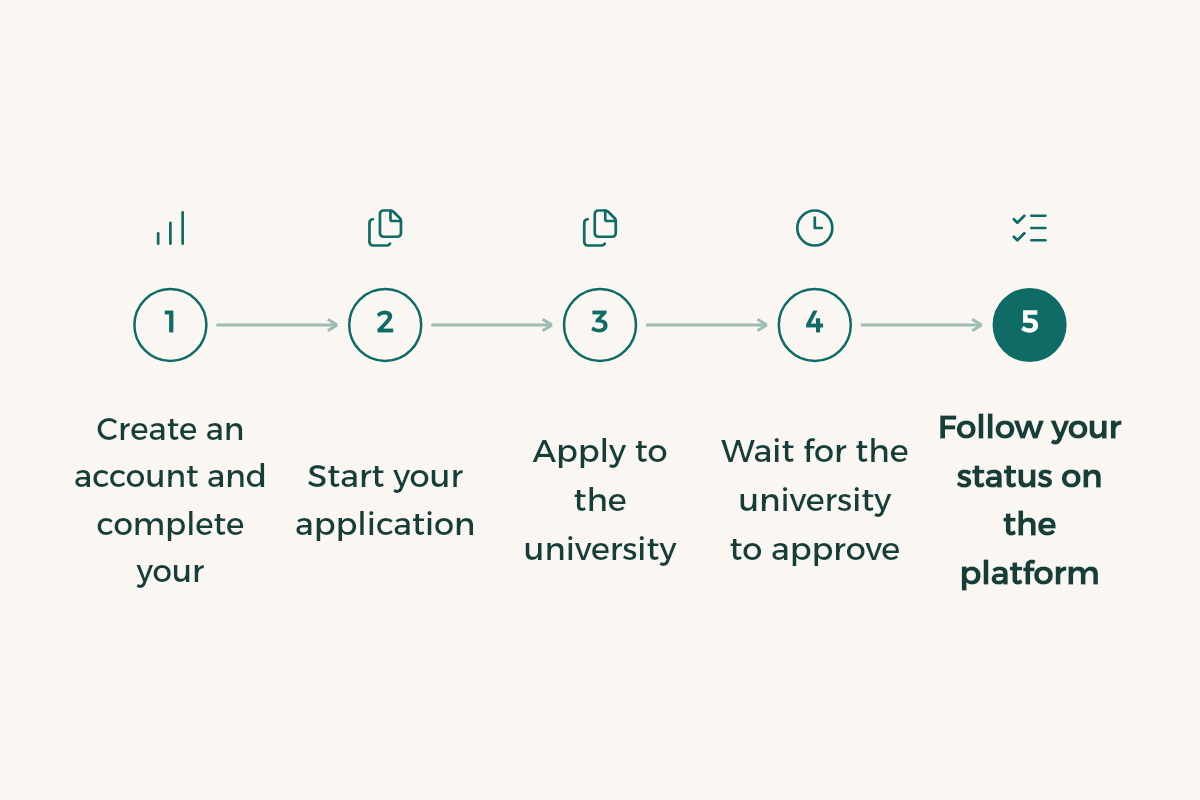
The platform FAQ explains that an application marked "under process" is still being reviewed by the institution, and that you should keep monitoring it until a final decision is issued. Do not read that status as a refusal, and do not submit a second application to the same programme without first checking with the university.
Which details can be changed after you submit
Contact details can be updated at any time. Other application data cannot be changed after submission, so review everything before you press send. A passport number can only be changed if the account is new and no application has been submitted from it. The practical rule is simple: compare your name and passport number with the document itself, not with what you remember, and write your name exactly as it appears in the passport.
The university makes the academic decision
The platform makes the process easier, but the academic decision belongs to the university. Read the international admission page of the university you care about, understand the conditions of its college and specialisation, and check which documents it asks for. Some colleges run written tests or interviews for certain programmes. For example, King Saud University says its external scholarship applicants may need a personal interview for medicine and dentistry, and a written test for architecture and planning. Those details do not always appear on the platform's general pages.
If you are thinking about a master's after your bachelor's, read the master's in Saudi Arabia guide. It explains the usual conditions for graduate study and how applicants are ranked. If your plan is to finish a degree in your own country first and then study here, check the equivalency rules early, since they differ from one case to another.
Life after admission
Admission is not the end of the road. You will need housing, a residence arrangement and a plan for daily life in a new city. Read the university housing guide to understand the options, and your first week at university to plan the start. If part of your study will be in Arabic, read about learning Arabic in Saudi Arabia before you arrive.
If you are already studying in the Kingdom and want to compare the Saudi student scholarship tracks, read scholarships for Saudi students. The two routes have different rules, so do not mix them up.