By the tiswa editorial team, from the official sources listed at the end of this guide. How we write our guides
In week two you send your supervisor a four-word title: “properties of semiconductor materials”. They smile and ask how many lab hours you have. You do not know. They do the sum on a sheet in front of you. The sample arrives in three weeks, the instrument is shared with two other groups, and every reading needs an hour to cool down. You have eleven working days. The title was not wrong. It just rested on nothing you actually control.
How do you work out the scope of a physics capstone project?
Scope is a number before it is an idea. Work out four quantities and put them on one page: the instrument hours your lab manager will sign off for you, the readings needed for one trustworthy data point, the number of points your curve needs, and the weeks you leave for analysis and writing. What remains after the subtraction is the real size of your project.
| Quantity | The question to ask | Red flag |
|---|---|---|
| Instrument hours | How many hours can I book, and who shares the instrument? | “I will find time”, with nothing booked in writing |
| Repeats | How many times do I repeat each reading to see the spread? | One reading per point |
| Points | How many points do I need to show a relationship or rule one out? | Four points and the word “linear” |
| Analysis | How many weeks do I keep for processing, plotting and writing? | Analysis starts two days after measuring ends |
| Fallback | What do I do if the instrument fails? | No plan beyond waiting |
An example, for illustration only and not a ready-made project: with thirty instrument hours and a point that needs three repeats at one hour each, you can afford about ten points for a single variable. That does not stretch to two variables at ten points each, which is a hundred. Trim the question now, before the calendar trims it for you in a way you would not choose.
Which graduation project ideas in physics are small enough?
- Pick one quantity to measure
A speed, an oscillation period, a current, a wavelength. If you wrote “and” between two quantities, you have two projects.
- Pick one variable to change
Temperature, length, voltage or angle. Hold everything else fixed and write down the values you held.
- Fix the range
From what to what? A wide range means more points and more hours.
- Write the prediction before you measure
What do you expect to see, and why? That is how you will know whether the result surprised you or confirmed you.
- Test the question in one sentence
“How does ... change when ... changes over the range ..., measured with ...?” If it takes two sentences, it has not narrowed yet.

This frame suits an experiment. If your project is a simulation or an analysis of published data, computing time replaces instrument hours, but the sum is the same: what do I have, how long does each run take, and how many runs do I need?
Should you estimate uncertainty before you start measuring?
Yes, and it is what separates a physics project from a desk report. NIST Technical Note 1297 sets out a method for evaluating and expressing measurement uncertainty. It separates components evaluated from repeated readings from those evaluated by other means, such as an instrument’s specification, and then combines them into one standard uncertainty.1 What matters for you is that you know your experiment’s error sources before you spend its hours.
Ask three things about every measurement. What is the smallest division on the tool? Does the reading wander on its own? What in the room affects it, such as temperature or vibration? Write the answers in week one. If your tool’s error is larger than the change you are looking for, the question is bigger than your instrument, and finding that out in week three beats finding it out in week eleven.
For planning the analysis, the research chart guide and the results section guide show how the numbers will be presented.
How do you keep graduation project documentation for a physics experiment?
Record every raw reading in a notebook or file with the session date and conditions, and never delete an odd reading without a written reason. The American Physical Society’s guidelines define fabrication as inventing or altering data to support a conclusion, define falsification as changing or omitting data so the record is misrepresented, and call intentional omission to mislead an egregious departure from expected norms. They also say scientists must ensure the integrity of data, analysis and presentation.2 None of that means every reading belongs on your final plot. It means every exclusion has a reason in your notebook.
Store the files in more than one place from day one. The research portable storage guide shows a simple setup, because losing two weeks of readings before submission is a story that repeats.
How much of the semester should you leave for analysis and writing?
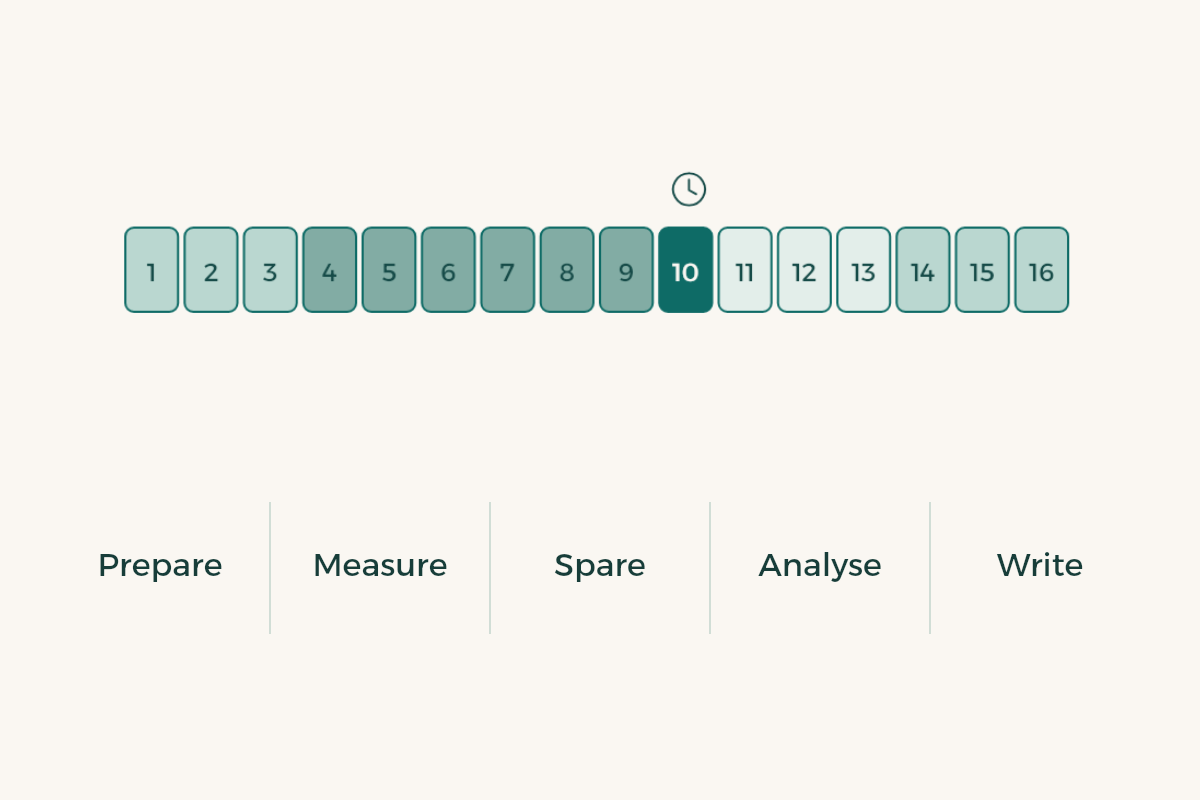
At least a quarter. As an example, a sixteen-week semester gives you four weeks with no new measurements. That sounds like a lot until processing begins and two points turn out to need repeating. Book those weeks in advance and a broken instrument becomes a small crisis instead of the end of the project.
Draw up a plain timetable: two weeks of preparation and reading, six weeks of measuring, one spare week for faults, three weeks of analysis and two for writing and the talk. This is an example, not a rule, so adjust it with your supervisor to your lab and your department.
What mistakes quietly widen a physics project?
The first is adding “compare with theory”, then “compare with a past study”, then “run a simulation”, because each looks small. Together they are a second project. The second is starting on an instrument you have not trained on, so the first weeks go on learning it. Ask for a short training session before you book your hours. The third is waiting for the perfect result and repeating forever. A measurement that does not match the prediction is a valid result if you can explain why.
Cite as you write, not afterwards. See the plagiarism guide and the APA citation guide, and the physics major guide if you are still shaping where your degree goes. When submission season brings printing and binding, browse the student deals.
How do you prepare for the graduation project defense with a physics scope?
Before the defense comes the scope talk. Send one page: the question in a line, the quantity, the variable, the range, the instrument hours you have booked, the weekly timetable and a fallback if the instrument fails. End with a closed question: would you rather I take the narrower range or the wider one? The email to professor guide helps with the opening, and the thesis supervisor guide explains what the role involves.