By the tiswa editorial team, from the official sources listed at the end of this guide. How we write our guides
A second-year business student in Sakaka, with a solid GPA, realises in semester four that the one course he looks forward to is programming. Time feels short and one question matters: can he move to a computing major without starting over? The student is an example, but the situation is familiar, and the answer sits in the university’s own policy, not in what classmates say.
What does internal transfer mean at Jouf University?
Internal transfer is a move inside the same university: from one college to another, from one department to another, or from one major to another. Jouf’s undergraduate study and examinations regulations allow it under controls the university approves.2 It is separate from external transfer, where a student arrives from another university and applies under a different announcement from the Deanship of Admission and Registration.
The difference matters in practice. If you transfer internally your courses stay in the same academic record, so there is no outside equivalency and no new institution in the calculation. If you want to leave Jouf for another university, the better guide is transferring between universities.
What are the internal transfer conditions at Jouf University?
The university publishes an admission, transfer and credit equivalency policy, and it sets out the conditions below for moving between colleges, departments and majors.1 We have kept them as written. Each programme also sets its own minimum GPA, which its college council decides.
| Condition | What the policy says |
|---|---|
| Number of times | Once during your studies, unless an exception is approved |
| Time limit | No more than two academic years, meaning four semesters, on the two-semester system, and six on the three-semester system |
| Minimum credit hours | 14 completed credit hours |
| Study plan | Latest approved plans only |
| Diploma to bachelor’s | Not allowed |
| Seats | Admission depends on seats in the new programme |
| Application period | The windows set by the Deanship of Admission and Registration |
A request outside the announced window is not accepted, so following the deanship’s calendar is part of the transfer itself.
How are applicants ranked when requests exceed seats?
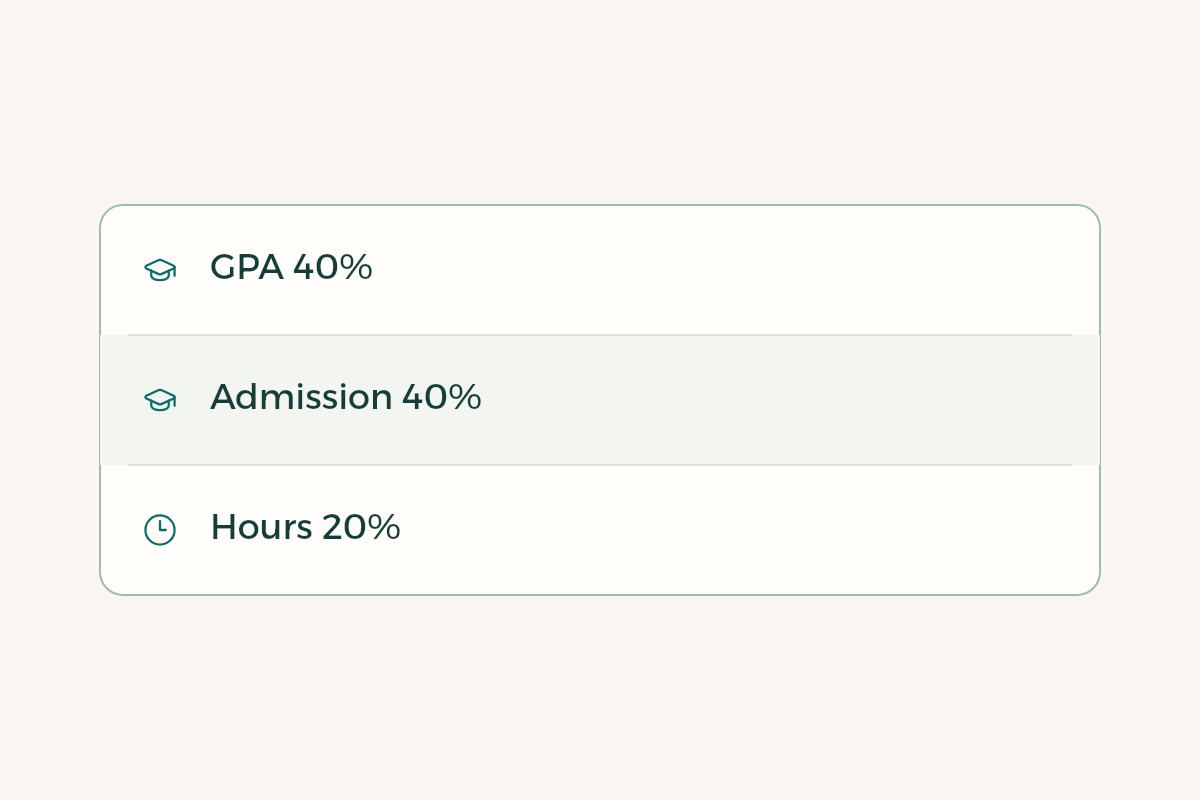
Many students assume GPA is everything. The policy describes a mixed score: 40% cumulative GPA, 40% the admission percentage you entered with, and 20% completed credit hours weighted by course. Each programme also sets a minimum GPA based on the lowest GPA accepted that year, and higher GPAs get priority.1
Here is an illustrative case with numbers we made up, not the university’s. Two students compete for one seat in the same programme. The first has a high GPA but an average admission percentage. The second has a slightly lower GPA, a high admission percentage and more completed hours. The second can come out ahead because of the other two weights. The point is to work out all three, not one.
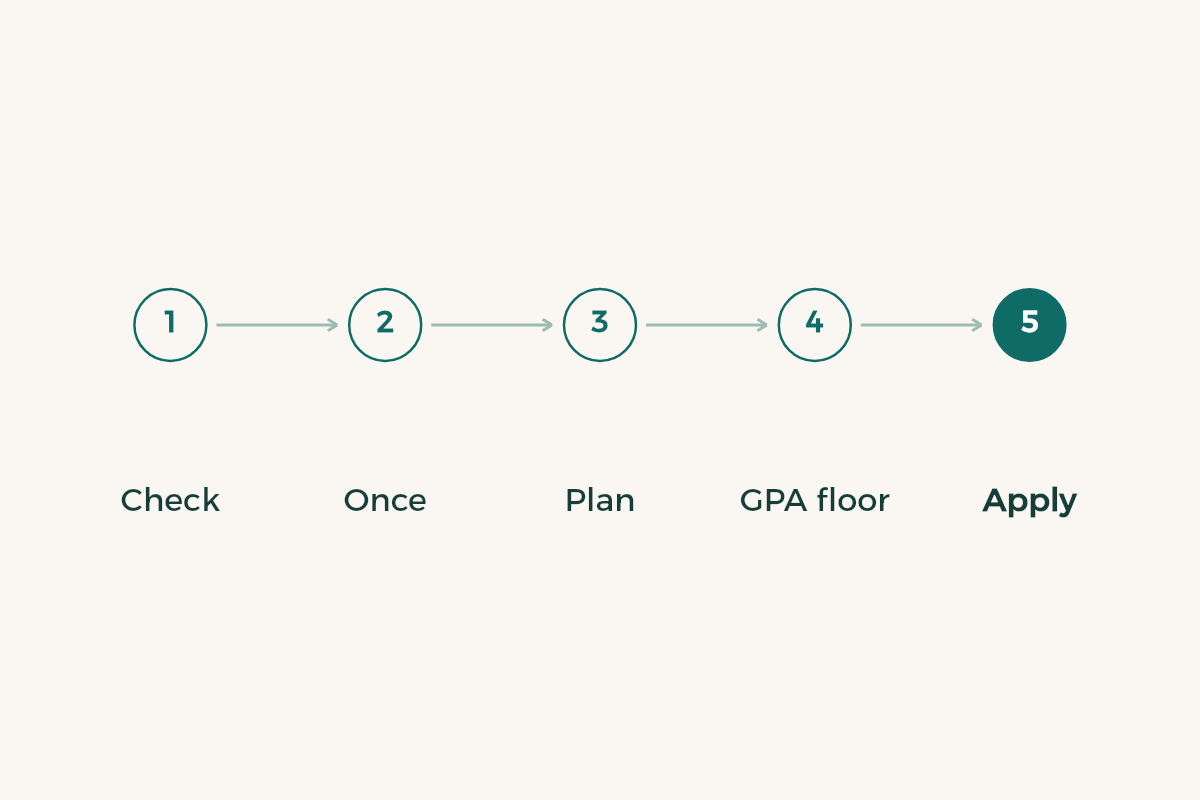
- Check where you stand
Count your past semesters. You need four or fewer on the two-semester system and at least 14 completed credit hours.
- Find out whether you transferred before
If you already moved between departments or colleges, the door is closed without an exception, so do not spend time on an ordinary request.
- Open the new programme’s plan
Transfers follow the latest plan. Compare your courses against it and see how many will count and how many you will repeat.
- Ask the department for the GPA floor
Each programme sets one through its college council, and it moves with the applicants. Ask your academic advisor for last year’s figure.
- Apply in the announced window and follow up
Put the deanship’s date in your calendar. If you are refused, ask why before you decide anything else.
When do you lose your right to transfer without noticing?
The first common mistake is counting semesters wrongly. A summer term and a semester you withdrew from both need a direct question to the deanship, because the university decides how they are counted. Withdrawal has its own guide, semester withdrawal, worth reading before you decide.
The second mistake is transferring to escape a low GPA. A transfer does not erase grades: first-department courses stay in your record and may still count. To improve the GPA itself, read raising your GPA and work out your figure with GPA calculation. The third mistake is moving into a new major without understanding how credit hours work, which the credit hours system explains.
Is there an exception to the one-transfer rule?
Yes, but it is not an open door. The policy says exception requests go with their justification to the Vice-Rector for Educational Affairs through the dean of the college you are leaving, and the Permanent Committee for Academic Affairs of Students reviews them and sends a recommendation.1 That means your dean has to back the request first, and your reason must be written and specific: a documented health situation, or a change in the programme itself, not simply a change of mind.
If you are still choosing a direction, read how to choose a major before you commit, because the best transfer is the one you never need.