By the tiswa editorial team, from the official sources listed at the end of this guide. How we write our guides
Picture an information systems student who sends one CV to ten organisations and hears back refusals or silence from all of them. You open the CV and find a good graduation project titled “Library management system”, with not one word about data, payments or verification. The project would fit a fintech role, but it is written in the language of a library. The problem is the wording, not the student.
How do you apply for a fintech internship as a student?
The route is set by the organisation: a form on its site, an email address or a careers page. Follow what it publishes to the letter, and check with your college training office, because your university sets the conditions and length of any placement. What concerns us here is what you write inside the application. NACE lists critical thinking, communication and technology among its career readiness competencies, and employers look for them.2 Any university project shows them if you write it up correctly.
One caution. Do not tell an organisation in your note that it is “opening internships” or “taking trainees” unless you saw that in a published posting. Work from the posting in front of you.
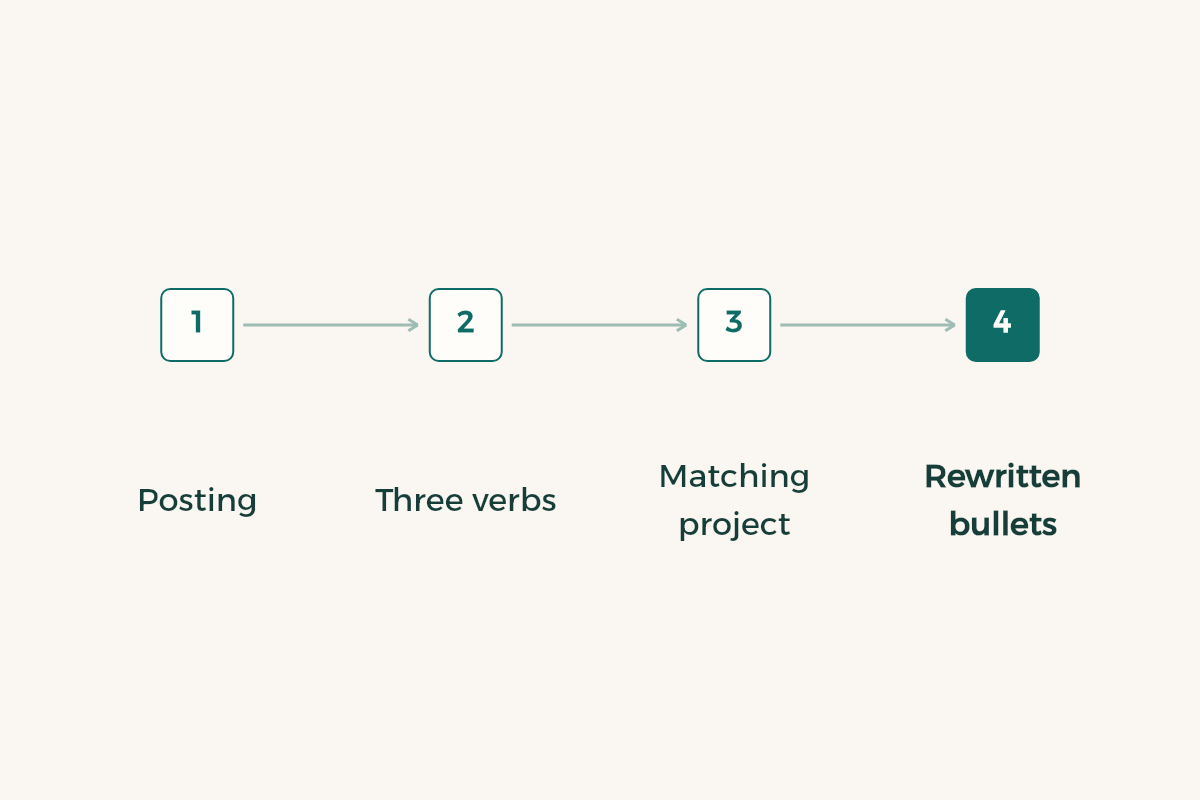
How do you read a posting and pull out what it wants?
- Copy the posting into a file
Postings are taken down after a few days, and you will want to refer back to it.
- Highlight verbs, not adjectives
“Analyse”, “document”, “test”, “support customers”. Words like “passionate” and “motivated” do not tell you what you will do.
- Pick the three verbs that repeat or come first
The rest is detail. If you count fifteen skills, the posting is a wish list rather than a test.
- Write under each what you actually did
A project, a course or an activity. A verb without evidence stays out.
- Leave out what you have not done
Do not list a skill you have never practised. You will be asked about it in the interview.
Which university project should you rewrite?
The best choice is the one that matches two of the three verbs, not the biggest or the newest. Below is how one project reads differently depending on the role. These are examples, not real work:
| University project | Role it serves | How to phrase it |
|---|---|---|
| Survey analysis in a statistics course | Junior data analyst | “Cleaned 150 responses, grouped them and compared two segments” |
| Web app from a software engineering course | Quality testing or technical support | “Wrote ten test cases for sign-in and a sandbox payment” |
| Case study in an accounting course | Finance operations | “Matched two entries against a sample statement and logged the differences” |
| Marketing plan for a student product | Product growth | “Compared three messages across the sign-up steps” |

Notice that each line carries a verb and a number, and no claim beyond them. If you cannot recall the numbers, go back to your files, and if they are gone, describe what you remember accurately and skip the figure. To build a piece you can attach to the application, read a fintech internship portfolio.
How do you write the note in four sentences?
- Sentence one: the role and where you saw it
“I am applying for the data analyst internship posted on your careers page.”
- Sentence two: the project
“In my statistics project I cleaned 150 responses, grouped them and compared two segments.”
- Sentence three: the link
“That is close to the data analysis task in your posting.”
- Sentence four: the ask
“My CV and a link to the project are attached, and I would welcome an interview.”
Professional writing guidance, including Purdue’s writing lab, advises fitting the application to the organisation and the job and keeping it specific and brief.1 Four sentences do that. If you need a layout for the CV itself, read the student CV guide, and to check a system can read your file, see the resume system check.
What is the difference between co-op and summer training?
Co-op is a stretch of real work built into your study plan, and summer training is a shorter spell in the break. Both answer to your university’s rules first and the host’s rules second. Ask your college training office three things: does this placement count for me, how many hours are required, and do I need an official letter? Then apply. A few days after you send the application, a polite follow-up is fine, and we cover it in following up on a training application.
If nobody replies, do not read silence as a refusal. Organisations review applications in batches. Send one follow-up, then move on to the next application.
What mistakes sink an application?
| Mistake | What happens | Do this instead |
|---|---|---|
| One CV for every organisation | The reader cannot see the link to the role | Change three bullets per application |
| A long list of skills | Nothing backs any of them | Two skills with one project each |
| A long cover note | It goes unread | Four sentences |
| A link that does not open | The application drops out quietly | Open it from a phone without logging in |
To prepare for the interview that follows, read how to explain your project in an interview, because the project you wrote into the application is the first question.