
By the tiswa editorial team, from the official sources listed at the end of this guide. How we write our guides
In week two you wrote a title you liked: “factors affecting Saudi stock prices”. You sent it to your supervisor and got the usual reply. Which factors? Which stocks? Which period? Where is the data? You opened your phone to find a site with prices and discovered that prices are the easy part, and the rest of what you need is scattered in places you do not know yet. That is where the real project begins.
How do you choose a finance graduation project question?
Write the question in one line containing four things: the variable you explain, the variable you think explains it, the sample and the period. “Is the debt-to-equity ratio related to profitability in listed companies in one sector over a stated period?” is a full question. “Debt and its effect” is half a title.
| Element | What you write | Red flag |
|---|---|---|
| Dependent variable | What you are trying to explain | Two outcomes in one question |
| Explanatory variable | What you expect to matter | No data exists for it |
| Sample | The number of firms or people and their sector | More than you can collect data for |
| Period | Specific years or events | A period in which accounting rules changed |
| Tool | A spreadsheet or statistics package | You do not know how to use it |
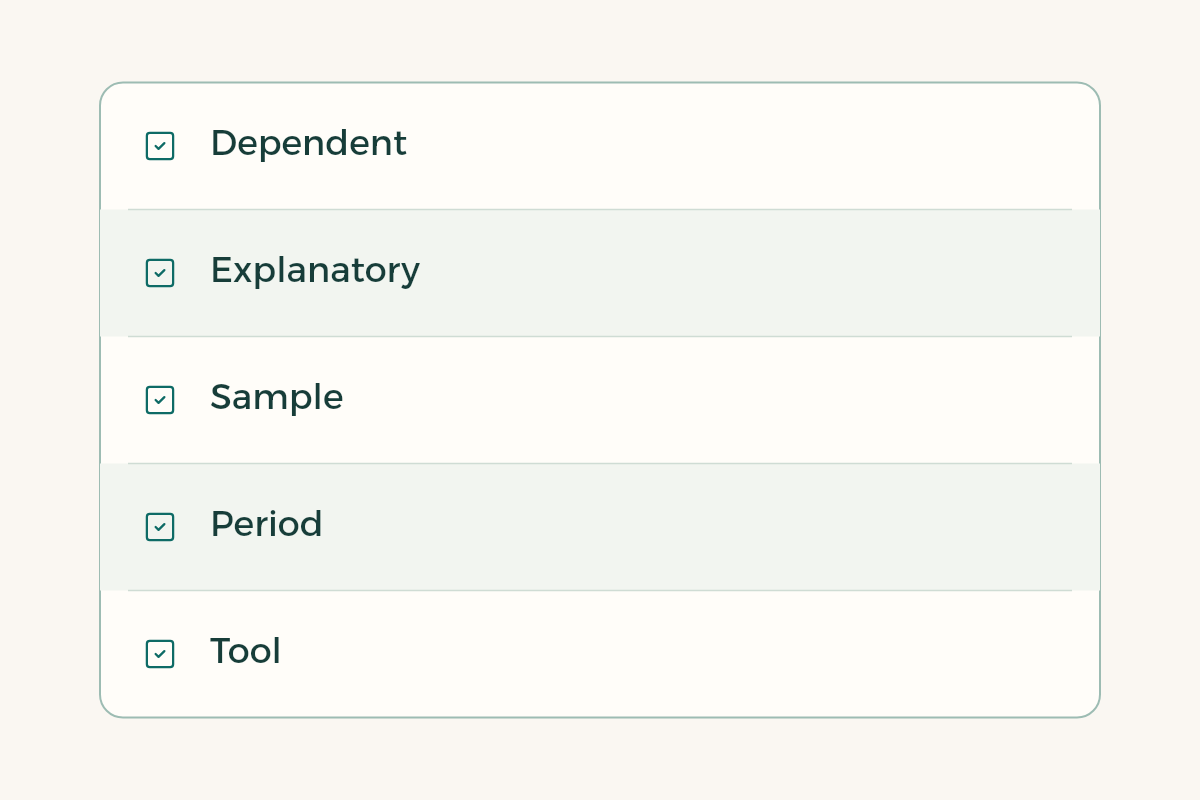
Students overlook the last row. If you cannot yet do descriptive statistics in a spreadsheet, read the Excel guide for students and the Excel charts guide before you decide on a design, because the tool sets what you can finish.
Which design suits a finance graduation project?
| Design | The idea | What it needs |
|---|---|---|
| Ratio analysis | Compare a ratio across firms or years | Published financial statements and a spreadsheet |
| Event study | Look at a price change after a stated announcement | The announcement date and prices around it |
| Survey | Ask investors or students about financial behaviour | A tested tool and enough replies |
| Case study | Analyse one firm’s financial decision | Published documents and permission if needed |
An example, for illustration only: an event study might ask “did a company’s share price move after a dividend announcement?”, which needs the announcement date and prices in a short window around it. That is a method, not a result, and you should claim nothing about the Saudi market until you have read the numbers yourself.
Most students pick ratio analysis, and that is reasonable. But make yourself say what is new. Comparing the same ratios for the same firms over the same years repeats hundreds of earlier projects. Change the sector, the period or the question.
Where do you find data for a finance graduation project?
The Capital Market Authority publishes regulations, announcements and the prospectuses of companies and funds.1 A prospectus is dense with historical numbers and explains the business and its risks. For economic background, the General Authority for Statistics publishes national accounts, prices, trade and investment.2
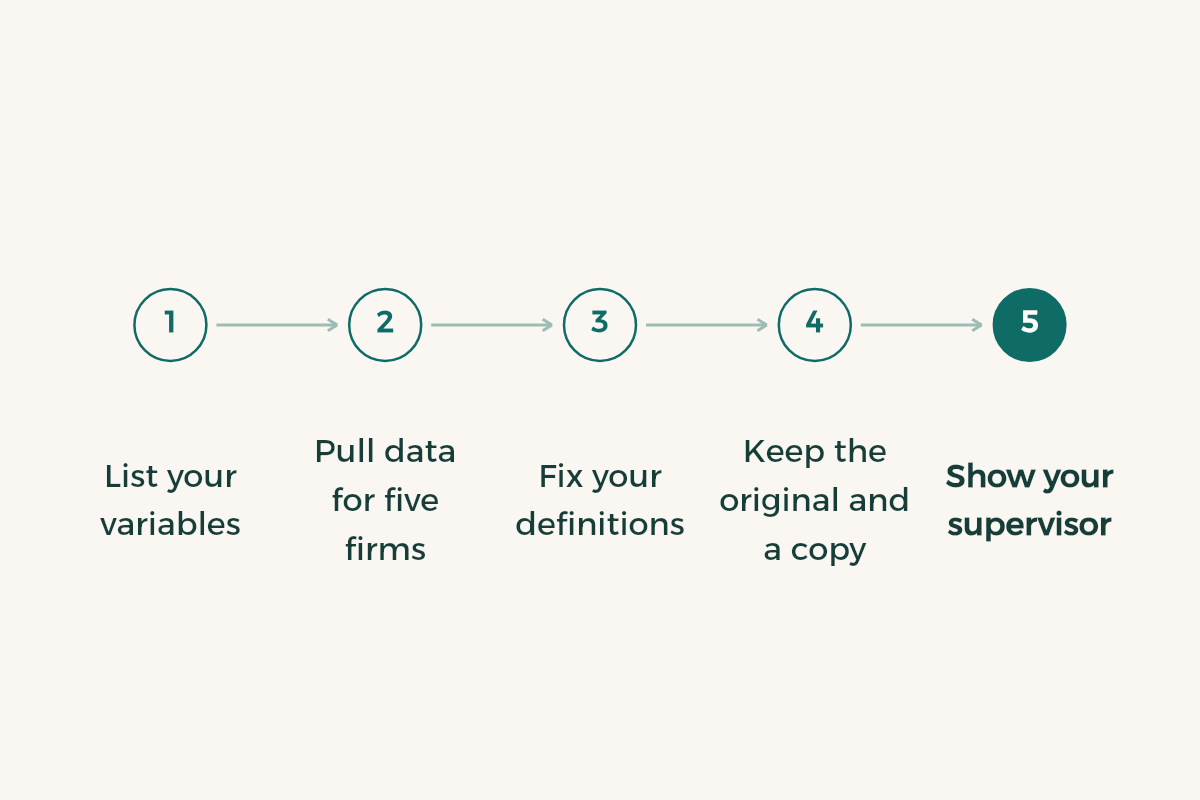
- List your variables
For each one write the source, the formula and the unit. If a variable has no source, drop it now.
- Pull data for five firms
Do not assume you will find the rest until you try. Write down the problems: missing numbers, missing years.
- Fix your definitions
Revenue, income and profit mean different things. Choose one definition and write it in the sheet.
- Keep the original and a copy
Never edit the original file. Work on a copy and keep the original as downloaded.
- Show your supervisor the table
Send it before you analyse. They may see that the sample is too small.
Historical prices for listed shares sit with the Saudi Exchange (Tadawul), so download them for five companies first. Then line up the announcement dates against the price dates, because a one-day error in a date can flip an event study.
Here is a sample twelve-week plan you can adjust. Weeks one and two for the question and sample, weeks three to five for collecting and cleaning data, weeks six to nine for analysis, weeks ten and eleven for writing, and the last for review. If data collection slips by three weeks the whole project is at risk, which is why you test with five companies in week one.
How many firms or participants do you need?
Your supervisor sets the number from the design, so do not hold to a figure from a post. A working rule is still useful: a result from ten firms is a story, not evidence for “affects”. Write “in our sample” in the conclusion, not “in the market”. Nobody punishes honesty, but they may punish a claim bigger than your data.
If your project is a survey, avoid collecting personal data you do not need, and ask your supervisor about your university’s policy. If you want to interview a professional, verify their licence with the regulator that licenses them. For lawyers, for instance, the Najiz platform lists licensed practitioners.3
What mistakes repeat in finance graduation projects?
The first is a period that contains one huge unusual event nobody mentions, so the result is credited to your variable when it came from the event. The second is comparing two firms from different sectors as if they matched. The third is copying tables from papers without understanding their formula. The fourth is leaving the conclusion to the last night.
The fifth is the most dangerous: analysis without a hypothesis. A coefficient appears and you explain it after the fact. Write the hypothesis before you run anything. For the proposal read the research proposal guide and the literature review guide, and look at the finance major guide to see where your project sits in the field.
How do you present the project to your supervisor and the committee?
Send one page: the question, the hypothesis, the sample, the source of each variable, the tool and a twelve-week timeline. In the viva give the answer first and the method second, not the other way round. The presentation tips help with that, and the graduation project ideas guide has a section for business and finance.
For printing and binding see the student discounts in Saudi Arabia, and browse the student discount index to see where you are asked to prove student status.