By the tiswa editorial team, from the official sources listed at the end of this guide. How we write our guides
The finance major in Saudi Arabia attracts students who like numbers and follow markets and the economy, but it is much wider than the stock market. Finance graduates work in banks, investment firms, corporate finance departments and government bodies, making decisions such as: should we invest in this project, how should we fund it, and what is this asset worth? This guide covers how long the degree takes, the main courses, admission, how finance differs from accounting, and the professional exams the Capital Market Authority (CMA) requires for some roles, with practical study advice.
How many years is a finance degree?
Finance is a bachelor's of about eight levels, roughly four years. At King Saud University (KSU), the finance plan in the College of Business Administration starts with the preparatory year, then courses shared with the other business majors such as accounting, economics, statistics and management, then specialised finance courses, with cooperative training near the end. Programme names vary, so you may see finance, financial management or financing, but the core content is similar. Read your department's plan before applying, since it sets the hours and courses for your intake.
What courses will you study?
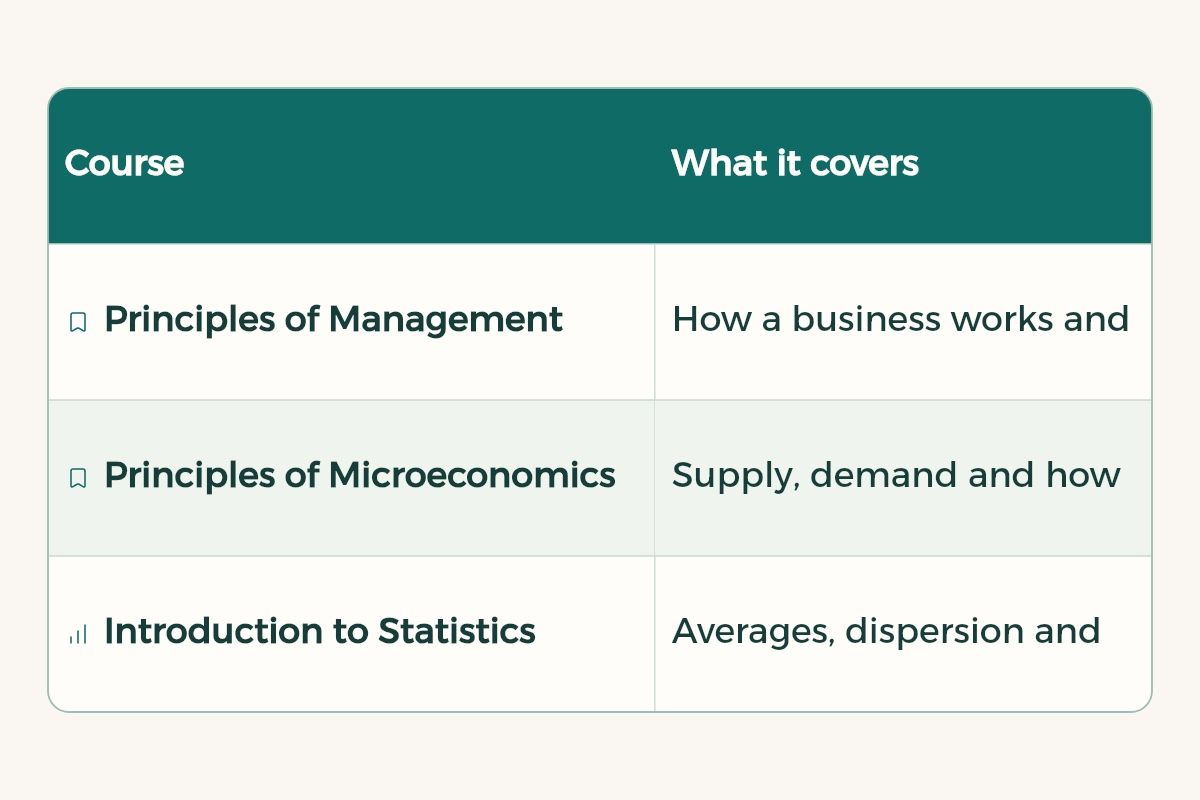
Here is a sample of courses named in the KSU finance plan:
| Course | What it covers |
|---|---|
| Principles of Management and Business | How a business works and where finance fits in |
| Principles of Microeconomics | Supply, demand and how firms and markets behave |
| Introduction to Statistics in Business | Averages, dispersion and probability, the basis of measuring risk |
| Principles of Accounting and Financial Reporting | Reading the statements that analysis is built on |
| Principles of Finance | Time value of money, return and risk |
| Corporate Finance | Project valuation, capital structure and its cost |
| Investment Essentials | Shares, bonds and building a portfolio |
| Financial Markets and Institutions | Banks, markets and how money moves between them |
The single most important idea in the major is the time value of money: a riyal today is worth more than a riyal next year. If you understand it well in principles of finance, most later courses follow from it, from project valuation to bond pricing.
Finance versus accounting
This question comes up constantly. Accounting records what happened and presents it in accurate statements under the standards. Finance uses those statements to make decisions about the future: where to invest, how to fund it, and how much risk to take. So finance students study accounting principles, and accounting students study finance principles, but the focus differs. Accounting has a clear professional body, SOCPA, while finance has qualifications tied to regulated roles in the capital market. If you are torn, read the accounting major guide and compare the courses.
Is finance right for you?
It suits you if you are comfortable with maths and statistics and enjoy building a model in Excel to see how the result moves when one assumption changes. It also suits you if you follow economic news and ask why a share rose or fell. If you expect the major to be day trading and quick profits, you will be surprised, because most of the work is analysis, reports and models. The major rewards the patient student who checks their numbers.
Admission to finance
Business colleges usually admit on a weighted score, and each university publishes its formula. One official example: Imam Abdulrahman Bin Faisal University uses 30% high school GPA, 30% General Aptitude Test and 40% Achievement Test. At some universities you join the college first and specialise later based on your GPA, so take your first year seriously. If you have a preparatory year, the preparatory year guide helps you get through it with a strong GPA.
Capital Market Authority qualification exams (CME)
The CMA publishes the professional qualification exams for people working in the capital market, developed with the Financial Academy. They are not needed to graduate, but they are required to register for specific roles. Examples from the CMA page:
- CME-1A: an international foundation certificate for those who want to work in the capital market.
- CME-1B: a foundation regulatory certificate giving an overview of the Saudi capital market and its rules.
- CME-2B: for registration in compliance and anti-money laundering roles.
- CME-3B: required to register as a broker.
- CME-4A and CME-4B: for registration under the management activity, such as fund managers, portfolio managers and investment analysts.
- CME-5A and CME-5B: to register as a corporate finance professional.
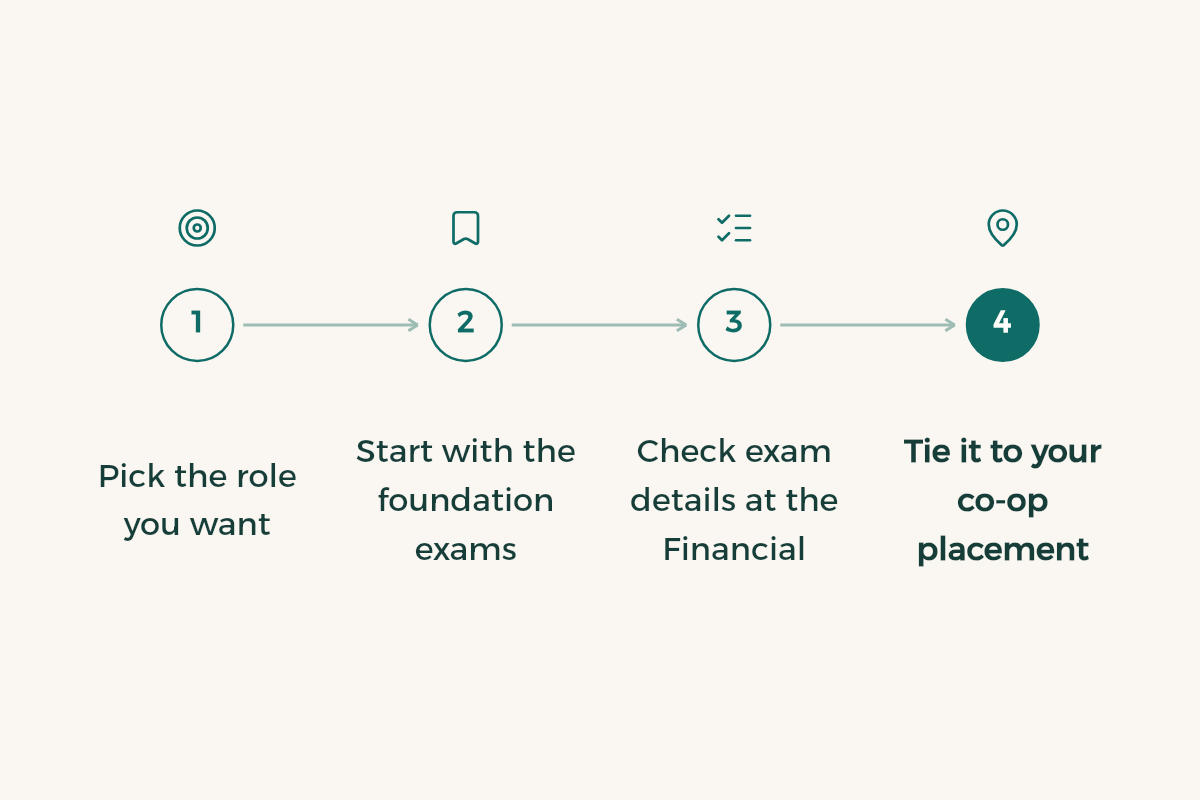
- Pick the role you want
Each exam is tied to an activity, so read the CMA page and choose the one linked to your path.
- Start with the foundation exams
The first certificates give a general base on the market and its rules and suit students near graduation.
- Check exam details at the Financial Academy
Dates, registration and exam format are on the exams page of the Academy's site.
- Tie it to your co-op placement
If your placement is with a financial firm, ask your supervisor which exam your future role needs.
Jobs for finance graduates
Typical fields include corporate finance departments, banks, investment and brokerage firms, asset management, corporate finance advisory, government bodies and funds. Some of these capital market roles require registration and the matching qualification, as listed above. Build experience through co-op training and summer training, since financial employers value practical experience early.
How to study finance
- Understand every formula before you memorise it: what each symbol means and why it divides or multiplies.
- Learn Excel's finance functions such as present value, future value and internal rate of return. Start with Excel for students.
- Solve problems by hand first and check in Excel, since exams are often on paper or with a calculator.
- Read one listed company's annual report each term and apply the ratios you studied.
- Keep up with statistics, because it underpins risk measurement in investment courses.
I am a finance student in principles of finance. Write six graded problems on present value, future value and annuities with simple numbers. Do not write the solutions yet. After I send my answers, tell me which ones I got wrong and explain the idea I missed without giving the final number, then give me the Excel function I can check it with.




If you are comparing neighbouring majors, read the economics major guide and the business administration major guide.