By the tiswa editorial team, from the official sources listed at the end of this guide. How we write our guides
Oxford's OPAL lists about 260 spoken academic phrases grouped by function, including signposting phrases such as I want to talk about3. Phrases like these are what make a student with average English sound organised in front of a graduation project committee, because they tell the audience where they are at every moment.
Why learn ready phrases instead of the whole talk?
Because a memorised script collapses at the first forgotten line. The British Council's LearnEnglish Teens guide to oral presentations recommends very short notes in point form if you are allowed paper, and warns that writing the whole talk and learning it by heart tests your memory more than your English1. Learn the structure and transitions; speak the content from notes.
These phrases have a name in academic English: signposting, showing the listener how the talk is organised5. A Cambridge University Press course in spoken academic English separates signposts, which preview the organisation or the next section, from shorter language signals that mark where you are and where you are heading4.
How do I start a presentation in English?
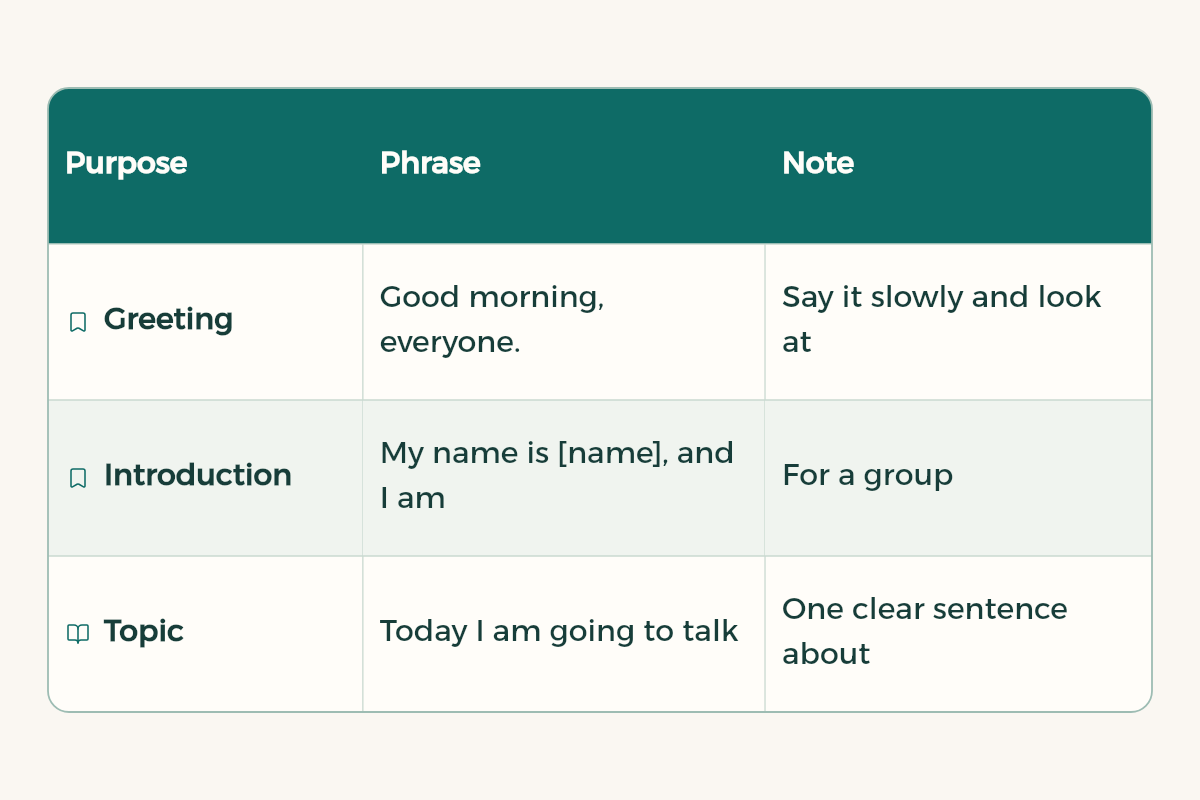
| Purpose | Phrase | Note |
|---|---|---|
| Greeting | Good morning, everyone. Thank you for being here. | Slowly, with your eyes on the room |
| Introduction | My name is [name], and I am a [major] student. | For a group: We are group [number]. |
| Topic | Today I am going to talk about [topic]. | One clear sentence |
| Aim | The aim of this presentation is to [explain / compare / propose] ... | Tells the audience what they will take away |
| Hook | Let me start with a number: ... | A figure from your research or project |
What phrases introduce the outline?
| Purpose | Phrase |
|---|---|
| Dividing the talk | I have divided my presentation into three parts. |
| First part | First, I will give some background on ... |
| Second part | Then, I will look at ... |
| Last part | Finally, I will finish with ... |
| Questions | There will be time for questions at the end. |
What are good transition phrases between slides?
| Purpose | Phrase |
|---|---|
| A new section | Now let us move on to ... |
| Linking back | This brings me to my next point. |
| Referring back | As I mentioned earlier, ... |
| A short recap | So far, we have looked at ... Now ... |
| Handing over | Now I will hand over to [name], who will talk about ... |
| Taking over | Thank you, [name]. I am going to explain ... |
How do I describe a chart in English?
Say what the chart shows, give one result, then explain it. Pick the precise word: sharply, slightly and significantly say more than very and a little. More are in academic English vocabulary.
| Purpose | Phrase |
|---|---|
| Introducing the chart | This chart shows ... / As you can see in this graph, ... |
| The axes | The vertical axis shows ..., and the horizontal axis shows ... |
| A rise | The number increased sharply from ... to ... |
| A fall | There was a slight decrease in ... |
| No change | The figures remained stable between ... and ... |
| A comparison | Compared with group A, group B was significantly higher. |
| An explanation | This suggests that ... / One possible reason is ... |
Keep sentences short and active. The British Council's English Online article gives the example Over one-third of applicants failed the interview, which is shorter and clearer than The interview was failed by over one third of applicants2. It also suggests slowing down on key points so the audience knows they matter2.
How do I end a presentation in English?
| Purpose | Phrase |
|---|---|
| Signalling the end | That brings me to the end of my presentation. |
| Recapping | So, we have looked at three points: ... |
| The final message | The main message I would like you to remember is ... |
| A recommendation | Based on these results, we recommend ... |
| Thanks | Thank you for your attention. |
| Opening questions | I would be happy to answer any questions. |
How do I answer questions after a presentation?
With a phrase that buys time, then a short answer. These cover most situations:
| Situation | Phrase |
|---|---|
| A good question | That is a good question. Thank you. |
| You did not hear | Sorry, could you repeat the question, please? |
| You did not understand | Do you mean ...? / If I understand correctly, you are asking about ... |
| You need time | Let me think about that for a moment. |
| You do not know | I am not sure about that, but I will check and get back to you. |
| Off topic | That is an interesting point, but it is outside the scope of this project. |
| A teammate knows more | [Name] worked on this part, so I will let them answer. |
What phrases work in a co-op training presentation?
A co-op talk is about what you did, not what the organisation does. One sentence on the organisation and department, then your main task, one result you can show, and what you learned. Skip the week-by-week diary. Useful lines: I completed my co-op training at [organisation], in the [department]. The main task I was responsible for was ... The most important thing I learned was ... For the interviews that often follow, see interviews in English.
How do I memorize a presentation fast?
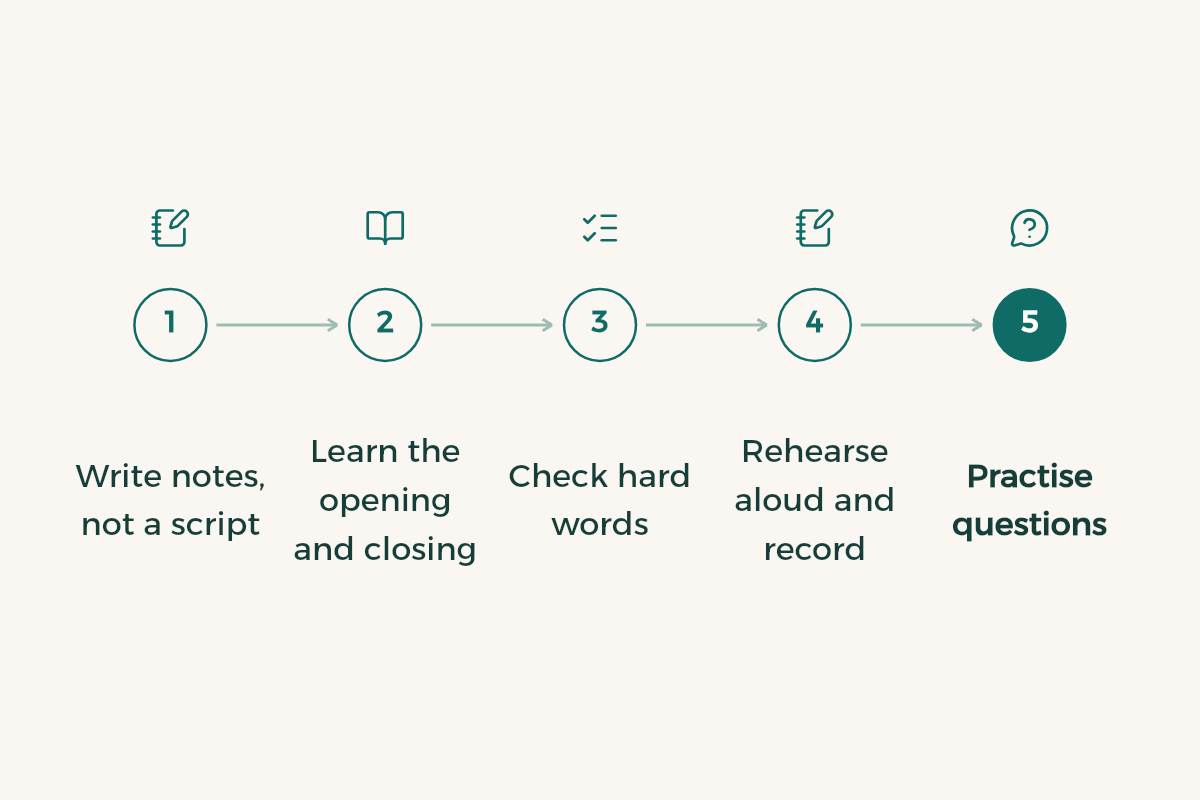
You do not memorise all of it. Learn the structure and the transitions, and rehearse the rest aloud:
- Write notes, not a script
Three points per slide at most, with your opening transition written above them.
- Learn the opening and closing
The first and last thirty seconds. A confident start calms you; a clear ending stays with the committee.
- Check hard words
Hear every technical term in the Cambridge Dictionary and mark the stressed syllable. More in how to improve your English pronunciation.
- Record yourself and listen
The British Council suggests recording yourself and listening back, or asking a friend to listen1.
- Prepare five likely questions
With a short answer for each, or ask ChatGPT for them after giving it your slide notes.
- Time it
If it runs long, cut a slide rather than talk faster.
A full week of preparation is laid out in presentation skills in seven days.
What mistakes do students make in English presentations?
- Reading the slides word for word with your back to the room.
- Opening with an apology for your English. Go straight to the greeting.
- Jumping between sections with no transition, so the audience gets lost.
- Filling gaps with so, ok and umm. A short silence sounds more confident.
- Speeding up when nervous. The same guide says to pause now and then and not speak too quickly1.
- Answering a question you did not understand.
For the slides themselves, see AI presentation makers and Canva for students; for a graduation project, graduation project defence slides.