By the tiswa editorial team, from the official sources listed at the end of this guide. How we write our guides
The date arrives, so on Wednesday night you open PowerPoint and spend two hours choosing a template and swapping fonts. At five in the morning you sleep, and next day you stand in front of the room not knowing how many minutes you will speak. The story is familiar and the cause is single: you spent all your preparation time on looks and none on rehearsal.
How do you practise a clear university presentation in a week?
- Day 1: write the message
One sentence answering: what do you want the audience to remember in ten minutes? If you cannot write it, do not open PowerPoint yet.
- Day 2: sketch the outline on paper
An opening, three main points and a close. Each point gets one example or one figure from your source. That is the whole structure.
- Day 3: build the slides
One slide per idea with as little text as possible. Put what you will say in the speaker notes, not on the slide.2
- Day 4: first run aloud
Stand up and speak through all the slides while timing yourself. Do not stop to fix mistakes; keep going to the end.
- Day 5: fit the time
Cut what runs over. A talk that finishes a minute early beats one that is cut off midway.1
- Day 6: mock talk
Present to a classmate or friend and ask for three hard questions. Note the questions and your answers.
- Day 7: setup
Copy the file to two places, check the laptop and clicker, and rehearse only the opening and the close. Change nothing.

What message should you build the talk around?
A message is a full sentence with a verb, not a title. “Digital marketing” is a title. “Instagram campaigns reach students at lower cost than traditional ads” is a message, and that is an illustration, not a claim. The difference is that a message gives every slide a job: it supports, explains or exemplifies. A slide that does not serve the message is cut, even if you like it.
For a short talk the best outline is a brief opening that states the message, three points, and a close that restates it in different words. Three points suit ten minutes because an audience holds little more than that. For how to design a deck that convinces a doctor or a panel, read how to make a presentation.
How do you practise aloud with a timer?
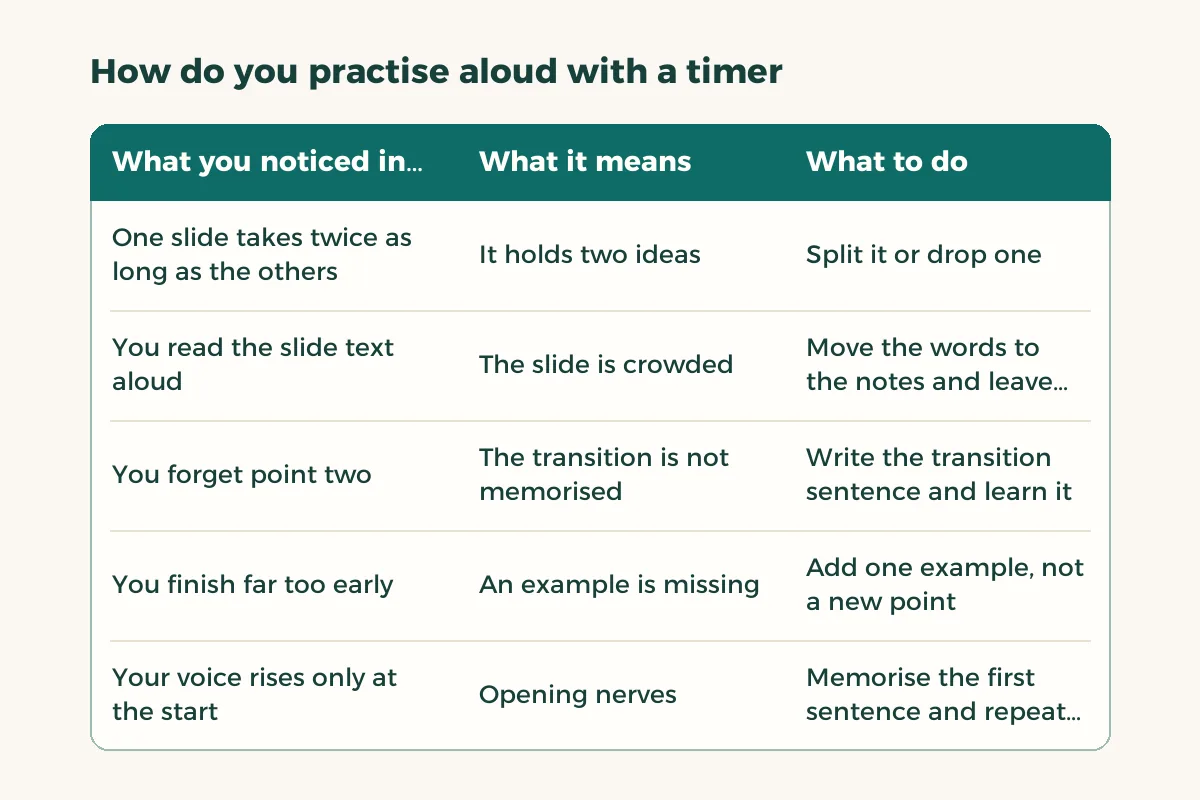
Silent reading fools you, because it runs twice as fast as speech and skips the stumbles. So practise standing and at normal volume. PowerPoint records the timing of each slide while you rehearse,1 and Keynote on a Mac has a similar rehearsal feature.4 If neither is available a phone timer will do; write down the time at each slide.
| What you noticed in practice | What it means | What to do |
|---|---|---|
| One slide takes twice as long as the others | It holds two ideas | Split it or drop one |
| You read the slide text aloud | The slide is crowded | Move the words to the notes and leave two on the slide |
| You forget point two | The transition is not memorised | Write the transition sentence and learn it |
| You finish far too early | An example is missing | Add one example, not a new point |
| Your voice rises only at the start | Opening nerves | Memorise the first sentence and repeat it ten times |
How do you prepare for audience questions?
Write five questions you might be asked, three about the content and two about the source or method. Answer each in two sentences. On day six ask your classmate for questions you did not expect, because surprise is the real test. If you do not know the answer, say so plainly: “I do not have that figure now, and I will check the source and send it to you”. That beats a guess you must correct later.
Talks judged by a panel, such as graduation projects, need extra question practice, and you will find the detail in graduation project defense slides. If you are thinking about using an AI tool to generate slides, read AI presentation makers first and check what it produces yourself.
How do you write a presentation conclusion?
The conclusion is thirty seconds and the last thing the audience keeps. Write it out in full and rehearse it more than any other part. Restate your message in different words from the opening, then add one sentence on what listeners should do with it: try it, read it or ask about it. Do not end with “that is all I have” or just “any questions?”. Better is “I will open the floor to your questions now”, and then wait.
Avoid adding new information in the close. It blurs the message and opens a door you have no time to shut. If time is short, cut a point from the middle and never the close. A talk that ends clearly is remembered better than a richer one that ends in a stumble.
What presentation mistakes keep repeating in university talks?
The first is reading the slide aloud, so the audience feels they do not need you. The second is opening with an apology such as “I did not prepare well”. The third is a final slide reading “Thank you” that stays up during questions, when a summary of your message would serve better. The fourth is talking to the screen, not the room, so practise lifting your eyes after every sentence.
The fifth is ignoring time. If you have ten minutes, plan for eight, because stumbles and questions take the rest. Someone who manages time well looks more professional than someone with a dazzling design. For material on preparing and practising talks, see the University of North Carolina writing centre.3
Do you need a course to learn presentation skills?
Not for one university talk; the plan above is enough. If you want to improve over the long run, present to classmates every two weeks in a study group, or record yourself explaining a lesson to a friend. Improvement comes from how often you speak on your feet, not from how many courses you attended.