By the tiswa editorial team, from the official sources listed at the end of this guide. How we write our guides
A student walks out of microeconomics with four pages of notes on price elasticity. Back in the dorm she reads them from the top, and they feel completely familiar. That is the trap: familiar is not the same as known. Recognising a sentence when you see it is one thing, and writing it when the page is blank is another. Active recall is practice at the second.
In an experiment published in Science, Karpicke and Blunt compared students who retrieved material from memory with students who drew concept maps while looking at the text, and the retrieval group did better on a test a week later.1 The older study by Roediger and Karpicke points the same way.2 Here we take one imaginary lecture on price elasticity of demand and walk through it. The lecture and its details are an invented example for teaching, not from any particular course.
How do you use active recall right after a lecture?
The best time for the first recall is within an hour or two of the end of class, while what you heard is fresh. Do not open your notes. Take a blank sheet and a timer set to ten minutes, and write everything you remember about the lecture in your own order.
- Empty your head onto the page
Ten minutes, no peeking. In the example the student writes that elasticity measures how quantity responds to price and that demand above one is called elastic. She gives the phone example and forgets the bread example.
- Open your notes and compare in a different colour
Add what you forgot and fix what you got wrong. Do not copy the notes. Complete your own page. In the example she adds the formula and the bread example.
- Turn the gaps into questions
Everything added in colour becomes a question: how is elasticity calculated? Why is demand for bread usually inelastic? Put the question on one side of a card and the answer on the back.
- Repeat the questions tomorrow
In the morning or between classes, five minutes, without looking at the answers. What you miss goes into a hard pile.
- Self-test at the weekend
Gather the week’s questions and test yourself under a timer. Anything you miss twice sends you back to the lecture.

What is the difference between active recall and rereading?
Rereading gives you a feeling of fluency, so you think you know it. Recall shows your gaps plainly, and it is uncomfortable because you will get things wrong. The wrong answers are working for you. Dunlosky and colleagues rated practice testing as high in usefulness and rereading and highlighting as low.4 The table is a quick comparison, built on the elasticity lecture.
| What you do | What it looks like after the lecture | What you learn from it |
|---|---|---|
| Reread your notes | Four familiar pages | That you recognise the wording, not that you can write it |
| Highlight the key parts | Colourful pages | That you chose what you think matters |
| Blank page, then compare | A gappy page and a coloured pen | Exactly what you forgot |
| Question cards | Ten cards from one lecture | What you can answer tomorrow |
How do you turn lecture notes into questions?
The Cornell note-taking system keeps a side column for questions and keywords next to your notes,3 which suits this purpose well. Write questions in the column instead of headings, then cover the notes with a sheet and test yourself. If you do not take Cornell notes, add the column after class. For more on notes, see the note-taking guide.
The best questions start with “how”, “why” and “what is the difference”, because answering them needs understanding, not memory. If your course is problem-based, make half your questions problems with new numbers that you change yourself, rather than the same numbers again.
How often should I repeat the questions?
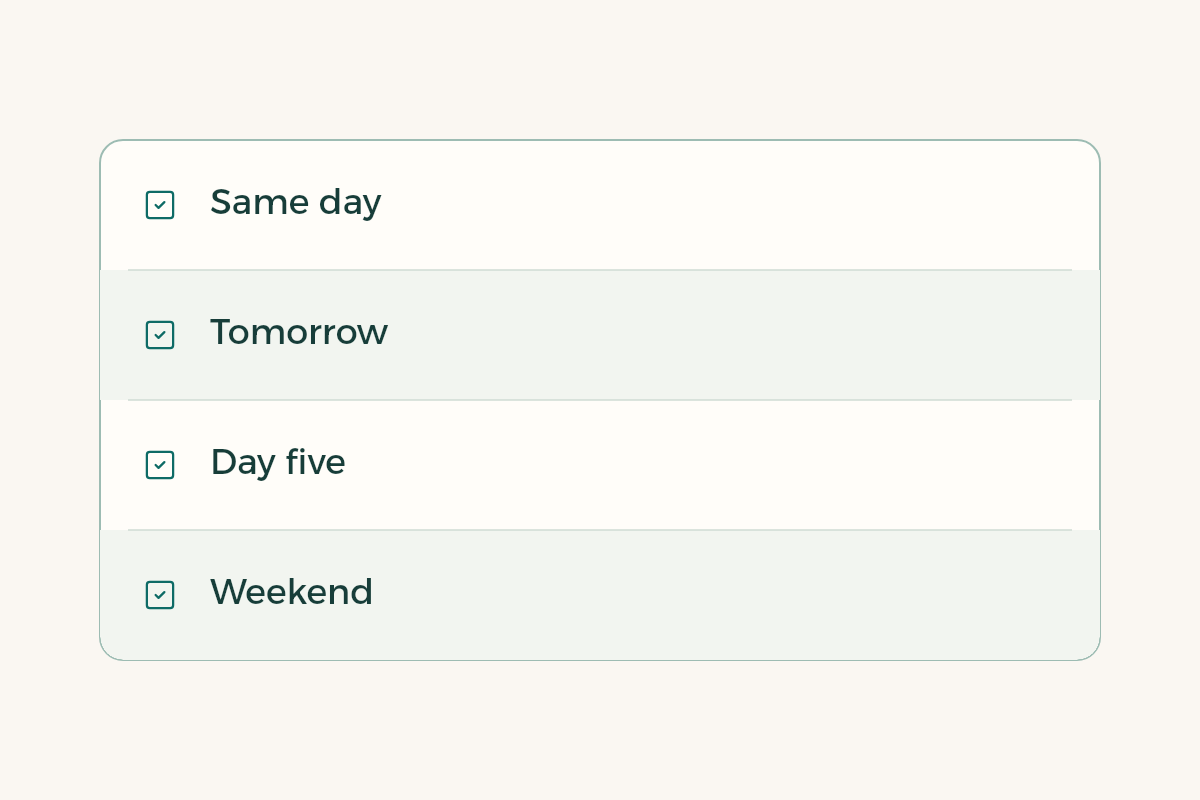
No single rule fits every course, but a simple pattern is enough: the same day, then tomorrow, then four or five days later, then before the exam. Questions you answered easily get reviewed less often, and the ones you missed come back sooner. That is close to the idea of spaced repetition explained in the active recall and spaced repetition guide.
As the final approaches, combine the whole term’s questions into one long test. The method for building it is in self-testing before the final exam.
Do I need a flashcard app?
No. Paper, a pen and a timer are enough for your first semester. An app helps once the cards pile up and you lose track of when to repeat them, but before that it is an extra. Choose what you will keep using, because a method you drop after two weeks is worth nothing however strong it is.
Tie recall to something fixed in your day: after the prayer that follows the lecture, on the bus, or with your first coffee. A habit with a fixed time survives, and one left to mood is forgotten by week three. If the lecture is practical, such as a lab or programming, replace the blank page with redoing the experiment from memory: write the steps or the code without looking, then compare with what you did in the lab.
And if time is short, take just three minutes: write three points you remember and one thing you did not understand. Three minutes a day beats two hours you postpone every week and then cannot find time for.