By the tiswa editorial team, from the official sources listed at the end of this guide. How we write our guides
You enrol in a ten-hour research course and finish it. Then you sit in front of your graduation project and the page stays empty, because what you needed was a way to turn a general idea into a question you can test, and the course spent six hours on the history of science. It was not a bad course. It was the wrong course for your stage.
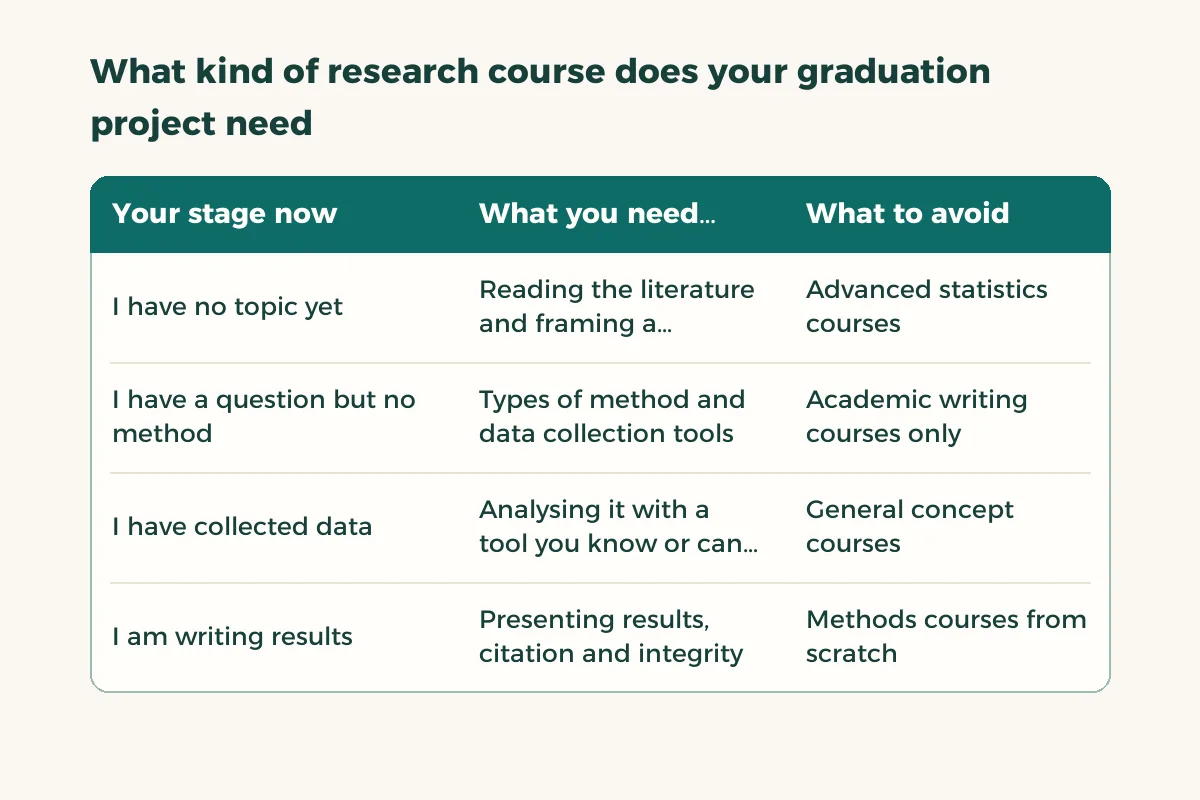
What kind of research course does your graduation project need?
A graduation project passes through stages and each one needs a skill. At the start you need to frame a question and set its scope. Next comes choosing a method and a way to collect data. Then analysing what you collected. Finally writing up the results and citing your sources. A course on the wrong stage costs you weeks, and a course on your stage saves you a month.4
| Your stage now | What you need from the course | What to avoid |
|---|---|---|
| I have no topic yet | Reading the literature and framing a question | Advanced statistics courses |
| I have a question but no method | Types of method and data collection tools | Academic writing courses only |
| I have collected data | Analysing it with a tool you know or can learn | General concept courses |
| I am writing results | Presenting results, citation and integrity | Methods courses from scratch |
If you are still near the start, read how to write a research question and the 12-week graduation paper plan to see where you stand.
How do you check a research course before enrolling?
- Read the learning outcomes, not the title
What will you be able to do afterwards? “Introduction to research” is vague, while “write a research question and choose the right method for it” is specific.
- Check the weekly schedule or modules
Does it move from question to method to analysis to writing, or does it jump around?
- Look for an applied exercise
The best courses make you write your question, your plan or part of your introduction.
- Confirm it covers integrity and citation
A course should deal with plagiarism, citing sources and data management. Free material on the responsible conduct of research is published by bodies such as the US Office of Research Integrity.1
- Ask your supervisor
Which course or workshop does your department or university use? What your university provides may spare you from enrolling elsewhere.
- Try the first lesson
If it is free, read it and see whether you can apply it to your topic today.

What should a good research course contain?
Four things recur in the useful ones. First, a method for framing the question, because research that starts with a vague question ends with vague results. Second, the types of method and how to choose between them: quantitative, qualitative or mixed. Third, analysis tools that fit your level rather than the most powerful ones. Fourth, research ethics, which is not an optional extra: participant consent, data protection and declaring sources all enter the marking of your work.
There are platforms that train researchers in ethics and compliance, such as the CITI Program, which institutions usually provide to their members.2 Ask your university whether it subscribes. If you want free material on method and statistics, open course materials such as those MIT OpenCourseWare publishes may be enough for someone who organises themselves.3
How do you apply what you learn to your project week by week?
A course that does not turn into pages of your project stays as information in your head. Tie each unit to a piece of writing in your project before you move to the next:
| Course unit | Piece in your project | Output |
|---|---|---|
| Framing the research question | Write three versions of your question and keep the narrowest | A paragraph on the question and the limits of the study |
| Literature review | Read five studies and record what each says in a table | A comparison table and two paragraphs |
| Method | Write why you chose your data collection tool | The method section in a first draft |
| Analysis | Analyse a small sample of your data | A chart or table and a first result |
| Writing and citation | Build the reference list with a citation tool | A complete reference list |
Citing from day one saves you a week at the end. If you have no tool yet, read the Zotero guide for students and citation basics. A good researcher also returns to the methodology section whenever the question changes.
Do you need a paid course or is what your university offers enough?
Start with what your university provides: the research methods course, library workshops and your supervisor’s guidance. These line up with your department’s requirements and may be free. If a skill remains that they do not cover, such as analysing data in a particular tool, pick a short course for that alone. Ask yourself what you will leave with. If there is no specific answer, do not pay.
If you are at the stage of working with a professor on a real study, read research with a professor and choosing a supervisor. Learning from a real project with someone who follows your progress is faster than any stand-alone course.