By the tiswa editorial team, from the official sources listed at the end of this guide. How we write our guides
Research with a professor is not only for postgraduate students. Many professors welcome a serious undergraduate to help gather data, review literature or prepare experiments. The experience gives you what lectures do not: how knowledge is actually built, how to write precisely, and how to work in a team on a question no one has answered yet. If you are thinking about a master's degree or a scholarship abroad, a reference from a professor you did research with is one of the strongest things you can carry.
What an undergraduate research assistant does
An undergraduate research assistant does not lead the research but helps with specific parts of it. You might find and summarise sources, enter and clean data, help with lab experiments, run surveys and interviews, or review parts of a paper. Tasks vary by field and professor, but the common thread is that you learn how research works from the inside.
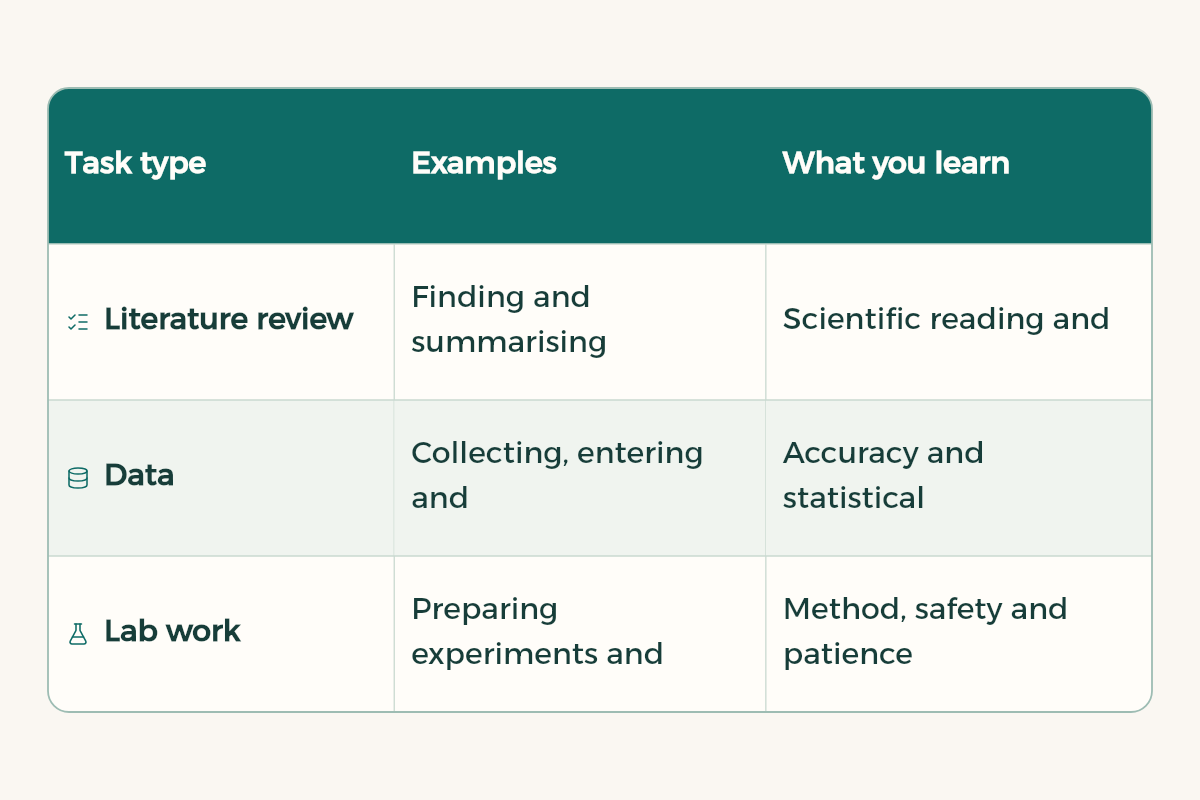
| Task type | Examples | What you learn |
|---|---|---|
| Literature review | Finding and summarising previous papers | Scientific reading and database searching |
| Data | Collecting, entering and cleaning data | Accuracy and statistical tools |
| Lab work | Preparing experiments and recording results | Method, safety and patience |
| Fieldwork | Surveys and interviews | Communication and research ethics |
| Writing | Reviewing wording and references | Academic writing and citation |
How to choose the right professor
Do not send one email to every professor in the department. Start with a professor you studied with and whose course you liked, or one whose research interests you. Open their university page and look up recent work on Google Scholar or the Saudi Digital Library through your university account. Read the abstracts of at least two papers so you can say something specific about their work.
- Is their research on a topic that genuinely interests you?
- Do they have current projects or postgraduate students working with them?
- Have you studied with them and do you know their style?
- Do they hold office hours you can visit?
The request email
If you decide to email, keep it short and specific. Introduce yourself, mention a particular paper or topic of theirs, say why it interests you, what skills you have and how many hours a week you can give, and ask for a short meeting. Do not attach a long CV; one page is enough.
Write me a short email (120 words) to Dr [name] in the [department] department.
I am a [major] student in year [number], and I took their [course] or read their paper on [topic].
What caught my attention: [something specific].
My skills: [such as a statistics package, writing, lab work].
I can give [number] hours a week.
Ask for a 15-minute meeting in their office hours. Keep the tone polite and formal without exaggeration.
If they do not reply or say no
Professors are busy, and no reply does not always mean no. Wait a week, then send a short, polite follow-up. If they decline, thank them and ask whether a colleague might need help. Do not stop at one professor; many students found their chance with the third or fourth.
What the professor expects from you
- Keep your hours
If you said eight hours a week, honour it.
- Be accurate
One data entry mistake can spoil a whole analysis.
- Ask when unsure
Do not guess; ask before you carry on.
- Research integrity
Never copy text without citing it, and never alter data.
- Regular updates
A short weekly message on what you did and what you hit.

Tools you will need
You will search, read and cite a lot. Learn referencing as in APA citation, and read how to write a research paper to understand paper structure. AI tools such as NotebookLM help you organise and understand sources, but do not rely on them to write research text, and follow your university's and professor's policy on their use. Create an ORCID account, a free researcher identifier you will need if your name appears on a paper.
How to benefit from the experience
- Add it to the research experience section of your CV, with specific tasks.
- Ask the professor for a reference after a semester or two of serious work.
- If you contributed substantially, ask politely whether you might be acknowledged or listed as an author, according to the norms of the field.
- Present the results if your university holds a student conference.
- Turn part of the research into a graduation project idea.
Research and postgraduate study
If you are considering a master's or PhD, in the Kingdom or through a scholarship abroad, undergraduate research experience makes a real difference. Admissions committees look for evidence that you know what research is and can work patiently on a long question. A letter from a professor saying you worked seriously with them on a real project is stronger than any GPA alone. Read scholarships for Saudi students too.
Common mistakes
- One generic email to every professor.
- Promising more hours than you can keep.
- Disappearing in exam weeks without telling the professor.
- Relying on AI to write research text.
- Expecting author credit for your first small task.
A first-term plan with your supervisor
Getting onto a research team is a start, but the real impression forms in the first weeks. This simple plan helps you become an assistant your supervisor can rely on from day one:
- Weeks one and two
Read two or three papers your supervisor suggests, and write a one-paragraph summary and one open question for each.
- Week three
Agree a small, specific task and a deadline with your supervisor, and confirm it in a short message.
- Mid-term
Send a brief update on what you have done and what you got stuck on, without waiting to be asked.
- End of term
Ask for a short review: what you did well and what to improve next term.
Keep a weekly log of what you read and tried. It helps when you write a research paper or format references in APA style, and it helps your supervisor if you later ask for a recommendation letter. If the research is close to your final-year topic, see graduation project ideas to connect the two from the start.