By the tiswa editorial team, from the official sources listed at the end of this guide. How we write our guides
Studying with music, or any sound in the background, splits students. Some cannot study without earphones; others need complete silence. And plenty of videos online promise that a certain kind of sound will "boost focus" or "make you smarter". So what does research actually say?
The honest answer: research does not promise that background sound will improve your studying. But it does give a clear, useful result: sounds with understandable speech and lyrics disrupt reading and comprehension more than others. This guide explains that finding and turns it into practical rules for when to study with sound and when you need quiet.
What do studies find?
A study by Oswald, Tremblay and Jones at Cardiff University, published in 2000, tested how background sound affects reading comprehension. It found that meaningful speech disrupted reading comprehension more than sound without understandable meaning.
A more recent study published on the University of California's eScholarship platform compared music with lyrics and instrumental music. It found that lyrics disrupted reading comprehension and serial recall (remembering items in order), while instrumental music did not show that effect in the experiment.
Note what these studies do not say: they do not say instrumental music raises your grades, and they do not say silence is bad. They say that lyrics and understandable speech in the background compete with your brain for the same job when you read or memorise words.
Why lyrics in particular?
When you read, your brain processes words and meaning. When you hear understandable speech at the same time, whether a song, a podcast or people talking nearby, your brain tries to process those words too. The two compete, and you find yourself reading the same line three times. That is why the studies found the harm in reading and memorising tasks specifically.
It is also why chatter in a cafe or a TV in the next room can be more distracting than you expect, especially in a language you understand.
Quick guide: sound or quiet?
| Type of study | Better choice | Why |
|---|---|---|
| Reading and understanding a chapter | Quiet or sound without lyrics | Understandable speech disrupted reading comprehension in studies |
| Memorising terms or definitions | Quiet or sound without lyrics | Lyrics hurt serial recall in the eScholarship study |
| Repetitive problem practice | Your preference | The task relies less on processing words |
| Organising notes or drawing | Your preference | A light task without heavy language load |
| Final review before an exam | Quiet | The exam itself is in a quiet room |
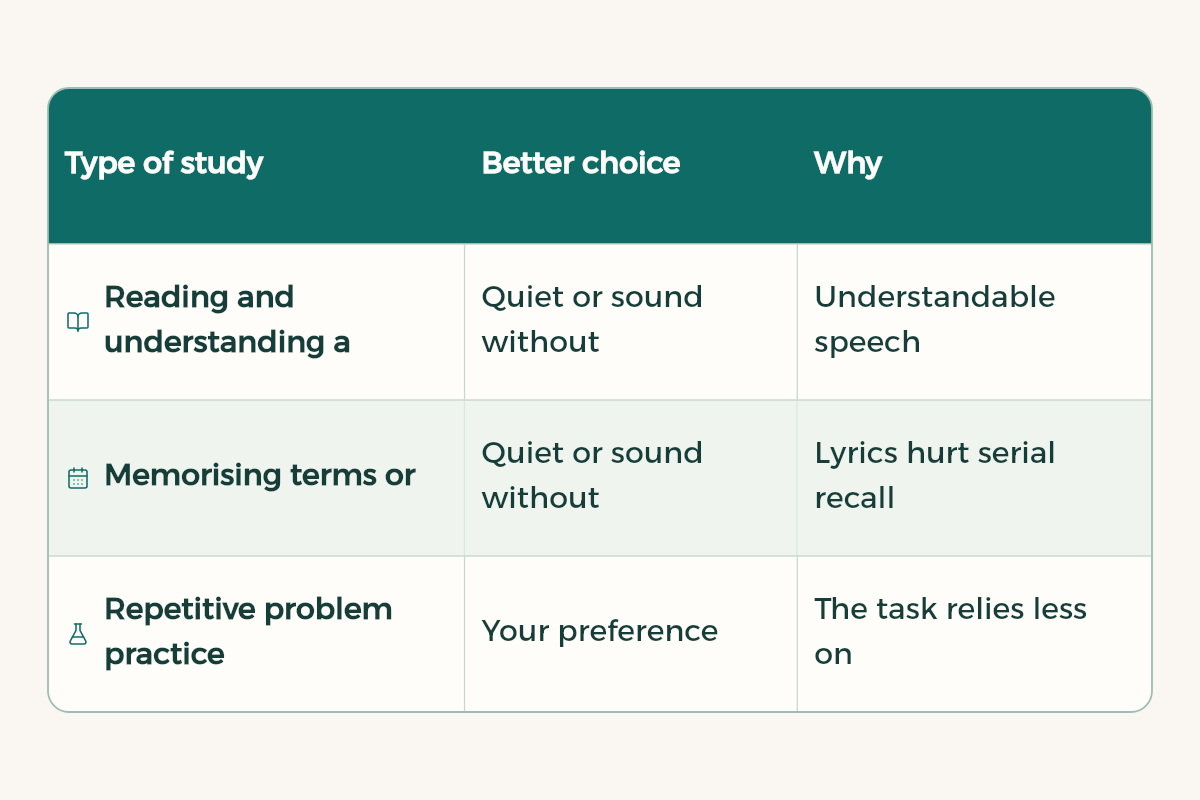
This table applies the study findings in practice; it is not a strict scientific rule. Test it and watch your own results.
Run a fair test on yourself
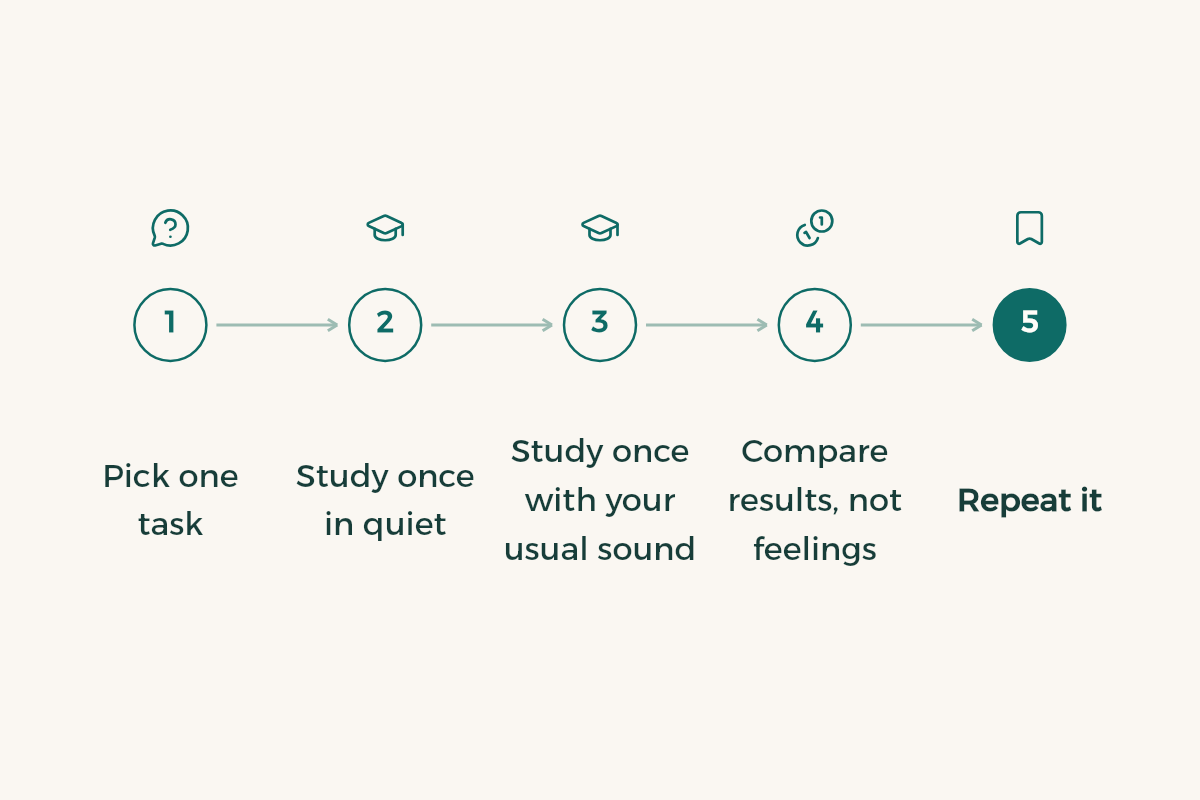
- Pick one task
For example, reading ten pages of a chapter you have not read yet.
- Study once in quiet
Read ten pages in silence, then spend five minutes writing down everything you remember.
- Study once with your usual sound
On another day, read ten new pages with the sound you like, then write from memory again.
- Compare results, not feelings
Do not ask "which session felt nicer?" but "in which one did I remember more?".
- Repeat it
One session is not enough. Repeat two or three times before you decide.
Alternatives to music with lyrics
- Full quiet: the simplest option, especially for reading and memorising.
- Earplugs or noise-cancelling headphones: they cut chatter in a dorm or library.
- White noise or rain sounds: sound without words that can mask talk around you. There is no research promise of better grades here, but there are no lyrics competing with your reading.
- Calm instrumental music: if you cannot study in silence, it was less disruptive than lyrics in the eScholarship study.
- The library: a quiet place built for study, with no TV or family conversation.
Podcasts and videos while studying
Podcasts and YouTube in the background are all understandable speech, the kind the Cardiff study found most disruptive for reading. They can be worse than songs because you follow the content closely. If you like podcasts, make them a reward during breaks between Pomodoro sessions, not a backdrop for reading.
Your phone is the bigger distraction
For many students the real problem with music is not the sound but the phone. You open the app to skip a song, see a notification, then a message, and ten minutes are gone. Prepare a long playlist before you start, or use one steady sound, and turn on a Focus mode. See our guides to iPhone Focus mode and how to focus while studying.
A prompt to plan your study setting
I am a student. I usually study at [place: home, dorm, library].
Sounds around me: [for example: siblings, TV, roommates].
I currently use: [music with lyrics, podcasts, nothing].
This week's tasks: [reading, memorising, problem practice].

Suggest a study environment plan:
- for each task type: quiet or sound without lyrics
- how to reduce noise around me without buying anything
- how to stop my phone distracting me while sound plays
Do not make research claims about improving grades.
The bottom line
If you are reading or memorising, lyrics in the background compete for the same job, and quiet or sound without words is the better choice according to the studies. For light tasks like organising notes, pick what feels comfortable. More important than the type of sound is testing yourself after studying and judging by results, not feelings. Read our guide on how to study effectively and browse more study guides.