By the tiswa editorial team, from the official sources listed at the end of this guide. How we write our guides
A week before the deadline you reach the section you kept postponing. You type: “Limitations include a small sample and limited time.” One sentence, and you move on. Two weeks later an examiner asks how big the sample was and what its size means for your conclusion. That is when you find the sentence gave you nothing you could defend.
What are the limitations of a capstone project?
They are the constraints on what you can say with confidence about your results. They cover what restricts generalising beyond your sample, what restricts interpreting the findings, and what restricts their practical use, and they arise from how the study was designed or the conditions it was carried out in.1 A limitation is not a confession of failure. It is an honest description of the ground your results stand on.
There is a practical side too. If you do not name your limits, someone else will, and less kindly. The University of Southern California Libraries guide notes that it is better to identify and acknowledge your study’s limitations yourself than to have a professor point them out and lower your grade because you seemed not to have noticed them.1 Stating a limit plainly raises trust in everything else you claim.
One distinction matters. Limitations are not the results chapter, and not the discussion that interprets them. Our guide to the discussion section shows how to tie a result to the question; this one goes deeper on the part that covers limits alone. The UNC Writing Center describes the discussion as the place that explores what findings imply and judges the limits of the experimental design.2
How to write a graduation project discussion with limitations, step by step?
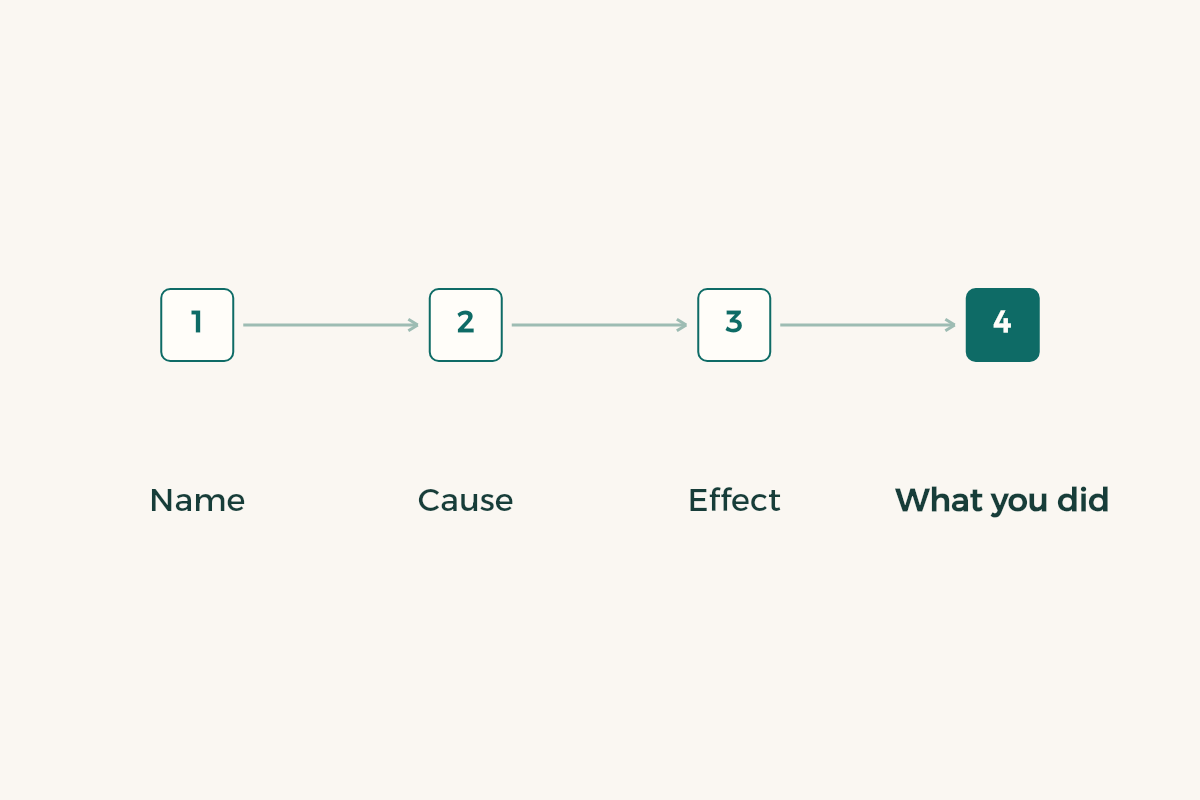
Give every limit a short paragraph with four moves: name it, give its cause, explain its effect, then say what you did. That order stops you from drifting into empty listing.
- Collect limits from your working notes
Review what went wrong while you were doing the work: data that never arrived, participants who dropped out, a tool that behaved differently from what you expected. Do not reconstruct from memory on the last day.
- Keep only the ones that matter
The guide advises limiting the discussion to limitations related to your research problem, so skip anything that was never an aim of your study.1
- Name it with numbers
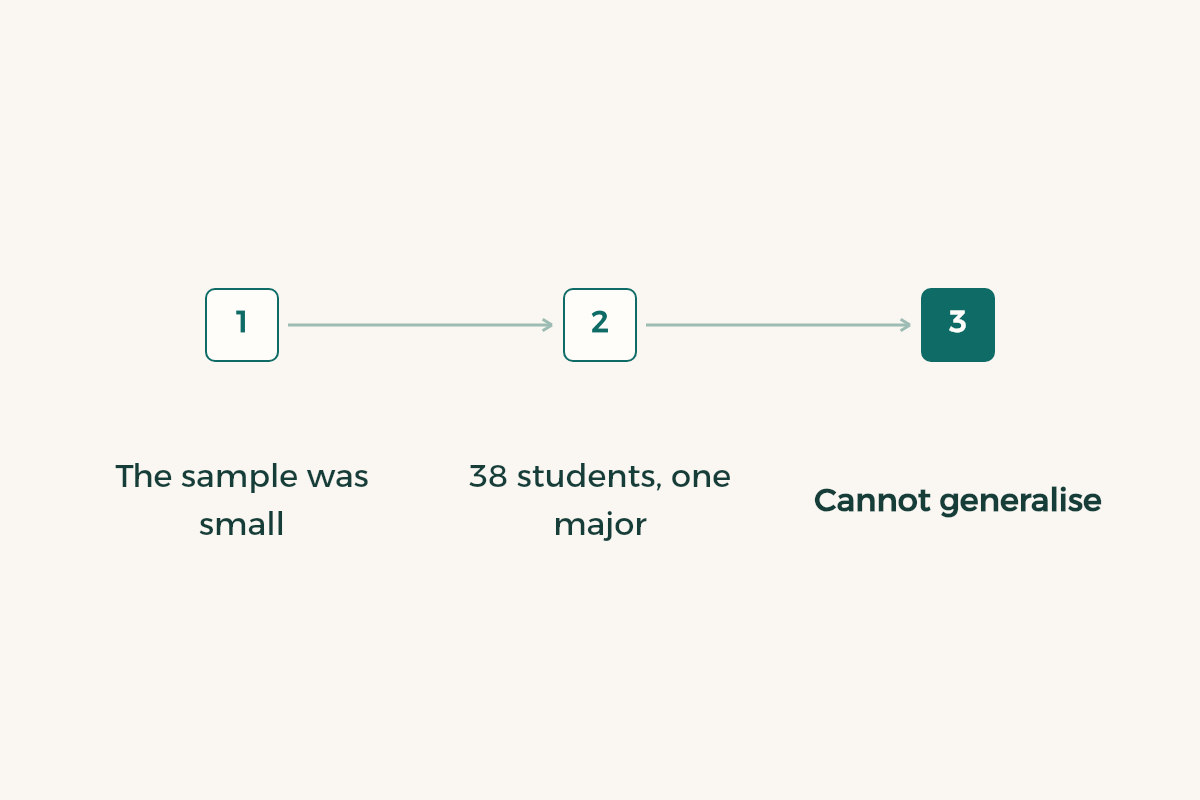
Write the count, duration and scope. “Thirty-eight students from one faculty took part” is clearer than “the sample was small.”
- Give the cause
Was it time, access to participants, missing data or the instrument? The cause shows whether the limit could have been avoided.
- Tie it to the conclusion
Say what you cannot claim because of it. “The finding cannot be generalised to students in other faculties” protects your conclusion.
- Say what you did and what could follow
State how you reduced the effect, and what a later study might do differently.1
Write in the past tense, because the limits became clear after the work was done.1 Pick one place for the section: the start of the discussion so readers know the boundaries before they read your analysis, or the end of the discussion before the conclusion. The same guide describes both.1 If your chapter also has conclusion material, read how to write a research conclusion so nothing repeats.
What separates a useful limitation from a generic one?
Precision and effect. A generic limit fits any project; a useful one fits yours. The examples below are illustrations, not taken from a real project.
| Generic wording | Specific wording (example) | What it adds |
|---|---|---|
| The sample was small | We gave the survey to 38 students in one major, so we do not generalise to other majors | Number, scope, effect |
| Time was limited | Data was collected over two weeks, so we could not measure change in behaviour over time | Duration and what went unmeasured |
| Data was hard to get | Records for a full year were unavailable, so we used six months | What was missing and the substitute |
| Answers were self-reported | Responses rest on what participants said about themselves and could not be checked | Nature of the data and why to be careful |
The self-report example is a standard one in methods guidance: what people say about themselves is hard to verify independently, so you must say you are relying on their honesty and memory.1 Other designs have other limits. A survey, a software build and an engineering prototype each break in different places, so ask where your method could be wrong, then write what you found. For describing the method itself, see the methodology section.
How do you write a research paper as a college student without losing marks over limitations?
Usually not; it tends to do the opposite. Showing that you saw the limits of your work signals that you understand your method and its surroundings, which is typically what an examiner is checking.1 What can hurt is either extreme: a section that inflates the limits until the work looks worthless, or one that hides them. The balance is to say confidently what your work shows and plainly what it does not.
If the problem is serious, such as failing to get the most important data, the guide suggests reframing the study as exploratory work that lays groundwork for a fuller one, while explaining what your work adds so far.1 Raise it with your supervisor well before submission, since they know what your department expects from this section.
What does a finished limitations paragraph look like?
An example for an imaginary project on study habits, not a real study: “Thirty-eight students from one major completed the survey. They were reached through direct contact rather than random selection, so their habits may differ from other students’, and we do not generalise the findings to other majors. Responses were collected over two weeks, which meant we could not measure how habits change near exams. Answers were self-reported, so we relied on what participants said. To reduce the effect, we compared the sample’s spread with the cohort’s. A later study could use a wider sample and follow it for longer.”
Notice what is there: numbers, a cause for each limit, an effect, what was done and what is suggested. If you are analysing your own data, check the real sample size in your sheet before you quote it; Excel for students helps with counting and filtering. Then reread your project abstract to make sure it claims nothing your limits do not allow.
Which mistakes keep appearing in limitations sections?
The first is listing limits that have nothing to do with the research question. The second is apologising instead of explaining: “we apologise for the small sample” tells the reader nothing, while the effect does. The third is writing a few lines here and then making sweeping claims in the conclusion that contradict them. The fourth is blaming “circumstances beyond our control” without describing them, which reads as dodging. The fifth is mismatch with the results: if you said the sample came from one major, do not write “Saudi students” in the conclusion; write “students of this major in the sample.”
Check your section with one question: if someone read only this part, would they know exactly what they may not conclude from your work? If yes, it does its job.