
By the tiswa editorial team, from the official sources listed at the end of this guide. How we write our guides
Families usually settle the allowance before each term, and the right figure depends on housing, the programme, the city, and the costs the family pays directly. So it should never begin with a number a friend mentioned. It should begin with a simple calculation that links the allowance to the real cost, then gets agreed with the student as percentages. Below you will find the method, a split you can adapt, and steps for the agreement.
What should a family calculate before setting the allowance?
Add up the real costs for one term: tuition if it applies, housing if the student pays rent, transport, books, and study subscriptions. These lines show the whole picture, and they separate what the family pays from what a grant or stipend might cover. Because fees differ between universities, start with university fees in Saudi Arabia to see which lines matter for your case.
What does a university stipend actually cover?
If your child receives a stipend, the useful question is what it covers and what stays with the family. Universities set their own rules. The King Saud University stipend page, for example, says stipends are not paid to students who withdraw from or postpone a semester, and not to students on academic warning whose GPA is below 21. A withdrawal or postponement can therefore stop income the family had counted on, so do not build the allowance on the stipend alone, and check the rules at your child's university.
If your child is at a private university, the Ministry of Education internal scholarship may cover the approved tuition for the specialisation if the ministry approves the request. The portal lists a minimum GPA of 2.75 out of 5 or 1.75 out of 4, and it can show registration as closed at a given time, so confirm the status before relying on it2. Start at the internal scholarship portal.
How do you split a student allowance by percentages?
Once you know the cost, split the monthly allowance into categories by percentage, and keep a share for emergencies. The table below is a general example for a student who lives with the family. Adjust it to your case, and keep the total at 100 percent:
| Category | Suggested share | What it covers |
|---|---|---|
| Transport | 25% | Fuel or public transport, and any university transport |
| Food and drink | 25% | Campus meals and food ordered from outside |
| Study | 20% | Books, printing, stationery and study software |
| Phone and subscriptions | 10% | The phone plan and only the essential subscriptions |
| Emergencies and savings | 20% | An amount kept for unexpected costs, in a separate account |
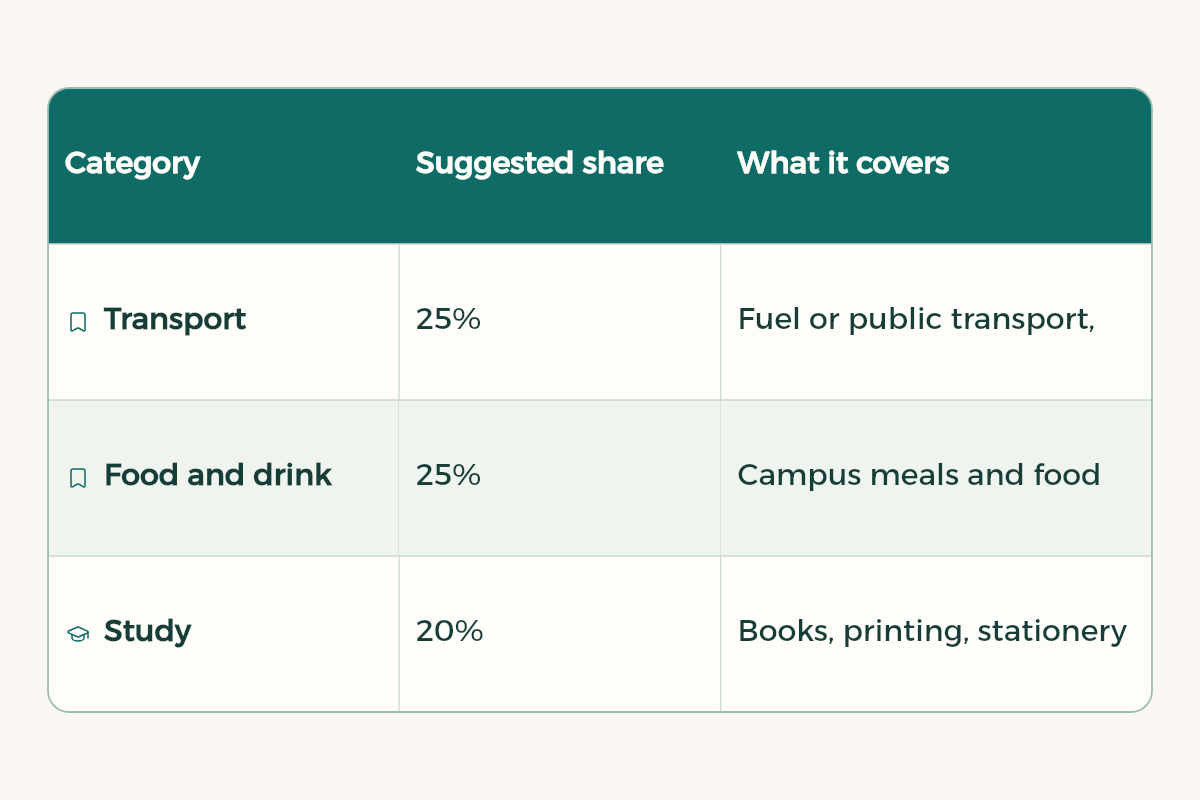
If the student pays rent, housing becomes its own line and the essentials share rises. In that case, trim the leisure share first, and do not drop savings altogether, because savings are what protect the student when a stipend arrives late. To track small recurring costs, read student budget planning.
How do the parent and the student agree the plan?
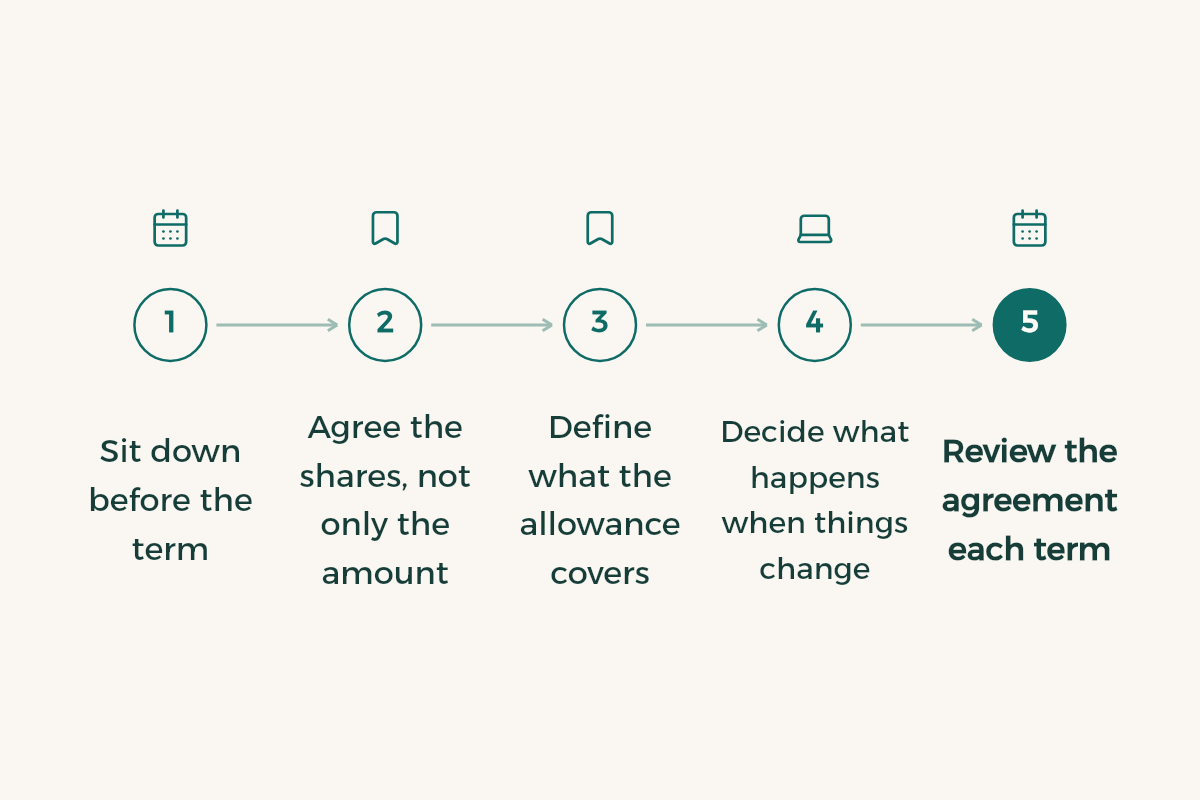
- Sit down before the term
Show the real cost to your child, not a closed number. A student who sees the figures usually accepts the allowance more easily.
- Agree the shares, not only the amount
Start with the table, and adjust the percentages together until the plan feels like theirs rather than imposed.
- Define what the allowance covers
Write down what it pays for, and what needs prior approval, such as a device or a long subscription. This prevents arguments in the middle of the month.
- Decide what happens when things change
Agree in advance what happens if the stipend is late, the student moves house, or leaves a term. The family needs a backup plan.
- Review the agreement each term
Before each term, review the cost, the stipend and the shares together. If the plan no longer fits, change it calmly and without surprises.
Does the allowance change between living at home and living away?
A student who lives at home usually pays no rent, but spends more on transport, takeaway food and personal subscriptions. A student who lives alone or with flatmates sees rent and bills at the top of the list, and the leisure share shrinks on its own. So do not copy percentages from one family to another. Start from the real housing situation, then adjust the table.
| Item | Lives with family | Lives away |
|---|---|---|
| Eating out | 25% | 35% |
| Transport | 25% | 15% |
| Study and subscriptions | 20% | 15% |
| Savings | 20% | 10% |
| Personal spending | 10% | 25% |
If the student lives in university housing, ask the university which services are included and which are paid separately. Those details change the size of each line. An agreement written down in one short page also cuts down the repeated questions that come up every week.
Mistakes families make most often
- Setting a fixed amount without checking the real cost, so the shortfall appears mid-term.
- Treating the stipend as steady income, although a withdrawal, a postponement or academic warning can change it.
- Transferring a lump sum with no agreement on what it covers.
- Forgetting recurring study and leisure subscriptions, which add up without notice.
Costs also vary from term to term. A term with labs or a graduation project needs a larger allowance than a theory-only term. Agree a temporary extra line for those terms, rather than changing the core shares each time, so the plan stays clear to the student.
When should you review the plan?
Review the split at three moments: after the first month, at the start of each new term, and whenever something changes, such as a move, a term with more lab work, or the start of part-time work. Keep each review short: what worked, what ran over, and what the student wants to change.
After the first month, compare actual spending with the shares. If one line runs well above its share, talk about the reason before raising the amount. A budgeting app makes that comparison a matter of minutes. A plan your child helped shape is one they are likelier to keep, and it teaches the habit of checking money calmly instead of worrying about it at the end of the month.