By the tiswa editorial team, from the official sources listed at the end of this guide. How we write our guides
It is eleven at night before the deadline. The paper is done and the conclusion is written, and only the list remains. You open twelve tabs and try to remember where each figure came from. Three sources have no title you can find. One has no year. The scene repeats every semester for one reason: references got written at the end instead of along the way.
How to write a research paper reference: what to record for every source
A reference entry in the major styles rests on four elements: the author responsible for the work, the date it was published, its title, and the place it can be retrieved from.1 Styles differ in order and punctuation, but the elements stay. So record all four in one file the first time you open the source, and do not worry about final formatting yet.
Add two lines of your own: the page number where the idea came from, and one sentence in your words saying what you took from it. The second line is the one that rescues you when you reread your notes a month later and cannot see why you saved a source.
| Element | What to record | Common slip |
|---|---|---|
| Author | Full name, or the organisation responsible | Writing the website name instead of the organisation |
| Date | Year of publication, or of the last page update | Leaving it blank when the date is not obvious |
| Title | The title as it appears on the source itself | Typing a title from memory |
| Where to find it | A direct link, a DOI, or journal name and volume | Copying a search-result link instead of the source link |
| Page and your note | Page number and a one-line summary | Pasting a quote with no context |
How to write a research paper with references: building the list as you read
You need one file, not a clever tool. A spreadsheet, a Word document or a reference manager you actually use will do, as long as it is the only place. Try this on a real paper of yours:
- Ask your supervisor for the style first
Your department may want APA, Harvard, IEEE or its own template. Ask before you start, because switching style after thirty entries is dull manual work.
- Open the references file before the source
This order is the trick. You record the four elements first and read second.
- Log the source even if you might not use it
An extra line costs little and a lost source costs a lot. Delete what you do not need later.
- Mark each quotation in your draft
Put the author and year in brackets beside every borrowed idea, even in shorthand.
- Review the file weekly
Ten minutes shows you which entries are incomplete and which you logged twice.

If your paper rests on dozens of sources, use a reference manager. Our guide to Zotero for students shows how to start, and references in Word covers the case where you write inside the document itself.
How do you match in-text citations to the reference list?
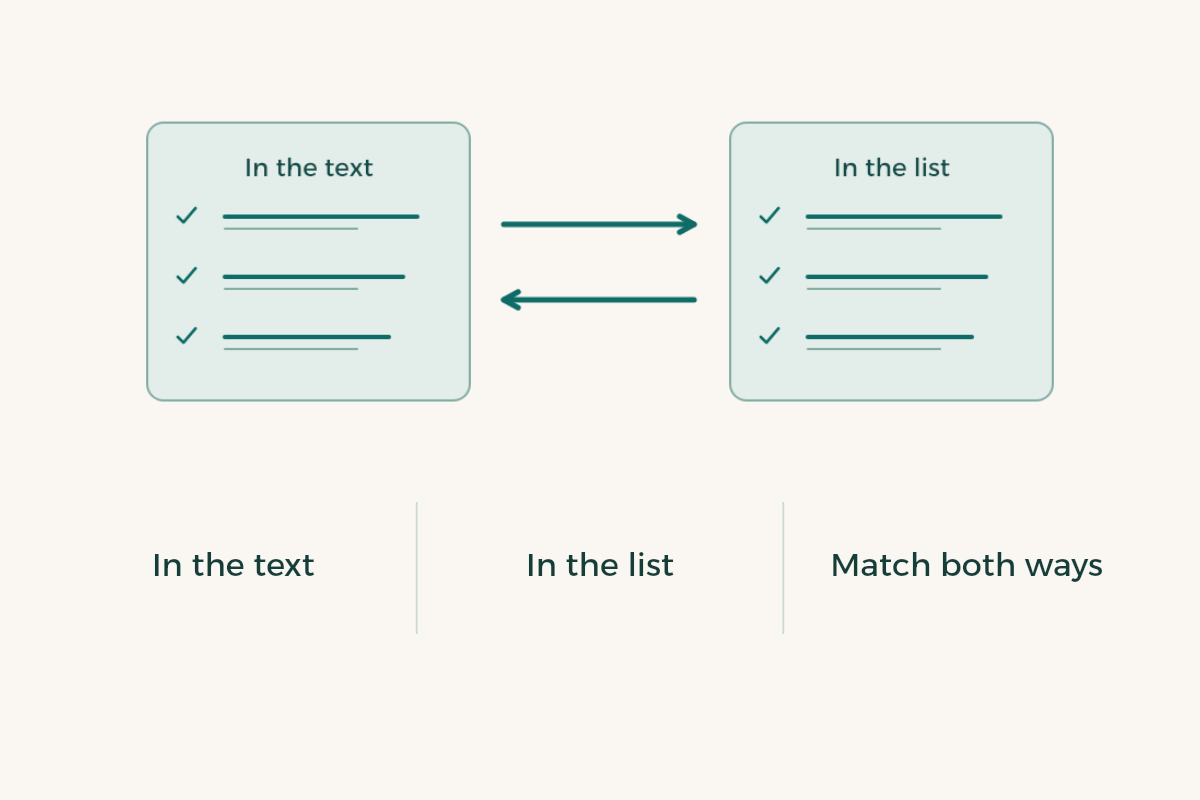
The rule that matters most in every style: what you cite in the text must appear in the list, and what is in the list must be cited in the text. A citation of Botto and Rochat (2018) matches a list entry for the Botto and Rochat work published in 2018.1 That is an illustration of the rule, not a source we are sending you to read.
Test it before you submit. Read the draft from the top, underline each citation, and find it in the list. Then reverse: start from the list and find each entry in the text. Three faults turn up most often: a source in the list that never appears in the text, a citation with no entry, and a year that differs between the two places.
| What you find | What it means | What to do |
|---|---|---|
| List entry with no citation | You read it but did not use it | Delete it, or use it in the text |
| Citation with no entry | You quoted without logging the source | Find it now; if you cannot, drop the idea or rewrite it from a source you can see |
| Different year in the two places | A copying slip, or two editions | Check the cover or title page and correct it |
| Name spelled two ways | Two entries for one author | Make both places identical |
Can you trust the Cite button in Google Scholar and reference tools?
Under each result in Google Scholar there is a Cite button that gives a ready-made format, and you can export the data to tools such as BibTeX, EndNote, RefMan and RefWorks.2 That saves real time. But Scholar’s own help page admits that automated extraction from articles in many fields can be tricky and that an error sometimes slips through.2
So treat an exported citation as a draft. Open the article and compare three things: the author’s name, the year, and the journal or publisher. Check that Arabic names written in Latin letters are spelled the same way in every entry. If the tool got the format wrong, fix it by hand before you accept it. For finding sources in the first place, read the Google Scholar guide.
How do you check your references before submitting?
This list takes about half an hour for an average paper and saves you the small marker comments that eat marks:
- Unify the style
Scan the whole list and confirm every entry follows one style: same order, same punctuation.
- Match both ways
Text to list, then list to text, as in the table above.
- Open every link
A dead link means the source moved or was removed. Look for another copy.
- Confirm each source exists
Especially anything an AI tool gave you. Search the title in your university library or Google Scholar; if it is not there, treat it as made up.
- Order the list
Follow the order of the style your department uses. Some are alphabetical and some follow order of appearance.
- Read the integrity policy
A quotation without a citation can count as plagiarism. The plagiarism guide explains the limits.
One point on honesty. Correct citation does not make your paper original. If you copy a paragraph, swap a few words and put a reference beside it, the problem is still there. The citation protects the person who had the idea, and your own wording protects you.
Which citation style should you use in your paper?
Your supervisor, department or college handbook decides, not us. Humanities papers may use one style and engineering papers another, and some departments publish their own template. If you cannot find a written guide, send your supervisor a one-line question: which citation style does this course use? Once you know, go to APA reference format or Harvard referencing for the details.