By the tiswa editorial team, from the official sources listed at the end of this guide. How we write our guides
How to write a masters thesis is a question nearly every graduate student asks, and many start writing chapter one without a plan, then stall at chapter three. A thesis is a research project with a recognised structure. Once you know that structure and split the work clearly, writing becomes less frightening and more regular. This guide sets out a general plan, then lists what to check in your university rules before you begin.
Start with your university's rules
Every university has its own thesis guide, with details you cannot guess: page layout, chapter numbering, how appendices are presented, and the forms you need at each stage. So before writing a single line, get the thesis guide from your department or the graduate studies deanship, and check that it is the latest approved version. The deanship page is the usual place for these procedures. For example, the graduate studies deanship page of Imam Mohammad Ibn Saud Islamic University is at the deanship page. If your university is different, search for its own graduate deanship page.
The usual structure of a thesis
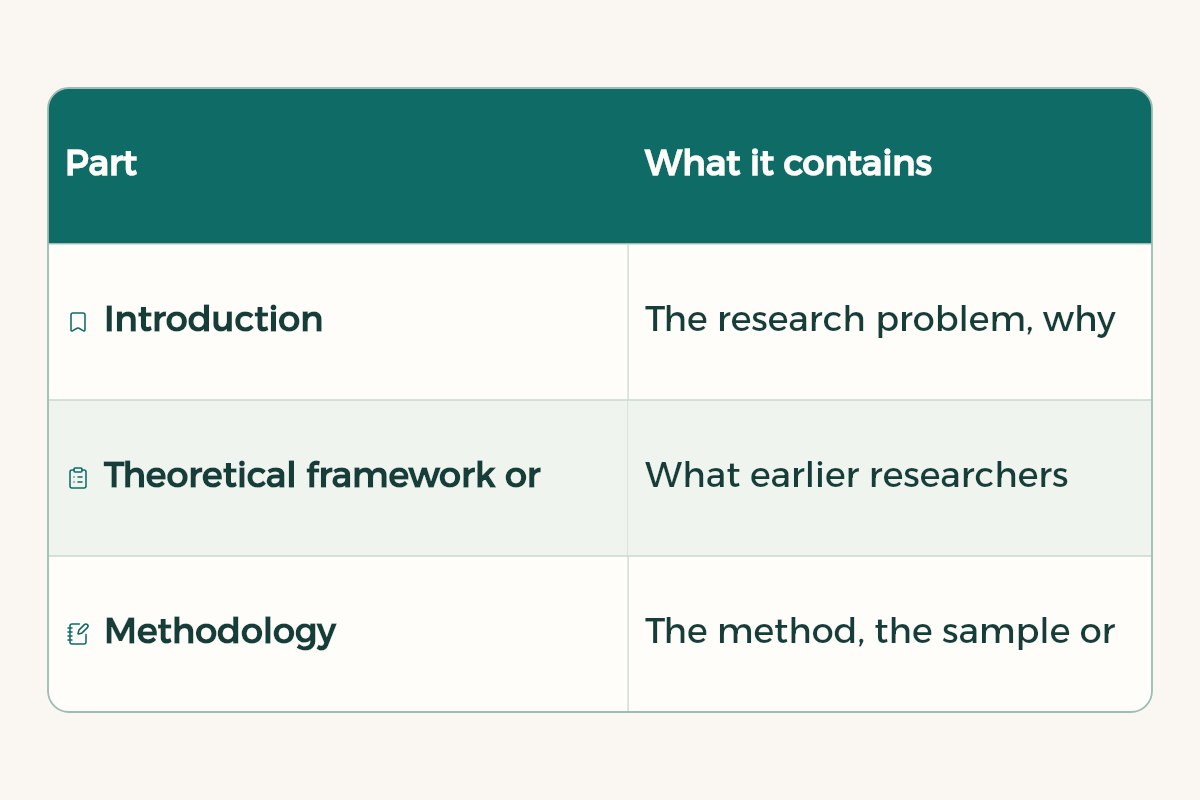
Names differ between fields, but most masters theses contain the parts below. Treat them as a general frame, then adjust them to your discipline and your university's guide:
| Part | What it contains |
|---|---|
| Introduction | The research problem, why it matters, your questions, the scope, and an overview of the chapters. |
| Theoretical framework or literature review | What earlier researchers found, where your study fits among them, and the gap it fills. |
| Methodology | The method, the sample or material, the data tools, how you analysed the data, and why you chose them. |
| Results | What you found, presented clearly, without over-interpreting it. |
| Discussion and conclusion | What the results mean, how they compare with earlier studies, the limits of the work, and recommendations if any. |
The chapter that usually takes the most time is the literature review, because it needs organised reading and then writing that compares and connects sources. Read how to write a literature review before you start it, and write the introduction after you know where your study stands, not before. For a clear introduction, see how to write a research introduction.
A timeline that actually works
A timeline that starts on day one and spreads the work evenly usually fails. It is better to start from the submission or defence date and work backwards: what must be finished weeks before submission, what must be finished before the defence, and what must be done this month. Write each stage as one sentence, then add the people you need, such as your supervisor, the library, or the statistics unit.
- Define the problem and questions
Write the main research question in one sentence, then three sub-questions, and show them to your supervisor before going further.
- Collect and sort your sources
Use a reference manager, and write a short note for each source: what it says, and how it helps your study.
- Build the outline and estimate pages
Write the chapter and section headings, and beside each one a rough page estimate.
- Write the chapters in any useful order
Many students write the method and results before the introduction, which is acceptable. The goal is a full draft of each chapter.
- Review with your supervisor in batches
Send a full chapter by an agreed date, then revise according to the feedback before moving on.
- Prepare the final copy and the defence
Check formatting, the contents page and references, and prepare a short talk explaining the idea, the method and the findings.

If writing stalls, try writing a paragraph every day, and separate reading time from writing time. For managing your time, read the Pomodoro technique and how to stop procrastinating.
Citations and formatting: do not leave them to the end
Many students leave referencing until the last week and lose days correcting entries. Add each source to a reference manager the moment you read it, and use the citation style your university or department requires, whether APA or another. For APA rules, see the APA citation guide. For the contents page and reference list in Word, read how to make a table of contents in Word and references in Word.
Avoid quoting without citing, because that mistake can damage the whole thesis. To understand what counts as plagiarism and how to avoid it, read how to avoid plagiarism, and check your text before submission with a plagiarism check.
Preparing for the defence
The defence is not a memory test. It is a discussion about your research decisions: why you chose this method, what your results can and cannot claim, and what the most important finding means. Write a list of questions you expect, prepare short answers, and be ready for suggested changes. Start with a ten-minute summary of the study, then practise it on a classmate. If your presentation needs design, check presentation tips.
A common mistake to avoid
The most frequent problem in a first thesis draft is a literature review written as a list of summaries. Each paragraph should answer a question your research asks, and say what the earlier work shows that your study builds on. Before you send a chapter to your supervisor, check that every paragraph has a clear purpose you could state in one sentence.
Keep a running document of sources as you read, with page numbers and a line on why each source matters. It saves hours when you reach the references, and it makes the defence easier because you can answer questions about any claim quickly.
If you have not started yet, read how to write a research proposal. A clear proposal shortens the first chapter, and it helps you choose a method before you start collecting data.